CLEAR Institute Scoliosis Protocol Charlotte NC | What It Is and How It Works | Dr. Justin Dick
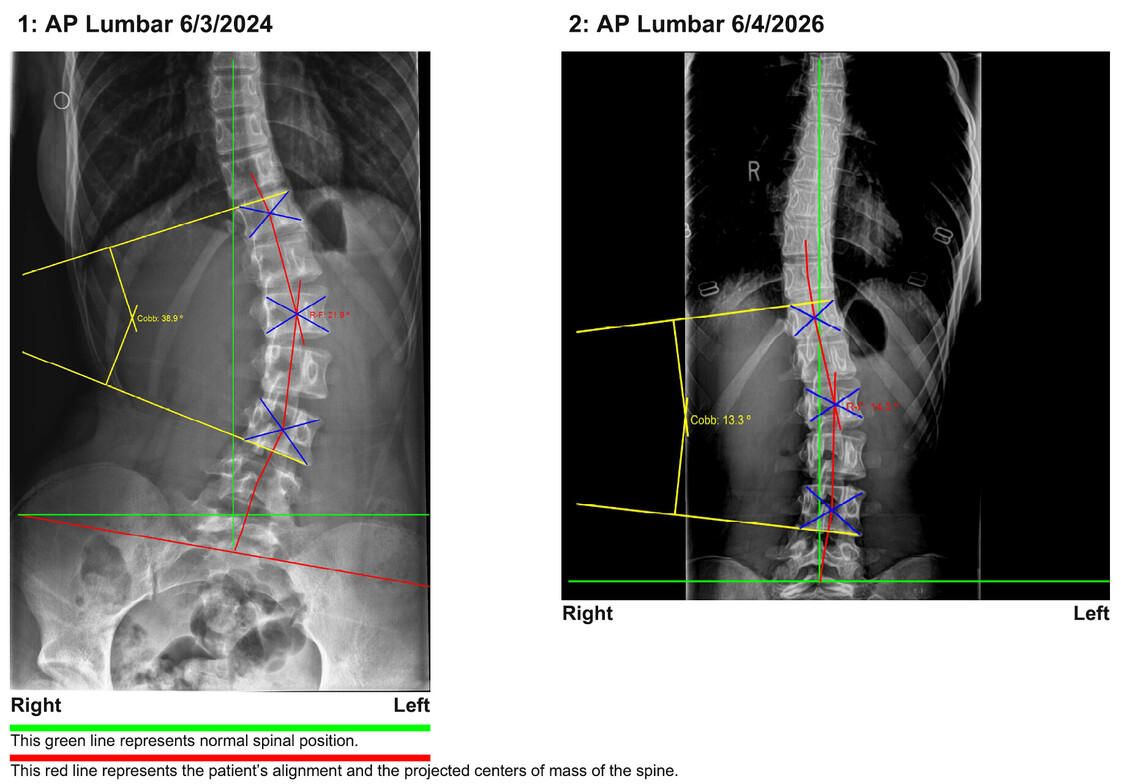
Documented Radiographic Outcome,
65% Cobb Angle Reduction, Two Year follow up
"My daughter's curve went from 38 degrees to 13 degrees in two years without surgery."
CLEAR Scoliosis Protocol Charlotte NC | Treatment Education | Clear Life Scoliosis
CLEAR Institute Protocol · Patient Education · Charlotte, NC
Most patients who arrive at Clear Life Scoliosis and Chiropractic Center have been told one of two things: observe and wait, or consider surgery. The CLEAR Institute multimodal protocol exists in the space between those two options — a structured, evidence-based, non-surgical approach to scoliosis reduction that produces measurable radiographic outcomes documented in peer-reviewed literature.
This page explains what the CLEAR protocol actually is, what each treatment component does mechanically, how they work together as a system, and what the process looks like for a patient at Clear Life in Charlotte. It is written for prospective patients, families, and referring providers who want to understand the clinical rationale behind each element before committing to a program.
Dr. Justin Dick is a CLEAR Scoliosis Institute Fellow and Board of Directors member — one of five globally — and the only CLEAR-certified clinician in the Carolinas with eight peer-reviewed publications indexed in PubMed. His published research includes direct documentation of CLEAR protocol outcomes in adolescent idiopathic scoliosis patients.
Scoliosis Reduction Charlotte NC — how CLEAR Institute protocol, ScoliBrace, SpineCor, BackGenius, and CBP-trained structural correction work together toward measurable Cobb angle reduction.
→ Schedule Your CLEAR Protocol Evaluation | Learn about scoliosis first
What the CLEAR Institute Is
The CLEAR Scoliosis Institute is an international nonprofit organization founded in 2000 by Dr. Dennis Woggon to develop and disseminate evidence-based non-surgical scoliosis management protocols. CLEAR has trained and certified clinicians across six continents and maintains an active research program with peer-reviewed publications in multiple indexed journals.
CLEAR certification requires completion of an intensive training program covering scoliosis evaluation, radiographic measurement, and the full multimodal treatment protocol. CLEAR Fellowship — the advanced tier held by Dr. Dick — requires additional clinical and research contributions beyond the base certification. Board of Directors membership is by appointment and reflects institutional leadership at the highest level of the organization.
The CLEAR protocol is not a proprietary adjustment technique. It is a systematically designed multimodal rehabilitation program in which each component addresses a specific dimension of scoliosis — structural, neuromuscular, and neurological — that other treatment approaches do not reach simultaneously.
Why multimodal matters in scoliosis
Scoliosis is a three-dimensional structural problem — coronal curve, sagittal imbalance, and axial rotation are all present simultaneously. A treatment that addresses only one dimension is treating a fraction of the condition. The CLEAR protocol was designed to address all three dimensions in a single coordinated program. Each modality targets a specific component of the deformity. Together they produce outcomes that no single intervention achieves alone.
The CLEAR Protocol — Every Component Explained
The CLEAR multimodal protocol consists of several distinct treatment components delivered in a specific sequence. Understanding what each one does helps patients engage with the process rather than simply receiving it.
Component 1
Whole Body Vibration
Whole body vibration is delivered through a vibrating platform that the patient stands or sits on at specific frequencies. The clinical application in scoliosis is neurological — whole body vibration at specific frequencies stimulates the muscle spindle receptors and vestibular system, producing a temporary reduction in muscle tone asymmetry and increasing neuroplasticity in the spinal stabilization system.
The practical effect is that the neuromuscular system becomes more receptive to corrective input immediately following vibration. WBV is used at the beginning of the treatment session specifically to prime the nervous system for the structural correction work that follows. Delivering corrective traction or mirror image adjustment to a high-tone, guarded neuromuscular system produces inferior outcomes compared to the same interventions delivered after WBV neurological priming.
Published research has demonstrated measurable changes in postural sway, muscle activation patterns, and proprioceptive function following WBV protocols in scoliosis patients. The mechanism is neurological, not mechanical — WBV does not directly move the spine.
Component 2
Mirror Image Traction
Mirror image traction is the structural correction component of the CLEAR protocol. The term mirror image refers to the principle that the traction setup is configured as the exact geometric opposite of the patient's specific curve pattern — not a generic traction setup, but a patient-specific corrective loading configuration derived from the radiographic data obtained in the initial evaluation.
The mechanism is ligament remodeling through viscoelastic creep — the same principle that underlies CBP structural correction. Spinal ligaments under sustained corrective load permanently deform in the direction of applied force over time. The traction setup places the spine in a mirror image corrective position and holds it there for a defined duration, progressively increasing time and corrective angle as the ligamentous structures adapt.
This is the component that produces the radiographically measurable Cobb angle reduction documented in CLEAR protocol outcome studies. It is not comfortable in the early stages — patients frequently experience unfamiliar muscle activation and positional discomfort as the spine is held in a position it has never been in before. That discomfort is expected and does not indicate harm. It diminishes as the tissues adapt over the course of the program.
Dr. Dick's published case series — the Non-Surgical Multimodal Approach to Adolescent Idiopathic Scoliosis using the CLEAR protocol — documents measurable radiographic Cobb angle reduction using mirror image traction integrated with the full CLEAR program. That paper is indexed in PubMed through Cureus.
Component 3
Scoliosis-Specific Exercise and Neuromuscular Re-Education
Scoliosis-specific exercise in the CLEAR protocol is not general core strengthening. It is targeted neuromuscular re-education designed to activate the specific muscle groups that are inhibited or asymmetrically loaded on the concave side of the scoliosis curve — and to inhibit the hypertonic muscles on the convex side that are maintaining the rotational component of the deformity.
The exercises are prescribed based on the patient's specific curve type, rotation pattern, and neuromuscular assessment. They are done in mirror image corrective positions that reinforce the structural correction being achieved through traction. A patient performing general core exercises in a symmetric posture is not receiving the same neurological input as a patient performing curve-specific exercises in a corrective position.
This component also serves as the home program foundation. Patients who engage consistently with their prescribed home exercises between clinic visits maintain the neurological gains from in-clinic treatment and accelerate the structural correction process. Compliance with the home exercise program is one of the strongest predictors of outcome in the CLEAR protocol literature.
Component 4
Mirror Image Spinal Adjusting
Mirror image adjustment in the CLEAR context targets specific segmental restrictions that are maintaining the rotational and translational components of the scoliosis deformity. Unlike general spinal manipulation, mirror image adjusting is directionally specific — each adjustment is delivered in the corrective direction relative to the patient's radiographic findings.
The neurological reflex response to spinal adjustment — the activation of mechanoreceptors and temporary reduction in nociceptive tone — creates a window of increased spinal mobility that is used immediately in the traction and exercise components that follow. The sequence matters: adjustment before traction, traction reinforcing the corrective position established by adjustment.
Component 5
Cervical Curve Restoration
Cervical involvement in scoliosis is underappreciated in most treatment protocols. Dr. Dick's published research — the retrospective cross-sectional analysis of abnormal cervical mechanics in scoliosis patients, recognized at the 2026 IRAPS symposium — found that 100% of adolescent idiopathic scoliosis patients in the study had lost their normal cervical lordosis, and over 70% had abnormal segmental translation specifically at C3-C4.
That finding has direct clinical implications. The righting reflex — the neurological system that keeps the eyes level with the horizon — operates through the cervical spine. Abnormal cervical mechanics force compensatory patterns throughout the entire spinal column. Treating thoracic and lumbar scoliosis without addressing cervical mechanics means treating the compensation pattern while ignoring a potential neurological driver.
At Clear Life, cervical evaluation and treatment are integrated into the CLEAR protocol for every scoliosis patient — not offered as an optional add-on. This reflects both the published evidence and the clinical reality that the cervical spine is not biomechanically separate from the structural scoliosis picture.
The Treatment Process at Clear Life — From Evaluation to Discharge
Understanding the sequence of a CLEAR protocol program at Clear Life helps patients set realistic expectations and commit to the process with full information.
| Phase | What Happens | Typical Timeline |
|---|---|---|
| Initial Evaluation | Weight-bearing radiographs, Cobb angle measurement, curve classification, skeletal maturity staging, neurological screening. Dr. Dick reads imaging directly as CNMT and ARRT(N)(CT). Findings reviewed with patient and family. Treatment options discussed including CLEAR protocol, bracing, and combined approaches. | Visit 1 |
| Treatment Planning | Individualized CLEAR protocol designed based on curve type, magnitude, flexibility, and patient goals. Bracing recommendation made if indicated. Home exercise program introduced. Intensive vs. standard program discussion. | Visit 1-2 |
| Active Correction Phase | Full CLEAR protocol sessions — WBV, mirror image traction, scoliosis-specific exercise, cervical correction. Sessions typically 60 to 90 minutes. Intensive programs compress this phase into consecutive daily sessions over one to two weeks. Standard programs distribute sessions over weeks to months. | Weeks 1 to 12+ |
| Progress Evaluation | Repeat weight-bearing radiographs at defined intervals to document Cobb angle change. Protocol adjusted based on radiographic response. Bracing integrated where indicated. | Every 8-12 weeks |
| Stabilization Phase | Structural gains consolidated through targeted strengthening and postural re-education. Reduction in session frequency as the spine stabilizes in the corrected position. | Months 3-6+ |
| Maintenance | Periodic monitoring with radiographic check-ups. Home exercise program maintained. Bracing continued where indicated. Management of progression risk through skeletal maturity. | Ongoing |
Intensive vs. Standard CLEAR Protocol Programs
Clear Life offers both intensive and standard delivery of the CLEAR protocol. The choice depends on patient schedule, travel distance, curve severity, and clinical urgency.
| Program Type | Structure | Best For |
|---|---|---|
| Intensive Program | Daily CLEAR protocol sessions over 1 to 2 consecutive weeks. Compresses months of standard care into a short window of high-frequency treatment. Followed by home program and periodic monitoring visits. | Patients traveling from outside Charlotte, high-progression-risk curves, patients who need rapid structural change before a growth spurt window closes, families who cannot commit to weekly visits long-term. |
| Standard Program | 2 to 3 sessions per week over a defined program period — typically 12 to 36 weeks depending on curve characteristics. Allows gradual tissue adaptation with time for home exercise compliance between sessions. | Charlotte-area patients with scheduling flexibility, smaller curves with lower progression risk, patients integrating treatment with school and activities. |
Dr. Dick's published two-week intensive case series — the Non-Surgical Multimodal Approach to AIS using a two-week CLEAR protocol — documents the radiographic outcomes achievable in the intensive format. For families traveling to Charlotte for intensive care, that paper provides the published evidentiary basis for the approach.
How the CLEAR Protocol Integrates with Bracing at Clear Life
The CLEAR protocol and scoliosis bracing are not mutually exclusive — at Clear Life they are integrated into a combined program for patients where both are clinically indicated.
The mechanical rationale is straightforward. The CLEAR protocol creates a corrective neurological and structural input during active treatment sessions. A ScoliBrace custom 3D orthosis maintains the spine in a corrective position during the hours the patient is wearing it — extending the structural correction input beyond the treatment session. The neuromuscular re-education done in clinic is reinforced by the postural demands of wearing a corrective brace. These two inputs working simultaneously produce better outcomes than either alone.
For patients where rigid bracing is not tolerated or not appropriate for the curve type, SpineCor flexible dynamic bracing provides neuromuscular corrective input during activity — a different but complementary mechanism. The bracing decision is made individually based on curve characteristics, skeletal maturity, and patient compliance profile. See our Bracing for Scoliosis overview for a full comparison of available systems.
What the Published Research Shows
The CLEAR protocol has a published evidence base that extends beyond Dr. Dick's own research — the CLEAR Institute has supported a growing body of peer-reviewed literature on non-surgical scoliosis outcomes. Within that literature, Dr. Dick's contributions are specific to the clinical populations and presentations seen at Clear Life.
- Non-Surgical Multimodal Approach to Adolescent Idiopathic Scoliosis (Lenke 5C) — Two-Week CLEAR Protocol — documents Cobb angle reduction in intensive format · Cureus / PubMed
- Retrospective Cross-Sectional Analysis of Abnormal Cervical Mechanics in Scoliosis Patients — IRAPS 2026 Recognition · Cureus / PubMed
- Reduction of Adolescent Idiopathic Scoliosis — 13-Month Follow-Up — long-term outcomes data · Cureus / PubMed
- Reduction of AIS Utilizing the Labyrinthine Righting Reflex — neurological mechanism application · Cureus / PubMed
- Radiographic Sagittal Alignment and Kinetic Chain Alterations in Geriatric Patients with Scoliosis · Cureus / PubMed
Frequently Asked Questions — CLEAR Protocol Charlotte, NC
What is the CLEAR Institute scoliosis protocol?
The CLEAR Institute multimodal scoliosis protocol is a non-surgical, evidence-based treatment system combining whole body vibration, mirror image traction, scoliosis-specific exercise, mirror image spinal adjusting, and cervical curve restoration. Each component addresses a specific dimension of scoliosis — structural, neuromuscular, and neurological — that other treatment approaches do not reach simultaneously. Dr. Justin Dick at Clear Life Scoliosis and Chiropractic Center in Charlotte, NC is a CLEAR Institute Fellow and Board Member. Call 980-368-0766 or book at clearlifescoliosis.janeapp.com.
How is the CLEAR protocol different from standard chiropractic for scoliosis?
Standard chiropractic adjustment addresses joint mobility and pain relief. The CLEAR protocol addresses the structural three-dimensional deformity through a coordinated system of neurological priming, ligament remodeling traction, scoliosis-specific exercise, and cervical correction. Each component is sequenced to maximize the corrective effect of the next. The outcomes are measured radiographically — Cobb angle change is the primary endpoint, not pain reduction alone.
Does the CLEAR protocol work for adults with scoliosis?
Yes. The CLEAR protocol has applications for adult scoliosis including degenerative curves, pre-existing adolescent curves that have progressed into adulthood, and adult patients managing pain and functional limitation. Goals for adults differ from adolescent goals — curve stabilization and pain reduction are typically more realistic than significant Cobb angle reduction in skeletally mature patients. The protocol components are adapted to adult tissue compliance and treatment tolerance. Learn more about adult scoliosis at Clear Life.
What is the difference between intensive and standard CLEAR protocol programs?
Intensive programs compress daily CLEAR protocol sessions into one to two consecutive weeks — designed for patients traveling to Charlotte from outside the area or those needing rapid structural intervention before a growth window closes. Standard programs deliver two to three sessions per week over 12 to 36 weeks. Both formats use the same protocol components. The intensive format is supported by Dr. Dick's published two-week intensive case series indexed in PubMed. The right format depends on curve urgency, patient schedule, and travel logistics.
How long before I see results from the CLEAR protocol?
Progress radiographs are obtained at defined intervals — typically every 8 to 12 weeks — to document Cobb angle change. Many patients report postural and symptomatic changes within the first few weeks of treatment. Measurable radiographic change typically requires a minimum of 12 weeks of consistent treatment. Long-term structural stabilization requires the full program including the stabilization phase. Outcomes depend on curve type, magnitude, skeletal maturity, and compliance with the home exercise program.
Is the CLEAR protocol available in Charlotte, NC?
Yes. Dr. Justin Dick at Clear Life Scoliosis and Chiropractic Center — 8814 Rachel Freeman Way, Suite 103, Charlotte, NC 28278 — is a CLEAR Institute Fellow and Board Member offering the full CLEAR multimodal protocol including both intensive and standard program formats. He is the only CLEAR-certified clinician in the Carolinas with eight peer-reviewed publications indexed in PubMed. Call 980-368-0766 or book at clearlifescoliosis.janeapp.com.
Does Clear Life serve CLEAR protocol patients from outside Charlotte?
Yes. Clear Life serves patients from Charlotte, Huntersville, Ballantyne, Matthews, Concord, Mooresville, Rock Hill SC, and Fort Mill SC, and nationally for intensive CLEAR protocol programs. The intensive two-week format was designed specifically for patients who cannot commit to long-term weekly visits at a single clinic.
Serving Charlotte and the Greater Carolinas
Clear Life Scoliosis and Chiropractic Center is located at 8814 Rachel Freeman Way, Suite 103, Charlotte, NC 28278. We offer the full CLEAR Institute multimodal protocol in both standard and intensive formats for adolescent, pediatric, and adult scoliosis patients from across the Charlotte metro and nationally.
Areas served: Charlotte NC, Huntersville NC, Ballantyne NC, Matthews NC, Concord NC, Mooresville NC, Rock Hill SC, Fort Mill SC.
Related Pages at Clear Life Scoliosis
- About Scoliosis — understanding the condition before understanding the protocol
- Scoliosis Care Program Overview — the full scoliosis service at Clear Life
- Treatment Options — how the CLEAR protocol fits into the full treatment approach
- Bracing for Scoliosis — how bracing integrates with the CLEAR protocol
- ScoliBrace Charlotte — custom 3D bracing combined with CLEAR protocol
- SpineCor Charlotte — flexible dynamic bracing alongside CLEAR protocol
- BackGenius Charlotte — functional medicine integration with CLEAR protocol
- Chiropractic BioPhysics Charlotte — CBP structural correction principles integrated with CLEAR
- Scoliosis Screening in Charlotte — for parents considering evaluation
- Research and Evidence — the published basis for CLEAR protocol outcomes
- Dr. Dick's Published Research — eight PubMed-indexed studies
- Scoliosis Cobb Angle Reduction Outcomes — documented results
- Scoliosis And General Physical Therapy or Chiropractic- what to do and not to do
- Limitations of Exercise Schroth and SEAS alone- Build with CLEAR Scoliosis
- Questions and Answers
- Patient Reviews and Testimonials
- Book Your Evaluation
- Families who are uncertain whether the CLEAR protocol is appropriate for their case can begin with a scoliosis second opinion evaluation before committing to a full treatment program.
