Scoliosis Education · Early Detection · Charlotte, NC
Early Signs of Scoliosis Charlotte NC: What to Watch For, How to Screen at Home, and When to Act
Scoliosis is typically detected between ages 10 and 14, during or just before the adolescent growth spurt. Most cases are identified visually : by a parent noticing that one shoulder appears higher than the other, or a school nurse performing an Adams forward bend test. The clinical reality is that the earlier a curve is identified and addressed, the greater the correction potential and the lower the progression risk before skeletal maturity.
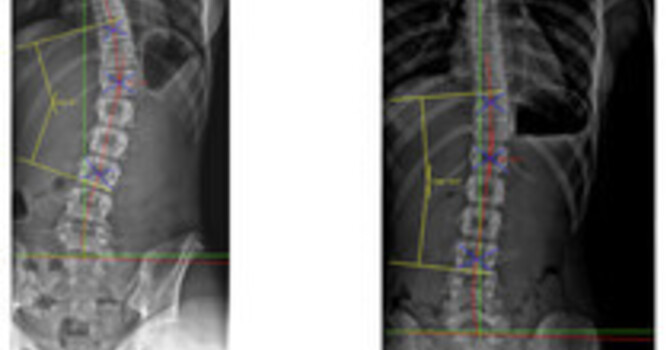
What most families do not realize is that visible postural asymmetry is often not the first structural change. The Cobb angle can reach 15 to 20 degrees before the lateral deviation is visible to the naked eye in a clothed child during normal daily activity. The signs described below are the ones worth looking for actively : not waiting to appear spontaneously.
Dr. Justin M. Dick, DC at Clear Life Scoliosis and Chiropractic Center, Charlotte NC. CLEAR Scoliosis Institute Senior Fellow and Board of Directors member. Multiple peer-reviewed, PubMed-indexed publications. No referral required. 980-368-0766.
Book Your Evaluation Call 980-368-0766
The Six Visible Signs of Scoliosis
Uneven Shoulder Height
One shoulder sits measurably higher than the other when the child stands facing forward in a relaxed posture. In a right thoracic Lenke 1 curve, the right shoulder is typically elevated because the rib cage on the convex side carries the shoulder girdle upward as the vertebrae rotate. This is the most commonly noticed early sign by parents.
Prominent Shoulder Blade
One scapula protrudes more than the other when viewed from the back. The scapula sits on the rib cage : when thoracic vertebral rotation elevates the ribs on the convex side, the scapula is carried with them into a more posterior and elevated position. Visible particularly in a tank top or swimwear.
Waist Asymmetry
The space between the arm and the body is unequal on the two sides when the child stands facing forward with arms relaxed. One side appears to have a fuller waist curve. This is the primary visual marker for lumbar and thoracolumbar curves (Lenke 5C, Lenke 6) where the rib hump is less prominent and shoulder asymmetry may be mild.
Uneven Hip Height
One hip appears higher or more prominent than the other. Hip asymmetry can reflect either a structural lumbar scoliosis tilting the pelvis, or a functional leg length discrepancy producing a secondary postural lean. Distinguishing structural from functional hip asymmetry requires standing radiograph : visual assessment alone cannot make this determination.
Rib Prominence on Forward Bend
When the child bends forward at the waist with palms together and arms hanging, one side of the posterior thorax elevates more than the other. This is the Adams forward bend test : the standard clinical screening tool for scoliosis. An angle of trunk rotation (ATR) of 5 to 7 degrees on scoliometer measurement at this position is the conventional referral threshold for standing radiograph and Cobb angle measurement.
Head Not Centered Over Pelvis
A plumb line from the center of the head does not drop through the midline of the pelvis. The body appears shifted to one side. This is the visible manifestation of a significant coronal imbalance and typically indicates a larger curve or a curve with significant translational component. In adults, this presentation often indicates de novo degenerative scoliosis with progressive sagittal and coronal decompensation.
How to Perform the Adams Forward Bend Test at Home
The Adams forward bend test is the standard clinical screening examination for scoliosis and can be performed by a parent without any equipment. Have the child stand barefoot, place palms together, and bend forward at the waist with knees straight until the torso is roughly parallel to the floor. The examiner stands directly behind and at eye level with the child's back. Look for: any posterior elevation on one side of the thorax that is absent on the other side, any lumbar asymmetry : one side fuller than the other at the lower back : and any visible deviation of the spine from the midline.
A positive Adams test : visible elevation on one side : does not diagnose scoliosis but it is the indication for professional evaluation. The scoliometer measurement at Clear Life Scoliosis gives a number to that elevation (the angle of trunk rotation in degrees) and determines whether the ATR threshold for standing radiograph is met.
The school screening gap.
Many schools in North Carolina perform Adams forward bend screening annually. Two limitations: school screenings are typically performed by school nurses rather than trained scoliosis specialists, and school screenings do not produce a Cobb angle measurement : they produce a referral recommendation. A child who passes a school screening but whose parents have observed visible shoulder or hip asymmetry should still receive a formal scoliosis evaluation. A school screening that produces no referral is not equivalent to a clinical evaluation finding no curve.
Early Signs by Age Group
Ages 10-14: Adolescent Idiopathic Scoliosis
The peak diagnosis window for AIS is the onset of puberty through early adolescence, coinciding with the growth spurt that acts as the primary driver of progression. The Risser 0 to 2 window : when progression risk is highest and correction potential is greatest : overlaps with this age range. A child in this age group with any positive Adams test finding warrants immediate scoliosis evaluation, not a six-month observational wait. The Risser stage on the radiograph at the first evaluation determines whether the window is fully open, partially closed, or nearly complete.
Ages 3-9: Juvenile Scoliosis
Juvenile scoliosis : developing between ages 3 and 10 : has a longer progression window than AIS because more growth remains. A curve identified at age 5 has many more years of growth force acting on it than one identified at 13. Early curves in this age group that appear mild by Cobb angle are not mild in terms of the progression opportunity they represent. Bracing during this period is the standard conservative approach alongside structural monitoring.
Under Age 3: Infantile Scoliosis
Infantile scoliosis (under age 3) is rare and differs etiologically from AIS. Most infantile curves resolve spontaneously. Those that do not progress along a different clinical path and require early aggressive management. The RVAD (rib-vertebral angle difference) on radiograph in the first months of life is the prognostic tool most commonly used to differentiate resolving from progressive infantile scoliosis.
Adults: De Novo Degenerative Scoliosis
Adults who develop new postural asymmetry after age 40, particularly a progressive lean to one side, increasing back pain with standing, or measurable height loss, may be developing de novo degenerative scoliosis. At the September 2026 Carolinas Scoliosis Screening Initiative in Charlotte, two adults over 50 were identified with de novo curves at 55 and 38 degrees : both had attributed their postural changes to normal aging. A standing radiograph with Cobb angle measurement is the only way to distinguish the structural cause from general age-related change.
Published Research: What Clear Life Scoliosis Found in Patients Who Had Been Evaluated Before
When to Stop Watching and Start Evaluating
Frequently Asked Questions: Early Signs of Scoliosis Charlotte NC
What are the first signs of scoliosis?
The earliest visible signs are uneven shoulder height, a prominent shoulder blade on one side, waist asymmetry (unequal space between the arm and body on each side), and uneven hip height. The Adams forward bend test : bending forward with palms together : reveals a posterior rib elevation when present. An ATR of 5 to 7 degrees on scoliometer measurement is the threshold for standing radiograph referral. Dr. Justin Dick at Clear Life Scoliosis Charlotte NC. 8814 Rachel Freeman Way Suite 103, Charlotte NC 28278. Call 980-368-0766.
Can you spot scoliosis without a doctor?
The Adams forward bend test can be performed by a parent at home and is the standard clinical screening tool used by school nurses and pediatricians. A positive finding : visible posterior thoracic or lumbar elevation on forward bend : is the indication for professional evaluation with standing radiograph and Cobb angle measurement. A negative home Adams test does not rule out scoliosis below the visible threshold. For any child with a family history of scoliosis or in the high-risk age range (10-14), formal evaluation at Clear Life Scoliosis Charlotte NC is appropriate regardless of visible signs. 8814 Rachel Freeman Way Suite 103, Charlotte NC 28278. Call 980-368-0766.
At what age does scoliosis usually show up?
Adolescent idiopathic scoliosis most commonly presents between ages 10 and 14, coinciding with the pubertal growth spurt that acts as the primary progression driver. This is also the Risser 0-2 window of highest progression risk and greatest correction potential. Juvenile scoliosis develops between ages 3 and 10. Infantile scoliosis develops before age 3. De novo degenerative scoliosis develops in adults typically after age 40. Dr. Justin Dick at Clear Life Scoliosis Charlotte NC. 8814 Rachel Freeman Way Suite 103, Charlotte NC 28278. Call 980-368-0766.
Is back pain an early sign of scoliosis in children?
Back pain is not a typical early sign of adolescent idiopathic scoliosis in children. AIS is generally pain-free in adolescence, which is why visual screening matters : the structural deformity develops without a pain signal to prompt evaluation. When a child with AIS does report back pain, it typically indicates either a larger curve with muscle imbalance, a curve with significant rotation, or a different underlying pathology. Back pain is more commonly the presenting complaint of adult scoliosis, particularly de novo degenerative cases. Dr. Justin Dick at Clear Life Scoliosis Charlotte NC. 8814 Rachel Freeman Way Suite 103, Charlotte NC 28278. Call 980-368-0766.
What happens if scoliosis is caught early?
Early detection at a smaller Cobb angle means the curve is less established, the vertebral rotation is lower (Nash-Moe Grade 0-1 rather than Grade 3-4), the skeletal growth window is still open (Risser 0-2), and the structural flexibility required for correction is present. Published outcomes at Clear Life Scoliosis Charlotte NC include 71% and 60% Cobb angle reduction at 12-month follow-up in adolescent Lenke 5C patients (PMID 41640942) and reduction from 42.4 to 23.8 degrees at 13-month follow-up (PMID 40062184). These outcomes were achieved in the moderate curve range during the active growth window. Dr. Justin Dick at Clear Life Scoliosis Charlotte NC. 8814 Rachel Freeman Way Suite 103, Charlotte NC 28278. Call 980-368-0766.
What is the Adams forward bend test?
The Adams forward bend test is the standard screening examination for scoliosis. The patient stands barefoot, places palms together, and bends forward at the waist with knees straight until the torso is roughly parallel to the floor. The examiner stands behind and looks for posterior elevation on one side of the thorax or lumbar region. The scoliometer placed at the most elevated point measures the angle of trunk rotation (ATR) in degrees. An ATR of 5 to 7 degrees is the conventional referral threshold for standing radiograph and Cobb angle measurement. At Clear Life Scoliosis Charlotte NC, ATR is documented at every assessment alongside the Cobb angle. 8814 Rachel Freeman Way Suite 103, Charlotte NC 28278. Call 980-368-0766.
Dr. Dick has multiple peer-reviewed, PubMed-indexed publications on scoliosis outcomes. Clear Life Scoliosis and Chiropractic Center serves patients from Charlotte, Huntersville, Ballantyne, Matthews, Concord, Mooresville, Steele Creek, Berewick, Rock Hill SC, Fort Mill SC, Greenville SC, and Spartanburg SC. No referral required. Cash-based practice.
Don't Wait for the Next School Screening : Charlotte NC
Dr. Justin M. Dick, DC : CLEAR Scoliosis Institute Senior Fellow · CLEAR Board of Directors · CNMT · ARRT(N)(CT) · CBP Trained · ISICO World Masters · SOSORT Provisional Member · NASS Member · Multiple peer-reviewed, PubMed-indexed publications. Adams forward bend with ATR, standing radiograph, Peirson analysis Cobb angle, Risser staging, Lenke classification. No referral required. Cash-based practice.
Charlotte, NC 28278
980-368-0766 | office@clearlifescoliosis.com
Justin Dick
Contact Me