Dr. Justin Dick, DC, owner and treating clinician at Clear Life Scoliosis and Chiropractic Center in Charlotte, NC, tracked this case over 20 visits across two months. It is presented here as a single documented example, not as a projection of what any other patient should expect. De novo scoliosis, also called adult degenerative scoliosis, is a coronal spinal curve that develops after skeletal maturity in a patient with no adolescent scoliosis history, most commonly linked to asymmetric disc and facet joint degeneration and rarely presenting before age 40.
What Makes This Different From Adolescent Scoliosis
De novo scoliosis is not a progressed childhood curve. It starts new, in a spine with no prior deformity, usually in the lumbar spine, usually driven by uneven degeneration of the discs and facet joints rather than the growth-related mechanisms behind adolescent idiopathic scoliosis. That distinction matters clinically: the treatment goals for a 60-something patient with a new lumbar curve are pain, function, and stability, not the growth-window curve management used in adolescent care. For the full clinical picture of adult degenerative presentations, see adult degenerative scoliosis and adult scoliosis: pain, balance, and function.
Case Findings
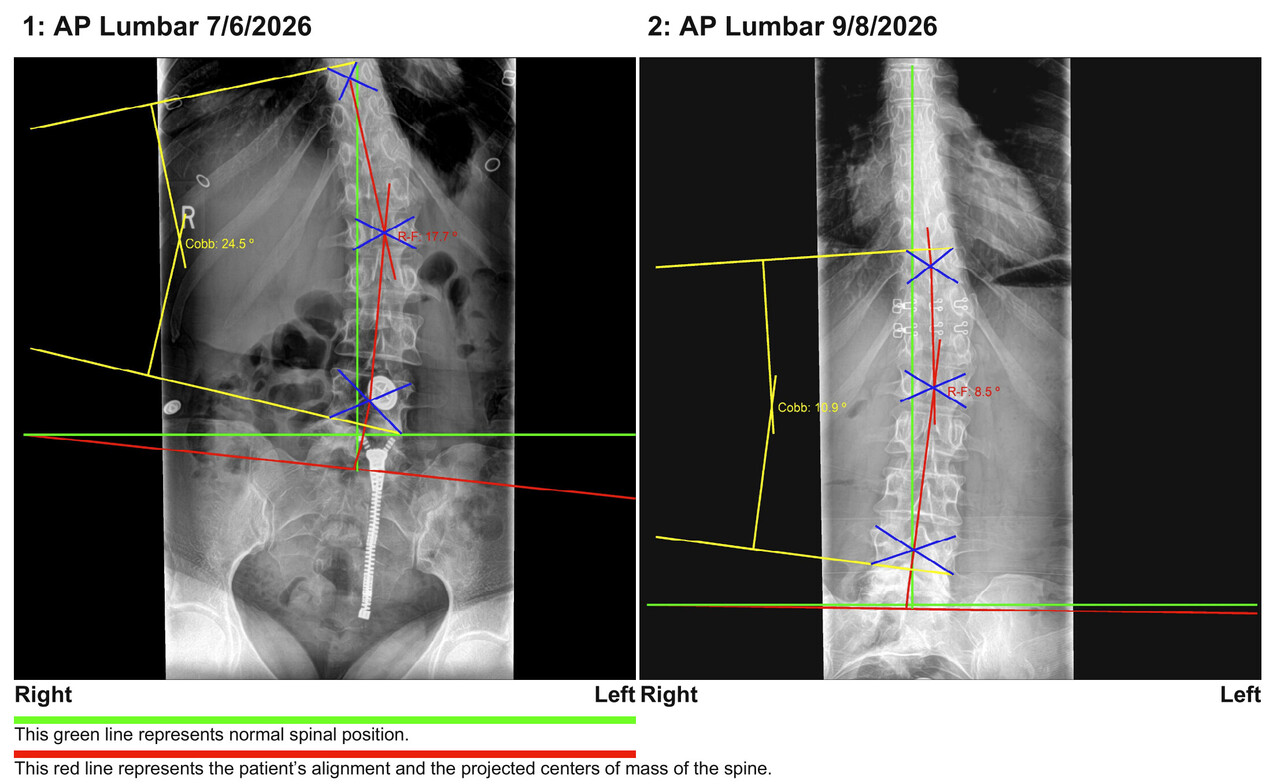
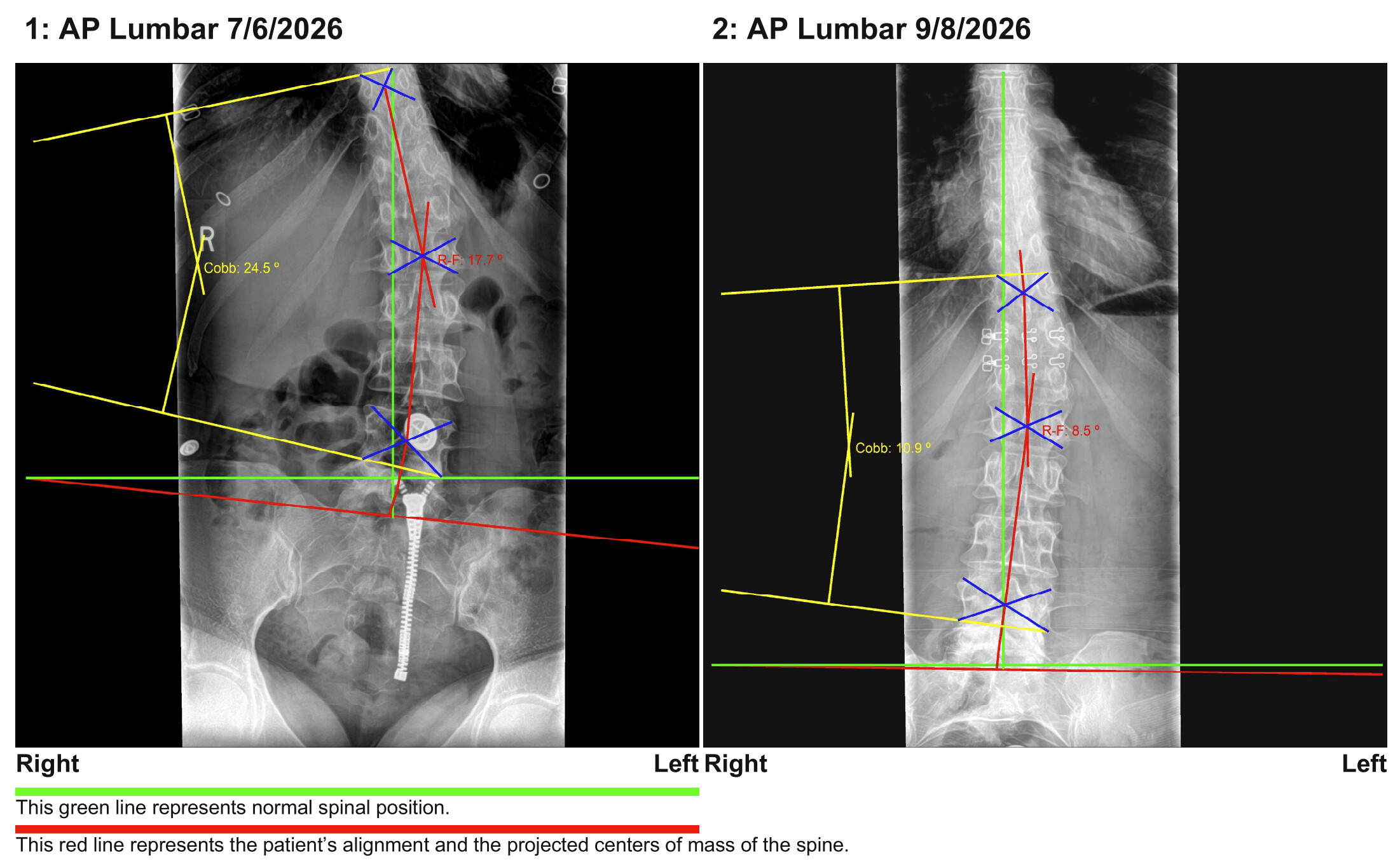
Before and after radiographs are shown below with the patient's identifying information removed. Cobb angle measurement followed the standard protocol used at Clear Life: initial measurement via Peirson analysis, confirmed with PostureRay digital measurement.
| Measure | Before | After (20 visits / 2 months) |
|---|---|---|
| Cobb angle | 24.5° (7/6/2026) | 10.9° (9/8/2026) |
| R-F angle (internal reference only, not defined in public copy) | 17.7° | 8.5° |
| Functional Rating Index (0–40, lower is better) | 18 | 4 |
| Chest expansion (4th intercostal space) | 1.5 in | 2.5 in |
| Stork balance test, eyes open | 30 seconds | 30 seconds |
| Stork balance test, eyes closed | 5 seconds | 7 seconds |
| Standing posture (visual/photographic) | See photo | See photo |
What These Numbers Actually Mean
A 13.6-degree Cobb angle reduction, from 24.5 to 10.9 degrees between the 7/6/2026 and 9/8/2026 films, is a measurable structural change, not just a symptom improvement. It was tracked using the same Peirson/PostureRay confirmatory protocol used across all Clear Life imaging, which addresses hand-measurement error but not the inherent 3 to 5 degree inter-rater variability in any Cobb reading. See Cobb Angle Definition for the full detail on that limitation.
The Functional Rating Index dropped from 18 to 4, a 14-point improvement on a 0-to-40 scale where lower scores mean less pain-related functional restriction. Published literature on the FRI puts its minimum clinically important difference at approximately 9 points, so this change clears that bar by a wide margin rather than sitting near the noise floor of the instrument.
Chest expansion, the difference in thoracic circumference between full exhale and full inhale at the 4th intercostal space, improved from 1.5 to 2.5 inches. Textbook normative values for adults sit around 2 to 3 inches, so this patient moved from a restricted reading toward the low end of the normal range, consistent with reduced rib cage asymmetry as the curve corrected.
The stork balance test, performed eyes open and eyes closed, isolates different inputs to postural control: eyes open reflects the combined visual, vestibular, and proprioceptive system, eyes closed removes vision and isolates the vestibular and proprioceptive contribution. Improvement in both conditions points to a general gain in postural control rather than a purely visual-compensation strategy. [VISIT FREQUENCY/MODALITIES] were used across the 20 visits.
What This Case Does and Doesn't Show
This is one patient, tracked by one clinician, over one course of care. It is not a controlled study, it has no comparison group, and it does not establish what any other patient with a similar de novo curve should expect. Curve flexibility, degree of existing degeneration, bone density, and overall health status all affect how a given case responds. Clear Life does not promise a specific degree of correction to any patient who has not been examined.
Research
This case follows the same Cobb angle tracking methodology used in Dr. Justin Dick's published case series, Reduction of Adolescent Idiopathic Scoliosis: A 13-Month Follow-Up (Cureus, 2025). Adult and geriatric outcome tracking specifically is addressed in Radiographic Sagittal Alignment and Kinetic Chain Alterations in Geriatric Patients With Scoliosis (Whelan JP, Dick JM, Cureus 2026, DOI 10.7759/cureus.105827). Full research record: Dr. Justin Dick Research.
FAQ
What is de novo scoliosis?
De novo scoliosis is a coronal spinal curve that develops in adulthood, with no history of scoliosis earlier in life, typically after age 40, usually driven by uneven disc and facet joint degeneration rather than the growth-related causes behind adolescent scoliosis.
Can de novo scoliosis be corrected without surgery?
Case-level correction has been documented at Clear Life Scoliosis and Chiropractic Center in Charlotte, NC, including a Cobb angle reduction from 24.5 to 10.9 degrees over 20 visits in one patient. This is a single case example, not a guaranteed outcome, and surgical referral remains appropriate for some presentations.
What does the Functional Rating Index measure?
It is a validated 10-item questionnaire assessing pain-related restriction in daily activities like sleep, personal care, and work, scored 0 to 40, with lower scores indicating less disability.
Why measure chest expansion in a scoliosis patient?
Chest expansion, the change in thoracic circumference between full exhale and full inhale, reflects rib cage mobility, which is commonly restricted by the rib asymmetry that accompanies a coronal spinal curve. Improvement toward normal values is an objective marker of reduced structural restriction.
What is the stork test used for?
It is a single-leg standing balance test performed with eyes open and eyes closed, used to assess postural control and the relative contribution of vision versus vestibular and proprioceptive input to balance.
Who tracked this case in Charlotte, NC?
Dr. Justin M. Dick, DC, at Clear Life Scoliosis and Chiropractic Center, 8814 Rachel Freeman Way, Suite 103, Charlotte, NC 28278, evaluated and tracked this patient's outcomes over the full course of care.
Service Area
Serving Charlotte NC, Huntersville NC, Ballantyne NC, Matthews NC, Concord NC, Mooresville NC, Rock Hill SC, and Fort Mill SC.
Related Pages
- Adult Degenerative Scoliosis
- Adult Scoliosis: Pain, Balance, and Function
- Cobb Angle Definition
- About Scoliosis
- Treatment Options
- Scoliosis Second Opinion
- Dr. Justin Dick Research
- Scoliosis Care Program
Contact
Clear Life Scoliosis and Chiropractic Center
8814 Rachel Freeman Way, Suite 103, Charlotte, NC 28278
980-368-0766
Schedule Your Evaluation
Individual results vary. This case represents the documented outcome of one patient and should not be interpreted as a typical or guaranteed result. All patients are evaluated individually before any treatment recommendation is made.
Justin Dick
Contact Me