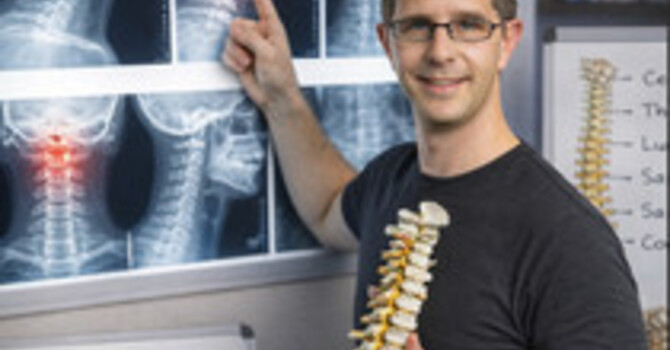
Whiplash describes the acceleration-deceleration injury to the cervical spine that occurs when the head is forced through rapid flexion and extension, most commonly in a rear-end or side-impact collision. The mechanism is the same one that has driven a meaningful part of Dr. Justin Dick's published research: how the cervical spine's mechanics change under load, and why the downstream symptoms of that change are so often under-recognized in a standard exam.
At Clear Life Scoliosis and Chiropractic Center in Charlotte, NC, whiplash and motor vehicle collision (MVA) injury care is handled by Dr. Justin M. Dick, DC, a clinician who holds dual imaging credentials (CNMT, ARRT(N)(CT)), is a certified DOT medical examiner on the National Registry of Certified Medical Examiners, and has authored peer-reviewed work on cervical mechanics and post-MVA spinal presentations. This page explains what whiplash is, what to expect from an evaluation here, and where the evidence for chiropractic management actually stands.
What Is Whiplash?
Whiplash is a soft tissue and joint mechanics injury, not a fracture, and that is precisely why it gets underestimated. The neck is whipped through flexion then extension (or the reverse, depending on impact direction) faster than the surrounding musculature can brace for it. The result is strain or microtrauma to the cervical facet joints, ligaments, discs, and the deep stabilizing muscles of the neck, along with irritation to the nerve roots and, in some cases, the vestibular and autonomic pathways that run through the upper cervical region.
Symptom onset is frequently delayed. It is common for someone to walk away from a collision feeling stiff but otherwise fine, only to have significant pain, headache, or restricted motion develop over the following 24 to 72 hours as inflammation sets in. This delayed pattern is one of the main reasons early evaluation and imaging matter, even when the initial presentation looks mild.
Common symptoms
- Neck pain and stiffness, often worse with rotation or extension
- Headaches, typically starting at the base of the skull (cervicogenic pattern)
- Reduced cervical range of motion
- Shoulder, upper back, or arm pain, with possible tingling or numbness
- Jaw pain or TMJ irritation
- Dizziness, tinnitus, or visual disturbance in a subset of cases
- Sleep disruption, difficulty concentrating, or irritability during the acute recovery window
That last cluster, the dizziness, tinnitus, and cognitive fog some patients report, sits outside the classic musculoskeletal picture and is easy to dismiss in a rushed exam. This is not a hypothetical concern for me. I published a peer-reviewed case report specifically on this problem: measurable changes in cervical sagittal alignment and associated neurological findings following conservative cervical rehab after a motor vehicle collision, in a patient who also had pre-existing scoliosis. That case documented exactly the kind of interaction I look for in practice, trauma layered onto a spine that already had baseline structural asymmetry, and it is the single most relevant piece of published evidence I can point to for whiplash care in this office.
Causes of Whiplash
- Rear-end and side-impact auto collisions — the most common cause seen in this office
- Commercial vehicle and trucking accidents — a population Dr. Dick also evaluates directly as a certified DOT medical examiner
- Contact sports — tackles and collisions producing the same flexion-extension mechanism
- Falls and workplace accidents
How We Evaluate and Treat Whiplash at Clear Life
The exam starts with a real history: mechanism of impact, direction of force, headrest position, whether the head was turned at the moment of collision, and the timeline of symptom onset. That last detail changes the clinical picture considerably, and it is also the kind of detail that matters if the case involves a personal injury claim.
- History and physical exam — orthopedic and neurological testing of the cervical spine, ligamentous stability screening, and a functional movement assessment.
- Imaging when indicated — Dr. Dick holds dual credentials in nuclear medicine and CT technology (CNMT, ARRT(N)(CT)) in addition to his chiropractic license, which shapes how imaging findings get read and correlated to the clinical exam rather than treated as an isolated report.
- Treatment specific to the injury — manual and instrument-assisted adjusting, soft tissue work, and a home rehabilitation program built around what the exam actually found, not a generic protocol.
- Documentation — for patients involved in an MVA, records are kept to the standard needed for personal injury claims and referring attorneys, without that documentation driving the clinical decisions.
Clear Life vs. a Typical Charlotte Auto Injury Clinic
| Factor | Clear Life Scoliosis and Chiropractic Center | Typical volume-based PI clinic |
|---|---|---|
| Treating clinician | Dr. Justin Dick, DC, treats and reads imaging directly | Often rotates between associates or techs |
| Imaging credentials | Dual-certified: CNMT, ARRT(N)(CT) | Outsourced to a third-party imaging center |
| Published research | Peer-reviewed, PubMed-indexed work on cervical mechanics and post-MVA presentations | Rarely publishes original clinical research |
| DOT medical examiner | Certified on the FMCSA National Registry | Not typically credentialed for this |
| Practice model | Cash-based, one clinician, no billing-driven visit quotas | Often insurance/PI-lien volume model |
Research and Evidence
The literature on whiplash-associated disorders is large but uneven. Most of it points toward early, active management (movement and targeted manual care) outperforming prolonged rest or a soft collar, and toward a meaningful minority of patients, commonly cited in the range of 15 to 20 percent, going on to develop chronic symptoms beyond the initial recovery window. I am not going to attach a specific percentage to this page without a citation I can stand behind, so treat that range as a general clinical expectation rather than a number pulled from one study.
Most directly on point for this page:
- Radiographic Sagittal Alignment and Neurological Changes Following Conservative Cervical Structural Rehabilitation After Motor Vehicle Collision in a Patient With Pre-existing Scoliosis: A Case Report (Dick JM, Paige P. Cureus. 2026 Mar 2;18(3):e104584) — documents measurable radiographic change in cervical sagittal alignment and associated neurological findings following conservative rehab after an MVC, in a patient with baseline scoliosis. This is the paper most relevant to whiplash presentations complicated by pre-existing spinal asymmetry. Read on PubMed Central.
Supporting work on the underlying biomechanics:
- A Retrospective Cross-Sectional Analysis of Abnormal Cervical Mechanics in Patients With Scoliosis (Cureus) — case-series level evidence on how altered cervical biomechanics present clinically.
- Refractory Lumbar Pain Following MVA in a Geriatric Patient (Cureus) — a case report addressing post-motor-vehicle-accident spinal pain that did not resolve with standard initial management.
All three are case-level evidence, not randomized trials, and I want that stated plainly rather than dressed up. Case reports and case series establish plausibility and clinical patterns in specific patients; they do not establish population-level effect sizes. For the full list of Dr. Dick's peer-reviewed publications, see the research and publications page.
Frequently Asked Questions
How soon after a car accident should I see a chiropractor for whiplash?
Within the first 72 hours if possible. Whiplash symptoms are frequently delayed, and early evaluation by Dr. Justin Dick, DC in Charlotte, NC allows imaging and baseline documentation to be captured before inflammation and compensation patterns obscure the original injury.
Do I need an X-ray or imaging after a whiplash injury?
Not always, but imaging is indicated when there are red flags (neurological symptoms, suspected fracture, significant trauma mechanism) or when documentation is needed for a personal injury claim. Dr. Dick's dual imaging credentials (CNMT, ARRT(N)(CT)) mean imaging decisions and interpretation happen with the same clinician managing the case.
How long does whiplash take to heal?
Most whiplash-associated disorder resolves within weeks to a few months with appropriate active care. A minority of patients develop persistent symptoms beyond six months, which is why early, correctly targeted treatment matters rather than a wait-and-see approach.
Can whiplash cause headaches, dizziness, or tinnitus?
Yes, in a subset of patients. These symptoms arise from irritation of upper cervical structures and, in some cases, vestibular involvement. They are part of what gets screened for in every evaluation at Clear Life Scoliosis and Chiropractic Center, 8814 Rachel Freeman Way, Suite 103, Charlotte, NC 28278.
Will chiropractic care for whiplash be covered if I'm in a personal injury claim?
Clear Life operates on a cash-based model rather than billing through auto insurance med-pay or PI liens directly. Patients working with an attorney on a personal injury claim can request documentation formatted for that purpose. Discuss specifics with our office at 980-368-0766.
What makes Dr. Justin Dick's approach to whiplash different from a typical Charlotte chiropractor?
Dr. Justin Dick, DC published a peer-reviewed case report specifically on radiographic sagittal alignment and neurological changes following conservative cervical rehab after a motor vehicle collision in a patient with pre-existing scoliosis (Cureus, 2026). Combined with dual diagnostic imaging credentials and DOT medical examiner certification, that is a combination not common among Charlotte-area chiropractors treating auto injury patients.
Service Area
Clear Life Scoliosis and Chiropractic Center treats whiplash and auto injury patients from Charlotte NC, Huntersville NC, Ballantyne NC, Matthews NC, Concord NC, Mooresville NC, Rock Hill SC, and Fort Mill SC.
Related Pages
- Personal Injury Program
- What Just Happened to Your Spine?
- Imaging, Documentation, and Diagnosis
- Treatment and Recovery
- For Attorneys and Referring Providers
- Questions, Evidence, and Next Steps
- Car Accident Chiropractor Charlotte NC
- Dr. Justin Dick Research and Publications
- Clinical Collaboration with Jeffrey Cronk, DC JD and Smart Injury Doctors
- About Scoliosis
- Our Team
- Book Your Evaluation
Schedule Your Whiplash Evaluation
Clear Life Scoliosis and Chiropractic Center
8814 Rachel Freeman Way, Suite 103, Charlotte, NC 28278
Phone: 980-368-0766 · clearlifescoliosis.com
Justin Dick
Contact Me