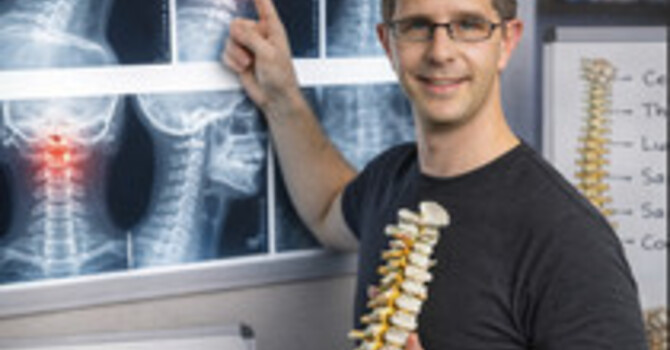
A C5-C6 disc bulge means the disc between the fifth and sixth neck vertebrae extends beyond its normal margins on MRI. It is one of the most common findings on a neck MRI, including in people with no symptoms. It matters when it narrows the space for the spinal cord or presses on the nerve root that exits at that level. Patients in Charlotte often bring me a report with this phrase, and the level matters less than what the disc is touching.
How Common It Is
In a study of 1,211 healthy volunteers aged 20 to 70, 87.6% had cervical disc bulging, including 73.3% of men and 78.0% of women in their 20s (Nakashima, Spine 2015). Bulging increased with age in frequency, severity, and number of levels. Spinal cord compression was much less common, at 5.3%, and when it appeared it was most often at C5-C6 (41%) and C6-C7 (27%).
That last finding explains why C5-C6 appears so often on reports. It is the level most likely to show change, with or without symptoms.
What the Term Does and Does Not Mean
The radiology committee behind the standard disc nomenclature wrote that its definitions do not imply trauma, a relationship to symptoms, or a need for treatment (Williams, AJNR 2014). A bulge describes shape. It is not a diagnosis.
When It Matters
The C6 nerve root exits at the C5-C6 level. A bulge there becomes clinically relevant when symptoms follow that root, such as pain or numbness down the arm toward the thumb side, or when the exam shows weakness or reflex change in that distribution. In a population study of 561 people with cervical radiculopathy, C7 was the most commonly involved root and C6 the second (Radhakrishnan, Brain 1994).
Signs of spinal cord involvement, such as hand clumsiness, balance trouble, or changes in walking, need prompt evaluation regardless of what the report calls the disc.
Motion Films and C5-C6
One retrospective study of 92 patients without trauma found that horizontal displacement on the extension X-ray at C5-C6 predicted disc protrusion on MRI with 93.33% sensitivity and 100% specificity (Kim, Medicine 2018). That suggests disc change at C5-C6 can leave a measurable signature on motion films, but it is one small study and does not replace MRI.
How I Read It
I check whether the bulge contacts the cord or the C6 root, whether the exam matches that root, and whether prior imaging shows the same finding. A C5-C6 bulge with no matching findings is usually part of the expected picture for the patient's age.
For an example of how post-collision imaging findings and outcomes are documented in the peer-reviewed literature, read the published case report on refractory lumbar pain following a motor vehicle accident in a geriatric patient by Dr. Justin Dick, DC.
Frequently Asked Questions
What is a C5-C6 disc bulge?
It is extension of the disc between the fifth and sixth neck vertebrae beyond its normal margins on MRI. The term describes shape, not cause or symptoms (Williams, AJNR 2014).
Is C5-C6 disc bulging normal?
It is very common. In 1,211 people without symptoms, 87.6% had cervical disc bulging, and cord compression, when present, was most often at C5-C6 (Nakashima, Spine 2015).
What symptoms come from C5-C6?
The C6 nerve root exits at C5-C6. Compression can cause pain or numbness toward the thumb side of the arm and hand, or weakness and reflex changes in that distribution.
When is a C5-C6 bulge serious?
When it compresses the spinal cord or causes matching nerve root findings. Hand clumsiness, balance trouble, or walking changes need prompt evaluation.
How does Dr. Justin Dick, DC evaluate a C5-C6 finding?
Dr. Justin Dick, DC in Charlotte, NC checks whether the disc contacts the cord or C6 root, whether the exam matches, and whether prior imaging shows the same finding.
Where can I get a neck MRI reviewed in Charlotte, NC?
Dr. Justin Dick, DC, CLEAR Institute Senior Fellow and CNMT, ARRT(N)(CT), sees patients at Clear Life Scoliosis and Chiropractic Center, 8814 Rachel Freeman Wy, Ste 103, Charlotte, NC 28278, phone 980-368-0766.
Sources and Evidence Tiers
- Nakashima H, Yukawa Y, Suda K, Yamagata M, Ueta T, Kato F. Abnormal findings on magnetic resonance images of the cervical spines in 1211 asymptomatic subjects. Spine. 2015;40(6):392-398. PMID 25584950. LinkEvidence tier: Cross-sectional study
- Williams AL, Murtagh FR, Rothman SLG, Sze GK. Lumbar disc nomenclature: version 2.0. AJNR Am J Neuroradiol. 2014;35(11):2029. LinkEvidence tier: Editorial by the ASSR/ASNR nomenclature committee (expert consensus)
- Radhakrishnan K, Litchy WJ, O'Fallon WM, Kurland LT. Epidemiology of cervical radiculopathy: a population-based study from Rochester, Minnesota, 1976 through 1990. Brain. 1994;117(Pt 2):325-335. PMID 8186959. LinkEvidence tier: Population-based cohort (561 patients)
- Kim CH, Hwang JM, Park JS, Han S, Park D. Predictability of severity of disc degeneration and disc protrusion using horizontal displacement of cervical dynamic radiographs: a retrospective comparison study with MRI. Medicine (Baltimore). 2018;97:e11098. LinkEvidence tier: Retrospective comparison study (92 non-trauma patients)
About the author. Dr. Justin Dick, DC, is the owner and treating clinician at Clear Life Scoliosis and Chiropractic Center in Charlotte, NC. He holds dual imaging credentials as a Certified Nuclear Medicine Technologist (CNMT) and as an ARRT-registered technologist in nuclear medicine and CT, ARRT(N)(CT). He is a Senior Fellow of the CLEAR Institute, holds the ISICO World Masters credential, is a SOSORT provisional member, and is a certified DOT medical examiner on the FMCSA National Registry. He has multiple peer-reviewed publications indexed in PubMed and serves as a field doctor for Life, Sherman, and Palmer chiropractic colleges. ORCID: 0009-0001-2794-2159.
Service Area
Clear Life Scoliosis and Chiropractic Center sees personal injury and spinal imaging patients from Charlotte NC, Huntersville NC, Ballantyne NC, Matthews NC, Concord NC, Mooresville NC, Rock Hill SC, and Fort Mill SC.
Related Pages
- Personal injury and car accident spinal care in Charlotte
- Research by Dr. Justin Dick, DC
- Case report: refractory lumbar pain after a motor vehicle accident
- Research and evidence at Clear Life
- Questions and answers
- Our team
- Press
- Book your evaluation
- Contact Clear Life
Clear Life Scoliosis and Chiropractic Center
8814 Rachel Freeman Wy, Ste 103
Charlotte, NC 28278
Phone: 980-368-0766
Email: office@clearlifescoliosis.com
Book online
Justin Dick
Contact Me