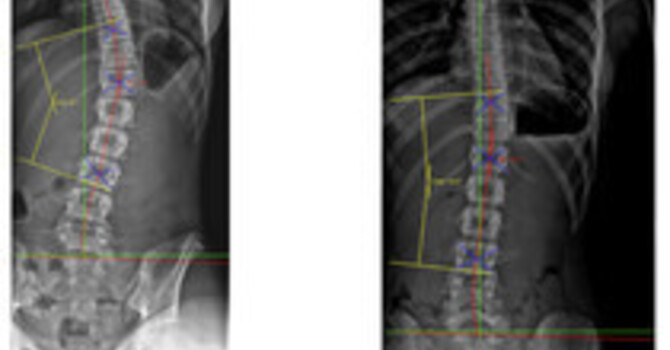
Short answer: Yes, for most people. The 2016 SOSORT guidelines recommend general sports for people with idiopathic scoliosis and recommend continuing sports during brace treatment. A 2016 study of 102 adolescent competitive tennis players found trunk asymmetry similar to school controls. The exception: SOSORT advises avoiding competitive activities that heavily mobilize the spine in adolescents at high risk of progression.
Golf and tennis come up often in scoliosis consults in my Charlotte office, from parents of a braced 12-year-old on a junior tennis team and from adults in their sixties with a lumbar curve and a standing tee time. Most of what is written on this topic is advice without citations. The evidence is thinner than either side of the argument usually admits, so this page separates what has been measured from what is clinical reasoning.
What the scoliosis guidelines say about sport
The International Scientific Society on Scoliosis Orthopaedic and Rehabilitation Treatment (SOSORT) published its third guideline edition from a 2016 consensus meeting (Negrini et al.). Six of its 68 recommendations cover sport (Table 15). They recommend that sport not be prescribed as a treatment for scoliosis (strength C, evidence level III); that general sports be performed for their psychological, neuromotor, and general health benefits (B, V); that school physical education continue through all treatment phases, with possible restrictions set by a clinician specialized in conservative care (B, V); that sports continue during brace treatment (B, V); that contact or highly dynamic sports be done with caution while braced (C, VI); and that competitive activities that greatly mobilize the spine be avoided in patients at high risk of progression (C, III).
Evidence tier: four of the six recommendations rest on level V or VI evidence, which in the SOSORT scheme means expert opinion and consensus. The guidance is reasonable. It is also mostly expert judgment, and that should be said plainly when a parent asks whether a sport is safe.
Does tennis cause or worsen scoliosis?
The best direct data is a 2016 cross-sectional study by Zaina and colleagues in the European Spine Journal (PubMed 26920135). It compared 102 competitive tennis players, all 12 years old, with 203 schoolchildren of the same age. Angle of trunk rotation was 3.2 degrees in female players against 2.8 in female controls (not significant), and 2.8 against 2.6 in males. Low back pain prevalence was similar, but tennis players reported more limitation of usual activity from it.
The design limits the conclusion. A cross-sectional study measures prevalence at one moment and cannot show what happens to a spine over years of play, a point made directly in a critique in the International Journal of Racket Sports Science (IJRSS). A 0.2-degree difference in males is statistically significant and clinically meaningless.
The opposite signal exists for other asymmetric sports. A screening study of 116 adolescent volleyball players reported scoliosis in 5.2% against 1% of controls who played no sport (Modi et al., Asian Spine Journal). Comparing athletes with non-athletes introduces its own bias, and screening studies cannot establish cause.
A 2022 meta-analysis in BMJ Open Sport and Exercise Medicine estimated idiopathic scoliosis prevalence in athletes at 27% (PubMed 35999823). The heterogeneity statistic (I-squared) was 98% and the 95% prediction interval ran from 1% to 69%, a spread of 68 percentage points. A pooled number with that much disagreement between studies tells an individual patient almost nothing.
Golf and the lower back
Golf loads land in the lumbar spine. Hosea and colleagues (1990) measured average lumbar compressive loads during a full swing of about 8 times body weight, against roughly 3 times body weight for running, as summarized in a review in the Asian Journal of Sports Medicine (PMC4335481). The same review reports that golf may irritate pre-existing low back conditions as people play and practice more.
I could not find a study that measured curve progression in adult golfers with scoliosis. Anyone who tells you golf does or does not worsen an adult curve is going beyond the data. What is reasonable to say: the forces are large, they concentrate where adult lumbar and thoracolumbar curves usually sit, and pain during or after golf in a person with a lumbar curve deserves an exam before more swing volume.
Teens playing sport while braced
A prospective cohort in the European Spine Journal (2022) followed adolescents with idiopathic scoliosis in a full-time brace and found that those playing sport twice or more per week had higher odds of curve improvement at 18 months; 290 patients (36.9%) never stopped sport during follow-up (doi:10.1007/s00586-022-07370-0). The design is observational. Teenagers who keep playing may also be the ones who wear the brace as prescribed, so sport may be a marker of adherence as much as a cause of better results.
Practically, the SOSORT recommendations and this cohort point the same way: keep the athlete playing, apply caution with contact and highly dynamic sports while braced, and reconsider high-volume competitive rotational training when the curve is at high risk of progression, which mostly means young, skeletally immature, and already moderate in size.
How a curve changes a swing (clinical reasoning, untested in trials)
In a typical idiopathic curve, the vertebrae at the apex are rotated toward the convex side. That fixed rotation is why many patients turn more easily one way than the other, and it can be measured at the exam with a scoliometer and with trunk and hip rotation range in each direction. A right-handed golfer with a right thoracic curve rotates the trunk toward the convexity on the backswing. Whether thousands of repetitions in that direction affect progression has not been studied. It remains an open question.
Some modifications have a mechanical rationale. A swing with less separation between shoulder and hip rotation, the so-called reduced X-factor, is described as lowering torque on the lumbar spine (Sports Injury Bulletin). Hip rotation capacity matters because the hips and thoracic spine share the work the lumbar spine should not do. For curves that are progressing during growth, SOSORT includes 12 recommendations on physiotherapeutic scoliosis-specific exercise (2016 guidelines),, and that exercise is where treatment effort belongs.
Scoliosis care for athletes in Charlotte
Dr. Justin Dick, DC, evaluates and treats adolescents and adults with scoliosis at Clear Life Scoliosis and Chiropractic Center, 8814 Rachel Freeman Way, Suite 103, Charlotte, NC 28278 (980-368-0766). Dr. Dick is a Senior Fellow of the CLEAR Institute, a SOSORT provisional member, and holds the ISICO World Masters credential. Care at Clear Life follows a phased sequence: a mobility phase, an adjusting phase, and a stability phase that includes self-corrective exercises and, when indicated, ScoliBrace fitting.
Dr. Dick's published work includes a retrospective cross-sectional analysis of abnormal cervical mechanics in patients with scoliosis and a study of radiographic sagittal alignment and kinetic chain alterations in geriatric patients with scoliosis. The full list is on the research page.
Frequently asked questions
Can I play golf with scoliosis?
Most people with scoliosis can play golf. The 2016 SOSORT guidelines recommend general sports for people with idiopathic scoliosis. Golf produces lumbar compression loads of about 8 times body weight (Hosea, 1990), so pain during or after play in someone with a lumbar curve deserves an exam. Dr. Justin Dick, DC, evaluates golfers with scoliosis in Charlotte, NC.
Can I play tennis with scoliosis?
In most cases, yes. A 2016 study of 102 adolescent competitive tennis players (Zaina et al., Eur Spine J) found trunk rotation similar to 203 school controls, though players reported more activity limitation from low back pain. The study was cross-sectional and cannot show long-term effects.
Will golf or tennis make my scoliosis worse?
No study has measured curve progression in adult golfers or tennis players with scoliosis. For adolescents, the 2016 SOSORT guidelines recommend avoiding competitive activities that greatly mobilize the spine only when the curve is at high risk of progression, typically in skeletally immature patients with moderate curves.
Can my teen play sports while wearing a scoliosis brace?
The 2016 SOSORT guidelines recommend continuing sports during brace treatment, with caution for contact or highly dynamic sports. A 2022 prospective cohort in the European Spine Journal found braced adolescents who played sport twice or more weekly had higher odds of improvement at 18 months, though the design was observational.
Do asymmetric sports cause scoliosis?
The evidence is mixed. A 2016 tennis study found no increase in spinal asymmetry, while a volleyball screening study reported scoliosis in 5.2% of players against 1% of non-athletes. A 2022 meta-analysis estimated 27% prevalence in athletes, but with 98% heterogeneity between studies, so no firm conclusion is possible.
Where can I get a scoliosis evaluation for golf or tennis in Charlotte, NC?
Dr. Justin Dick, DC, a Senior Fellow of the CLEAR Institute and SOSORT provisional member, sees adolescents and adults with scoliosis at Clear Life Scoliosis and Chiropractic Center, 8814 Rachel Freeman Way, Suite 103, Charlotte, NC 28278, phone 980-368-0766.
Sources
- Negrini S et al. 2016 SOSORT guidelines: orthopaedic and rehabilitation treatment of idiopathic scoliosis during growth. Scoliosis Spinal Disord. 2018;13:3
- SOSORT 2016 guidelines, Table 15: recommendations on sports activities
- Zaina F et al. Tennis is not dangerous for the spine during growth: results of a cross-sectional study. Eur Spine J. 2016;25(9):2938-44
- Tennis and scoliosis: an approach without prejudice. International Journal of Racket Sports Science (critique of study designs)
- Modi HN et al. Muscle imbalance in volleyball players initiates scoliosis in immature spines: a screening analysis. Asian Spine J
- Prevalence of idiopathic scoliosis in athletes: a systematic review and meta-analysis. BMJ Open Sport Exerc Med. 2022;8(3):e001312
- Sports activities in adolescents with idiopathic scoliosis treated with a full-time brace, prospective cohort. Eur Spine J. 2022. doi:10.1007/s00586-022-07370-0
- Golf-related low back pain: a review of causative factors and prevention strategies (reports Hosea et al. 1990 lumbar loads). Asian J Sports Med
- Sports Injury Bulletin, golf swing kinematics and low back pain (X-factor summary)
Related pages
- Scoliosis care program at Clear Life
- About scoliosis
- Treatment options
- Bracing for scoliosis
- ScoliBrace in Charlotte
- Research and evidence
- Dr. Justin Dick's published research
- A retrospective cross-sectional analysis of abnormal cervical mechanics in patients with scoliosis
- Radiographic sagittal alignment and kinetic chain alterations in geriatric patients with scoliosis
- Our team
- Book your evaluation
- Questions and answers
Clear Life Scoliosis and Chiropractic Center
Dr. Justin M. Dick, DC
8814 Rachel Freeman Way, Suite 103, Charlotte, NC 28278
Phone: 980-368-0766 · office@clearlifescoliosis.com
Book online · Serving Charlotte, Huntersville, Ballantyne, Matthews, Concord, Mooresville, Rock Hill, and Fort Mill
Justin Dick
Contact Me