Parents and adult patients ask this question constantly, and the honest answer is that it depends on what "treatment" is actually being compared, because the two professions are not testing the same intervention. Physical therapy for scoliosis almost always means Physiotherapeutic Scoliosis-Specific Exercises, known in the literature as PSSE, which includes methods like Schroth and SEAS. Chiropractic care for scoliosis, when it goes beyond routine adjustment, usually means a structural, protocol-driven rehabilitation model built around traction, corrective positioning, neuromuscular re-education, and manipulation, aimed at measurable Cobb angle change rather than symptom management alone. The version of that model I practice and publish on follows a Chiropractic Leadership, Educational Advancement, and Research (CLEAR) Institute framework.
At Clear Life Scoliosis and Chiropractic Center in Charlotte, I treat this as a research question before I treat it as a marketing question. Here is what the PT literature shows, and here is exactly what my own published clinical work does and does not establish.
How the Two Approaches Differ Mechanically
PSSE trains the patient to actively self-correct posture in three dimensions using breathing mechanics, muscle activation on the concave side, and postural habituation carried into daily activity. The CLEAR Institute protocol I follow is more externally applied in delivery: mechanical traction, corrective positioning, and proprioceptive neuromuscular training apply corrective input to the spine directly, paired with manipulation and, in more severe or rapidly progressing cases, an intensive short-duration schedule aimed at measurable curve reduction on follow-up radiographs rather than primarily functional or postural improvement alone.
What the Physical Therapy Evidence Shows
A 2012 Cochrane review rated the evidence for PSSE as low to very low quality across Cobb angle, trunk rotation, pain, and quality of life outcomes. Since then, several randomized controlled trials have strengthened the picture. In a long-term Schroth-based RCT built on the Scientific Exercise Approach to Scoliosis, or SEAS, active self-correction exercise improved Cobb angle by 5.3 degrees at skeletal maturity, while a traditional exercise comparison group showed stable, unimproved curves. A 2025 review in Physiotherapy characterized the certainty of evidence for therapeutic exercise as still very low overall, but noted low to moderate certainty that PSSE outperforms general therapeutic exercise for preventing progression greater than 5 degrees at the end of growth.
The 2016 SOSORT guidelines, developed through a multi-stakeholder Delphi consensus, position PSSE as an accepted conservative intervention but are explicit that PSSE alone should not replace bracing once a curve exceeds roughly 25 degrees during growth. That is an important caveat that gets lost in a lot of marketing copy from PT clinics: PSSE is evidence-supported as an adjunct and as a tool for mild curves, not as a standalone bracing substitute for larger curves.
Source: 2016 SOSORT Guidelines, Scoliosis and Spinal Disorders · Schroth RCT, SOSORT 2017 Award
What Our Published CLEAR Institute Research Shows
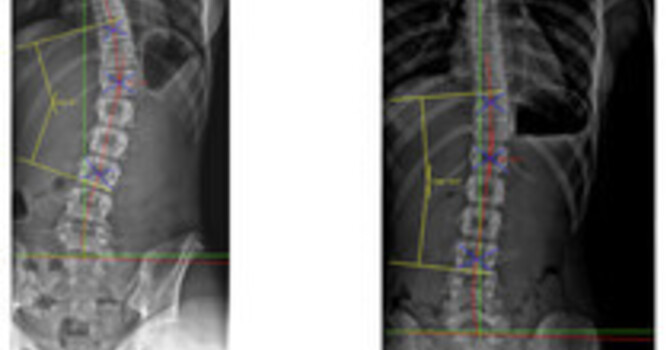
I have multiple peer-reviewed, PubMed-indexed publications examining CLEAR Institute protocol outcomes in scoliosis patients, and I would rather walk through exactly what each one does and does not establish than wave at a publication count. In a single case report I co-authored with Sandy Spurgeon, a 14-year-old male with severe adolescent idiopathic scoliosis, Risser 2, presenting with a 42.4 degree Cobb angle, was followed for 13 months of consistent adherence to the Clear Life Scoliosis Reduction treatment plan. His Cobb angle was reduced to 23.8 degrees, alongside improvements in mobility, chest expansion, and respiratory capacity. That is a single case, and the paper itself states further study is needed to establish long-term efficacy.
In a case series I co-authored on a two-week intensive CLEAR Institute protocol for Lenke 5C adolescent idiopathic scoliosis, two patients completed 20 sessions of mechanical traction, corrective positioning, proprioceptive neuromuscular training, and whole-body vibration over two weeks, with bracing introduced during week two. One case showed a lumbar Cobb angle reduction from 35.7 to 21.7 degrees post-intensive, holding at 10.4 degrees at 12 months, a 71 percent total reduction. The second case went from 38.9 to 24.7 degrees post-intensive, holding at 15.7 degrees at 12 months, a 60 percent total reduction. Bracing was concurrent in both cases, so the correction cannot be attributed to manual protocol elements alone.
A case report I co-authored with John Whelan on the SKOLIOS neuromechanical rehabilitation device, which we developed and hold under provisional patent, documented a Cobb angle reduction from 10.9 to 3.8 degrees in a single adolescent idiopathic scoliosis patient. The device is not FDA cleared, and a single case report needs replication before anyone treats it as generalizable. A separate paper on sagittal alignment and kinetic chain changes in geriatric scoliosis, led by Whelan with me as co-author, adds mechanistic detail on how postural chain alterations present in older adults with structural curves.
I want to be direct about the evidence tier here because I would expect the same directness reviewing someone else's claims: this is case report and small case series evidence from a single treating group, not randomized controlled trial evidence, and it has not yet been independently replicated outside our own clinical research. That puts it below the PT literature's Cochrane-reviewed RCTs in study design, even where the individual outcomes reported are large.
Sources: Dick JM, Spurgeon S, 13-Month Follow-Up, Cureus 2025 · Lenke 5C Intensive Protocol Case Series, Cureus · SKOLIOS AIS case report, Cureus · Whelan JP, Dick JM, sagittal alignment and kinetic chain, Cureus
Evidence Comparison at a Glance
| Approach | Typical Evidence Tier | Representative Finding | Honest Limitation |
|---|---|---|---|
| PSSE / Physical Therapy | Cochrane review, multiple RCTs | 5.3° Cobb improvement at skeletal maturity (Schroth/SEAS RCT) | Cochrane rates overall certainty low to very low; not a substitute for bracing above ~25° |
| Clear Life / CLEAR Institute Protocol | Case reports, small case series | 42.4°→23.8° at 13 months; 71% and 60% reduction at 12 months (2-case series) | Single treating group, no RCT yet, not independently replicated, bracing often concurrent |
| Clear Life / SKOLIOS | Single case report | 10.9° to 3.8° in one AIS patient | N of 1, device not FDA cleared, replication needed |
So Which Should You Choose?
Neither profession has a monopoly on evidence here, and I would be misrepresenting my own field if I told you otherwise. What I look at clinically is curve pattern, growth remaining, prior treatment history, and whether the patient responds better to active self-correction training or to a passive corrective loading model. Some patients do best combined, using PSSE-style home exercise alongside a CLEAR Institute structural protocol. A proper evaluation, including postural and radiographic imaging analysis, is what actually answers this question for an individual patient rather than a blog post doing it in the abstract.
Frequently Asked Questions
Is chiropractic care as well studied as physical therapy for scoliosis?
No, and it is important to say that plainly. Physical therapy's PSSE approach has been reviewed by Cochrane and tested in multiple randomized controlled trials. The CLEAR Institute protocol research published by Dr. Justin Dick is currently at the case report and small case series stage, which is a lower evidence tier.
Can a physical therapist and a chiropractor work together on the same scoliosis case?
Yes. Dr. Justin Dick at Clear Life Scoliosis and Chiropractic Center in Charlotte, NC frequently coordinates with physical therapy providers, particularly when a patient is already established in a Schroth or SEAS program and wants a structural chiropractic evaluation added.
Does physical therapy alone stop scoliosis from progressing?
The evidence suggests PSSE can reduce the rate of progression and, in some RCTs, meaningfully improve Cobb angle in mild to moderate curves, but SOSORT guidelines are clear that PSSE alone should not replace bracing once a curve exceeds roughly 25 degrees during growth.
What does Dr. Dick's own research say about chiropractic treatment for scoliosis?
Dr. Justin Dick has multiple peer-reviewed, PubMed-indexed publications on CLEAR Institute protocol outcomes, including a 13-month follow-up case report showing a Cobb angle reduction from 42.4 to 23.8 degrees, a two-case intensive protocol series showing 71 percent and 60 percent total curve reduction at 12 months, and a SKOLIOS device case report showing a reduction from 10.9 to 3.8 degrees. These are early-stage case reports and small case series, not guarantees of outcome.
Where is Clear Life Scoliosis and Chiropractic Center located?
Clear Life Scoliosis and Chiropractic Center is located at 8814 Rachel Freeman Way, Suite 103, Charlotte, NC 28278, and can be reached at 980-368-0766.
How do I find out which approach fits my curve?
The only way to answer that honestly is a hands-on evaluation with imaging. You can schedule one directly with Dr. Justin Dick at Clear Life Scoliosis and Chiropractic Center in Charlotte, NC through the link on this page.
Serving Charlotte and Surrounding Areas
Clear Life Scoliosis and Chiropractic Center in Charlotte, NC treats patients traveling from Huntersville, Ballantyne, Matthews, Concord, Mooresville, Rock Hill SC, and Fort Mill SC for scoliosis-specific evaluation and care.
Related Pages
- About Scoliosis
- Treatment Options
- Scoliosis Care Program
- Research and Evidence
- Bracing for Scoliosis
- Questions and Answers
- Dr. Justin Dick Research
- Our Team
- Choosing-a-scoliosis-specialist-charlotte-nc-what-to-look-for-what-to-ask-and-what-the-evidence-should-show-before-you-commit-to-a-treatment-plan
8814 Rachel Freeman Way, Suite 103, Charlotte, NC 28278
Phone: 980-368-0766
Justin Dick
Contact Me