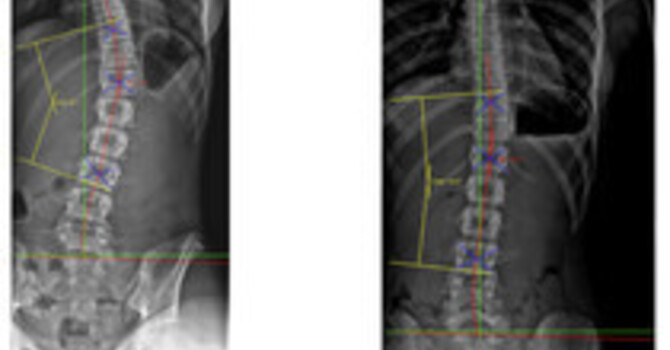
Dextroscoliosis means the spine curves with its convex side, the outside of the bend, pointing to the patient's right. Levoscoliosis means the convex side points to the left. "Dextroconvex" and "levoconvex" say the same thing more explicitly. The words describe direction only. They do not tell you how large the curve is, whether it is structural, or what caused it.
I am Dr. Justin Dick, and I hold CNMT and ARRT(N)(CT) imaging credentials. At Clear Life Scoliosis and Chiropractic Center in Charlotte, NC, patients often arrive with a radiology report that says "mild dextroscoliosis" and nothing else. This post explains what that phrase does and does not tell you, and the situations where direction actually changes what happens next.
How Direction Is Named
Direction is named for the convex side, the side the curve bulges toward. A thoracic curve bulging to the right is a right thoracic curve, or a thoracic dextroscoliosis. A lumbar curve bulging to the left is a left lumbar curve, or a lumbar levoscoliosis. Many spines have both, which is why a report can mention dextroscoliosis and levoscoliosis in the same sentence. My post on double major and S-shaped curves covers spines with two structural curves.
Direction is described from the patient's perspective. Radiographs are viewed with a marker that shows which side is which, and a mislabeled or flipped image can reverse the reported direction. That is uncommon, but it is one more reason I review the images, not just the report.
What "Mild Dextroscoliosis" on a Report Leaves Out
A one-line impression on a chest X-ray, abdominal film, or CT scan was usually written by a radiologist looking for something else. It rarely includes a Cobb angle, rotation, curve location, or whether the film was standing. "Mild" in that context is a visual impression, not a measurement. To decide anything, you need a standing radiograph with a measured Cobb angle and a clinical exam. My post on scoliosis misdiagnosis covers why measurement method matters.
A small lateral bend on a supine film taken for another reason may not be a structural scoliosis at all. The standard definition requires a Cobb angle of 10° or more with rotation, as discussed in my post on postural versus structural curves.
When Direction Changes the Workup
Direction matters in specific combinations. In Xu and colleagues' 2020 study of 714 adolescents with scoliosis who had whole-spine MRI, a left thoracic curve, meaning a thoracic levoscoliosis, was an independent risk factor for an intramedullary spinal cord abnormality, along with male sex, a sharply angled curve, abnormal abdominal reflexes, and ankle clonus. In Zhang and colleagues' MRI study of 504 children under 10 with presumed idiopathic scoliosis, both left thoracic curves and right lumbar curves were associated with neural axis abnormalities.
So a thoracic levoscoliosis or a lumbar dextroscoliosis in a young patient, particularly a boy or anyone with neurological findings, is a reason for MRI and a medical referral before an idiopathic plan begins. Those studies come from hospital cohorts that likely include more complex cases than a typical practice, so the percentages overstate the risk for an average patient. The direction of the association is consistent. My post on thoracic scoliosis covers this in more detail.
Direction in Adults
In adults, the report's direction mostly matters for planning: which side of the lumbar spine is loaded, where nerve openings may narrow, and how the pelvis is tilted. My posts on spinal stenosis with scoliosis and pelvic tilt cover those mechanics. Direction alone does not predict pain.
How Dr. Justin Dick Reads Direction at Clear Life
At our Charlotte office, a report that mentions dextroscoliosis or levoscoliosis leads to a standing PA and lateral study when one is not already available, with each curve's location, direction, Cobb angle, and rotation recorded. Direction is then read against age, sex, and the neurological exam. An atypical direction pattern with any red flag goes to MRI first. You can also listen to our podcast episode on dextroscoliosis.
Comparison
| Term on the report | Meaning | When it changes the workup |
|---|---|---|
| Dextroscoliosis / dextroconvex | Convex side to the patient's right | Lumbar dextroscoliosis in a young child was associated with neural axis abnormalities (Zhang 2016) |
| Levoscoliosis / levoconvex | Convex side to the patient's left | Thoracic levoscoliosis was an independent MRI risk factor in adolescents (Xu 2020) |
| "Mild" without a Cobb angle | Visual impression, often on a non-spine study | Needs a standing film with a measured Cobb angle before any decision |
| Both terms together | Two curves in opposite directions | Determine whether both are structural |
Research and Evidence
Evidence tiering: the direction-related MRI associations come from two retrospective hospital cohorts with likely referral bias. The definitions of direction are standard terminology. The point that incidental reports rarely include measurements is my clinical observation from reviewing outside imaging.
My own published work uses measured, direction-specific curve data. The Lenke 5C case report, A Non-surgical Multimodal Approach to Adolescent Idiopathic Scoliosis (Lenke 5C) Using an Intensive Two-Week CLEAR Institute Protocol: A Report of Two Cases (Cureus, 2026, PMID 41640942), and the cervical mechanics study, A Retrospective Cross-Sectional Analysis of Abnormal Cervical Mechanics in Patients With Scoliosis (Cureus, 2025, PMID 41018459), both report Cobb angles measured on standing radiographs.
References
- Xu W, Zhang X, Zhu Y, et al. An analysis of clinical risk factors for adolescent scoliosis caused by spinal cord abnormalities in China: proposal for a selective whole-spine MRI examination scheme. BMC Musculoskelet Disord. 2020;21(1):187. doi:10.1186/s12891-020-3182-z
- Zhang W, Sha S, Xu L, et al. The prevalence of intraspinal anomalies in infantile and juvenile patients with presumed idiopathic scoliosis: a MRI-based analysis of 504 patients. BMC Musculoskelet Disord. 2016;17:189. doi:10.1186/s12891-016-1026-7
- Negrini S, Donzelli S, Aulisa AG, et al. 2016 SOSORT guidelines: orthopaedic and rehabilitation treatment of idiopathic scoliosis during growth. Scoliosis Spinal Disord. 2018;13:3. doi:10.1186/s13013-017-0145-8
- Lenke LG, Betz RR, Harms J, et al. Adolescent idiopathic scoliosis: a new classification to determine extent of spinal arthrodesis. J Bone Joint Surg Am. 2001;83(8):1169-81. PMID 11507125
- Whelan J, Paige P, Dick JM. A non-surgical multimodal approach to adolescent idiopathic scoliosis (Lenke 5C) using an intensive two-week CLEAR Institute protocol: a report of two cases. Cureus. 2026;18(1):e102006. doi:10.7759/cureus.102006
- Dick JM. A retrospective cross-sectional analysis of abnormal cervical mechanics in patients with scoliosis. Cureus. 2025;17(8):e91098. doi:10.7759/cureus.91098
Frequently Asked Questions
What is dextroscoliosis?
Dextroscoliosis is a scoliosis curve with its convex side, the outside of the bend, pointing to the patient's right. It describes direction only, not size or cause.
What is levoscoliosis?
Levoscoliosis is a curve with its convex side pointing to the patient's left. A thoracic levoscoliosis was an independent risk factor for spinal cord abnormality on MRI in a 2020 study of 714 adolescents.
Is dextroscoliosis or levoscoliosis worse?
Neither is worse by direction alone. Severity depends on Cobb angle, rotation, and growth remaining. Certain directions, such as a left thoracic curve, warrant additional workup.
My chest X-ray says mild dextroscoliosis. What should I do?
Incidental reports rarely include a measurement. Dr. Justin Dick at Clear Life Scoliosis in Charlotte, NC recommends a standing radiograph with a measured Cobb angle and an exam before any decision.
What does dextroconvex mean?
Dextroconvex means the convex side of the curve faces right. It is another way of saying dextroscoliosis.
Where can I get a scoliosis report reviewed in Charlotte, NC?
Clear Life Scoliosis and Chiropractic Center, 8814 Rachel Freeman Way, Suite 103, Charlotte, NC 28278, reviews outside imaging and reports with Dr. Justin Dick, DC, who holds CNMT and ARRT(N)(CT) imaging credentials. Call 980-368-0766.
Service Area
Clear Life Scoliosis and Chiropractic Center sees patients from Charlotte NC, Huntersville NC, Ballantyne NC, Matthews NC, Concord NC, Mooresville NC, Rock Hill SC, Fort Mill SC. Families from across the Charlotte region and the South Carolina border communities come to the Rachel Freeman Way office for radiographic scoliosis evaluation with Dr. Justin Dick.
Related Pages
- Podcast: Dextroscoliosis
- Thoracic Scoliosis
- Thoracolumbar Scoliosis
- Double Major and S-Shaped Scoliosis
- Can Scoliosis Be Misdiagnosed?
- Postural vs Structural Scoliosis
- Cobb Angle Explained
- Scoliosis Imaging and Measurement
- Radiographic Imaging Credentials
- Scoliosis Second Opinion
Schedule an Evaluation in Charlotte
If a report gave you a direction and nothing else, the next step is a measured standing film. Dr. Justin Dick can review what you have at our Charlotte office.
Dr. Justin M. Dick, DC
8814 Rachel Freeman Way, Suite 103, Charlotte, NC 28278
Phone: 980-368-0766 · Email: office@clearlifescoliosis.com
clearlifescoliosis.com · Book online

Justin Dick
Contact Me