By Dr. Justin M. Dick, DC · Senior Fellow, CLEAR Scoliosis Institute · CNMT, ARRT(N)(CT)
A 59-year-old woman came to Clear Life Scoliosis and Chiropractic Center in Charlotte after a side-impact collision while turning. She rated her headache, neck pain, and dizziness each at 10 out of 10, present all day. She was missing work, and her Functional Rating Index was 33 out of a possible 40, where higher scores mean more disability.
This page covers what we found, what changed over about 12 weeks, and what we did not measure. I wrote it for people in Charlotte sorting out care after a crash and for the attorneys and physicians who refer them. Identifying details have been removed.
Presentation at Intake
Along with the three main complaints, she reported low back and hip pain, memory difficulty, and visual disturbance. She had a history of prior concussions. Upper neck pain at C1 and C2 spread up the left side of her head into the back of the skull with every neck movement.
Strength testing was 4 out of 5 in the right biceps and triceps and the left wrist flexors. Pinwheel testing found heightened sensation on the right from C2 through T1 and at C6 on the left, and reduced sensation in the L4, L5, and S1 dermatomes. Spurling's and foraminal compression tests reproduced neck pain on both sides.
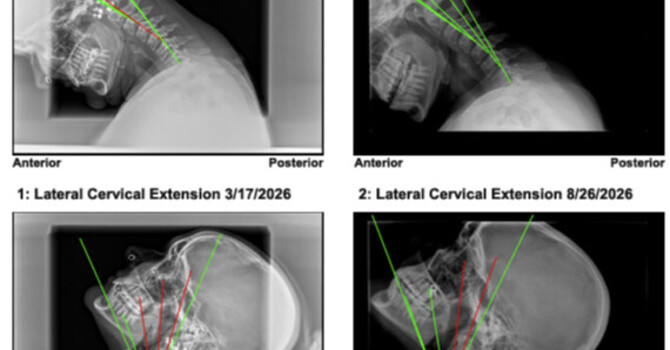
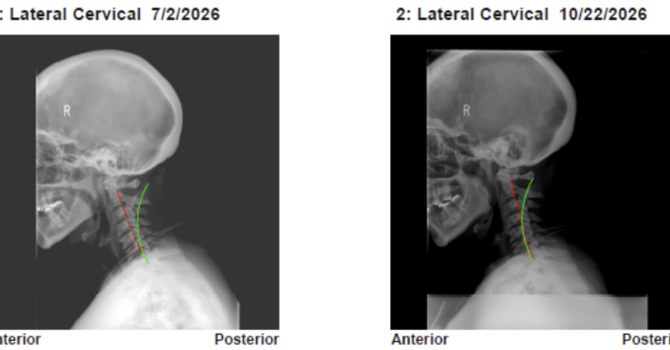
Upright radiographs showed a neck curve of -19.7° from C2 to C7, against an ideal of -42°, and the head carried 31.9 mm forward of C7, where under 15 mm is the reference. The lumbar curve measured -4.5° against an ideal of -40°. The neck films showed moderate to severe diffuse degenerative change. Disc degeneration at C4 to C6 had caused her no symptoms before the collision.
We measured her AP lumbar film for scoliosis, as we do for every patient. Her lumbar side curve was 3.2°. The Scoliosis Research Society threshold for scoliosis is 10°, so she does not have scoliosis.
How She Was Treated at Clear Life in Charlotte
Neck adjusting was done with an instrument (ArthroStim at 6 Hz) rather than manual thrust. Care also included cervical traction, Mirror Image® positioning from Chiropractic BioPhysics, pulsed electromagnetic field therapy, whole-body vibration, proprioceptive work on a wobble cushion, kinesiology taping, and a home exercise program. Visits were frequent in the first weeks and tapered over about 12 weeks.
Other clinicians were involved. She was followed by a neurologist for memory and vision concerns, planned an eye examination, completed a mental health follow-up, and discussed blood work to assess for brain injury. Her outcome reflects all of that care and the passage of time, not ours alone.
Intake vs. 12-Week Re-Examination
| Measure | Intake | Follow-up |
|---|---|---|
| Headache (0 to 10) | 10, constant | 5 at 2 weeks; 1 at 12 weeks |
| Neck pain (0 to 10) | 10, constant | 5 at 2 weeks; 1 at 12 weeks |
| Dizziness (0 to 10) | 10, constant | Resolved at 12 weeks |
| Pain spreading from the upper neck into the head | Present | No longer spreading at 12 weeks |
| Sensation testing, arms and legs | Abnormal in multiple cervical and lumbar dermatomes | Within normal limits at 12 weeks |
| Missed work | Missing workdays | No missed work reported by week 4 |
| Functional Rating Index (0 to 40) | 33 | Not repeated |
| Arm strength | 4/5 in right biceps and triceps and left wrist flexors | Not retested |
Symptom ratings are her own reports on a 0 to 10 scale. Sensation findings are from examiner testing.
What These Numbers Show and What They Do Not
The examiner finding that changed is sensation: abnormal responses across several cervical and lumbar dermatomes at intake were within normal limits at 12 weeks. Her headache, neck pain, and dizziness ratings fell from 10 to 1 or to none, and she stopped missing work within about four weeks.
The gaps are real. We did not repeat X-rays, so this page makes no claim about changes in her neck or lumbar curve. We did not repeat the Functional Rating Index or retest arm strength, which leaves the disability and motor picture at 12 weeks undocumented. She told us at her last visit that she expected to feel better than she did, and she still had low back soreness and stiffness.
She had pre-existing degeneration, prior concussions, care from several other specialists, and the natural improvement many people show in the months after a collision. One patient with no control group cannot separate those effects from ours. I would want a repeat questionnaire, strength testing, and films before calling this a documented result.
How This Fits Our Published Work
Dr. Justin M. Dick, DC has seven PubMed-indexed papers, all published in Cureus. The three below are closest to this case. All are case reports or a retrospective cross-sectional study, which is low on the evidence hierarchy: they describe what happened, and they cannot show cause.
A 28-year-old woman with moderate thoracic scoliosis and right C5-C8 weakness after a collision. Functional Rating Index fell from 23 to 3 over 17 visits, with normalized strength and sensation and increased cervical lordosis on repeat films.
Cureus. 2026;18(3):e104584 · DOI: 10.7759/cureus.104584
A 66-year-old woman with prior lumbar and cervical fusion and mild thoracic scoliosis. Functional Rating Index fell from 22 to 11 over a 10-week program.
Cureus. 2026;18(2):e103540 · DOI: 10.7759/cureus.103540
A Retrospective Cross-Sectional Analysis of Abnormal Cervical Mechanics in Patients With Scoliosis
37 patients with adolescent idiopathic scoliosis; abnormal segmental translation was most frequent at C3-C4 (70.3%).
Cureus. 2025;17(8):e91098 · DOI: 10.7759/cureus.91098
The full list is on the research page for Dr. Justin M. Dick, DC.
Car Accident Care at Clear Life Scoliosis in Charlotte
Personal injury patients at Clear Life Scoliosis and Chiropractic Center are treated on a lien basis, with no out-of-pocket payment at the time of care. Every post-collision evaluation includes a history, a neurological and orthopedic exam, range of motion measurement, and upright radiographs when indicated. The personal injury program page covers the process in detail.
Frequently Asked Questions
What X-rays are taken after a car accident at a chiropractor in Charlotte, NC?
At Clear Life Scoliosis and Chiropractic Center in Charlotte, NC, Dr. Justin M. Dick, DC takes upright neck and low back X-rays after a collision, and flexion and extension views of the neck when the history or exam calls for them. The films are measured for neck curve, forward head position, segmental motion, lumbar curve, and degenerative change. He holds CNMT and ARRT(N)(CT) imaging credentials in addition to his chiropractic license.
Can a car accident make pre-existing neck arthritis start to hurt?
Degenerative disc changes are common in adults and often cause no symptoms. A collision can be followed by new pain in a neck that already had those changes, as in the case on this page, where disc degeneration at C4 to C6 had caused no symptoms before the crash. X-rays show the degeneration; they cannot date when pain started, which is why the history before the accident matters.
Does this patient have scoliosis?
No. Her lumbar side curve measured 3.2 degrees. The Scoliosis Research Society defines scoliosis as a curve of 10 degrees or more on X-ray, so this is a normal finding. Dr. Justin M. Dick, DC measures every lumbar film for coronal curve so that a real scoliosis is not missed after an injury.
Do I have to pay out of pocket for car accident care at Clear Life Scoliosis in Charlotte?
Personal injury patients at Clear Life Scoliosis and Chiropractic Center are treated on a lien basis, so there is no out-of-pocket payment at the time of care. The clinic is at 8814 Rachel Freeman Way, Suite 103, Charlotte, NC 28278, and the phone number is 980-368-0766.
Has Dr. Justin M. Dick, DC published research on car accident injuries?
Yes. Dr. Justin M. Dick, DC has seven PubMed-indexed papers in Cureus. Two are case reports on post-collision care: one on cervical alignment and neurological changes after a collision in a 28-year-old woman with pre-existing scoliosis, and one on refractory lumbar pain after a collision in a 66-year-old woman with prior lumbar surgery. Case reports describe individual patients and cannot establish that a treatment works for everyone.
How long does recovery from whiplash with headaches and dizziness take?
It varies, and no single case predicts it. The patient on this page reported headache and neck pain at 1 out of 10 and no dizziness after about 12 weeks of care in Charlotte, but she still had low back soreness and was being followed by other specialists for memory and vision concerns. Recovery is judged by repeat examination, not by the calendar.
Where is Clear Life Scoliosis and Chiropractic Center located?
Clear Life Scoliosis and Chiropractic Center is at 8814 Rachel Freeman Way, Suite 103, Charlotte, NC 28278. Phone 980-368-0766. The practice sees patients from Charlotte, Huntersville, Ballantyne, Matthews, Concord, Mooresville, Rock Hill SC, and Fort Mill SC.
Service Area
Clear Life Scoliosis and Chiropractic Center sees post-collision and scoliosis patients from Charlotte, NC, Huntersville, NC, Ballantyne, NC, Matthews, NC, Concord, NC, Mooresville, NC, Rock Hill, SC, and Fort Mill, SC.
Related Pages
- Personal Injury and Car Accident Care in Charlotte
- About Scoliosis
- Scoliosis Treatment Options
- Scoliosis Care Program
- Research and Evidence
- Dr. Justin M. Dick, DC: Published Research
- Sagittal Alignment in Geriatric Patients With Scoliosis
- Refractory Lumbar Pain After a Car Accident in a Geriatric Patient
- Patient Testimonials
- Questions and Answers
- Meet Our Team
- Contact Clear Life
Clear Life Scoliosis and Chiropractic Center
Dr. Justin M. Dick, DC
8814 Rachel Freeman Way, Suite 103, Charlotte, NC 28278
Phone: 980-368-0766 · Email: office@clearlifescoliosis.com
This case review describes one patient. Results vary, and one case does not predict another. This page is educational and is not a substitute for an individual examination.
Justin Dick
Contact Me