Kyphosis Treatment Charlotte NC — Non-Surgical Care for Thoracic Hyperkyphosis, Scheuermann's Disease, Dowager's Hump, and Wedged Vertebrae
A rounded upper back is not simply a posture problem. Depending on the specific structural cause — whether postural adaptation, Scheuermann's disease with wedged vertebrae, osteoporotic vertebral collapse, or degenerative disc and facet changes — the clinical picture, the progression risk, and the appropriate treatment approach are categorically different. Treating all of these under the same label of "kyphosis" without distinguishing between them produces generic care that addresses none of them precisely.
At Clear Life Scoliosis and Chiropractic Center in Charlotte, NC, the evaluation for thoracic hyperkyphosis begins with standing weight-bearing radiographic analysis — not a postural screen or visual assessment. The specific Cobb angle of the thoracic curve, the shape of the vertebral bodies, the presence or absence of wedged vertebrae, the sagittal balance profile, and the integrity of the cervical lordosis above the apex are all assessed before a treatment recommendation is made. Dr. Justin M. Dick, DC holds CNMT and ARRT(N)(CT) dual imaging credentials and CLEAR Scoliosis Institute Fellowship — with Board of Directors membership — and has published multiple peer-reviewed case reports indexed in PubMed on structural spinal deformity and rehabilitation outcomes. No referral required. Call 980-368-0766.
Schedule Your Evaluation Call 980-368-0766
What Kyphosis Actually Is — And Why the Type Matters Clinically
The thoracic spine has a natural kyphotic curve — a forward-facing arc that is both normal and structurally necessary for sagittal balance. The clinical problem is not kyphosis itself but hyperkyphosis — an excessive thoracic forward curvature that exceeds the normal range of approximately 20 to 40 degrees as measured on a standing lateral radiograph. When the thoracic Cobb angle exceeds 40 to 45 degrees in a growing patient or 50 degrees in an adult, the curve is considered hyperkyphotic and the associated clinical consequences become relevant.
The four types of hyperkyphosis encountered at Clear Life Scoliosis Charlotte NC have distinct structural characteristics, distinct progression risks, and distinct treatment implications.
Postural Hyperkyphosis
The critical radiographic distinction between postural and structural hyperkyphosis is vertebral body shape. In postural hyperkyphosis the vertebrae are rectangular on a lateral film. The curve is a product of disc and soft tissue adaptation, not bone deformity. Treatment directed at the disc and soft tissue environment — CBP-trained structural traction, postural rehabilitation, scoliosis-specific extension exercise — produces meaningful structural response when applied before the curve becomes fixed.
Scheuermann's Disease — Structural Kyphosis With Wedged Vertebrae
Scheuermann's disease produces a kyphotic curve that does not fully reduce on passive hyperextension — unlike postural hyperkyphosis, which is flexible. The rigidity is the radiographic signature of the structural wedging. On a lateral film, measuring the anterior and posterior heights of each involved vertebra and documenting wedging of 5 degrees or more at three consecutive levels confirms the Sorensen criteria. This measurement is what distinguishes Scheuermann's from postural hyperkyphosis and determines which treatment approach is appropriate.
In adolescents with open growth plates and Risser 0 through 2 staging, the growth window is the most mechanically favorable period for influencing vertebral body shape. Anterior vertebral body height is partially modifiable during growth through the application of corrective loading — the Hueter-Volkmann principle, which describes how compressive force on a growth plate inhibits growth while tensile force stimulates it. Structural rehabilitation that reduces the anterior compression on the wedged vertebrae during the growth phase allows anterior vertebral body height to partially normalize. This is the mechanical rationale for early intervention in Scheuermann's — not simply improving posture but influencing the structural trajectory of the vertebral body itself during the period when it can still change.
Dowager's Hump — Postmenopausal and Osteoporotic Kyphosis
The dowager's hump presentation requires radiographic assessment to distinguish between osteoporotic compression fractures — which represent a specific medical management situation requiring bone density assessment, calcium and vitamin D status evaluation, and in some cases pharmacological intervention — and age-related degenerative hyperkyphosis without acute fracture. Treating a dowager's hump without first establishing whether acute or subacute vertebral fracture is present is a clinical error. The evaluation at Clear Life Scoliosis Charlotte NC begins with standing radiographic assessment before any treatment is applied.
Conservative structural rehabilitation for osteoporotic hyperkyphosis targets the unfractured segments — improving thoracic extension capacity, strengthening the posterior chain musculature that resists forward collapse, and reducing the forward head carriage that compounds the compressive loading pattern. PEMF therapy as a clinical adjunct addresses the cellular bone metabolism environment — relevant given FDA clearance for bone healing applications. Goals are stabilization, pain reduction, and slowing of progression rather than structural correction to a normal Cobb angle, which is not a realistic expectation in established osteoporotic hyperkyphosis.
Degenerative Hyperkyphosis
In adults without osteoporosis, progressive thoracic hyperkyphosis develops through disc height loss, facet joint arthrosis, and anterior vertebral osteophyte formation that cumulatively reduce the anterior column height relative to the posterior column — producing a gradual forward tilt at each affected level. The kinetic chain compensation pattern described in published research from Clear Life Scoliosis — Whelan JP, Dick JM, Cureus 2026, DOI 10.7759/cureus.105827 — is directly relevant here: in aging patients with structural spinal deformity, chronic pain may originate from the compensatory loading patterns throughout the kinetic chain rather than from the primary curve itself. That reframe informs where treatment effort is directed in degenerative hyperkyphosis presentations.
Wedged Vertebrae — The Radiographic Finding That Changes Everything
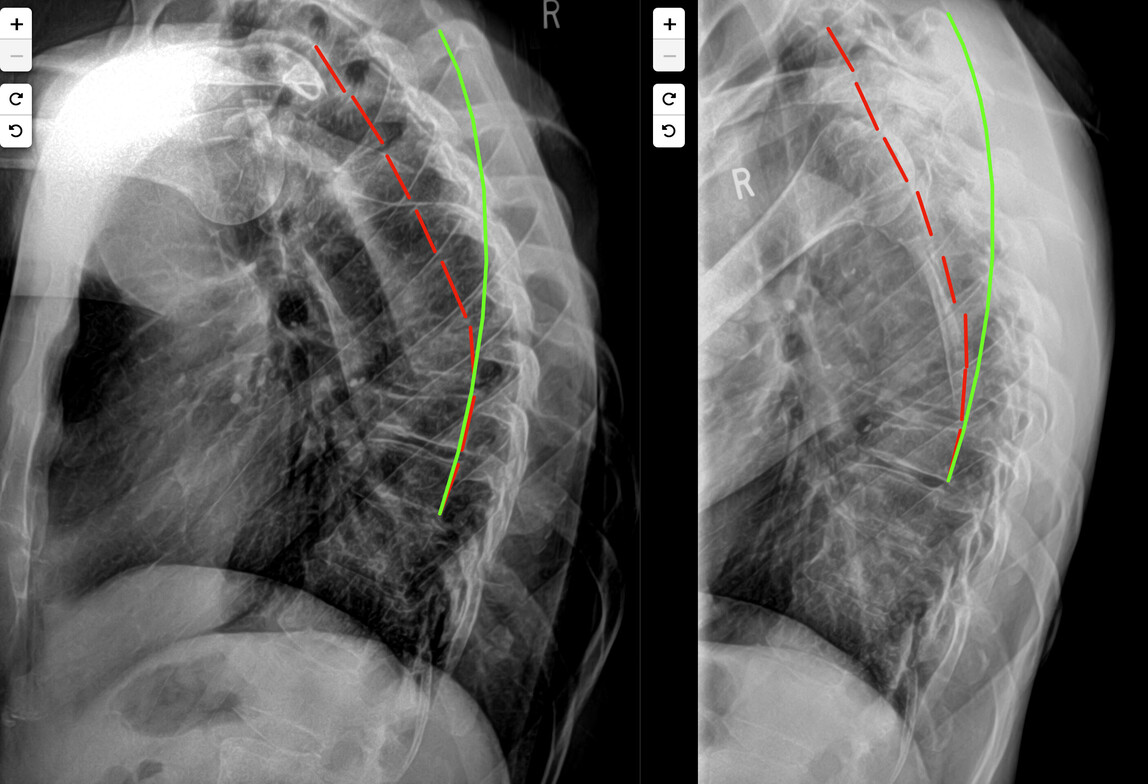
Wedged vertebrae is the specific structural finding that distinguishes Scheuermann's kyphosis from every other type. On a standing lateral thoracic radiograph, a normal thoracic vertebral body appears roughly rectangular — approximately equal anterior and posterior height. A wedged vertebra is shorter anteriorly than posteriorly. The anterior height reduction is typically expressed as a percentage of the posterior height: a vertebra with 80% anterior height relative to posterior height has 20% anterior wedging.
The Sorensen diagnostic criteria for Scheuermann's disease require anterior wedging of at least 5 degrees at three or more consecutive thoracic vertebral levels. In practice, wedging is often more extensive than the minimum criteria — involving five to eight consecutive levels in moderate to severe Scheuermann's presentations.
The clinical implications of wedged vertebrae are several. The deformity is structural — embedded in the bone — which means it does not fully correct with soft tissue treatment alone. The correction potential depends on remaining skeletal growth in adolescent patients. In skeletally mature patients the structural wedging is fixed, and treatment goals shift from correction toward stabilization, sagittal balance optimization, and pain management through the kinetic chain.
Quantitative measurement of anterior and posterior vertebral body heights is performed at Clear Life Scoliosis Charlotte NC using PostureRay software — with initial analysis using Peirson analysis — on standing lateral radiographs. That measurement is what establishes whether wedged vertebrae are present, at how many levels, and to what degree. Without that measurement, a Scheuermann's diagnosis is an impression rather than a clinical determination.
How the Evaluation at Clear Life Charlotte Differs From a Standard Assessment
The evaluation for thoracic hyperkyphosis at Clear Life Scoliosis and Chiropractic Center in Charlotte, NC includes several components that are not standard in general chiropractic or physical therapy assessment.
- Standing weight-bearing lateral thoracic radiograph — Thoracic Cobb angle measured from the upper endplate of the most tilted superior vertebra to the lower endplate of the most tilted inferior vertebra. Supine or seated imaging understates the Cobb angle by reducing gravitational loading on the curve. Standing imaging is the clinically relevant measurement.
- Vertebral body height measurement — Anterior and posterior heights of each thoracic vertebral body measured quantitatively to identify wedged vertebrae and apply Sorensen criteria for Scheuermann's disease. This is not performed in standard chiropractic assessment without specific radiographic training.
- Sagittal balance assessment — C7 plumb line relative to the sacral vertical axis. Sagittal imbalance — the head displaced anterior to the sacrum — has independent functional consequences and determines how aggressively sagittal correction should be pursued in the treatment plan.
- Cervical lordosis measurement — The thoracic kyphosis and cervical lordosis are coupled in the sagittal plane. Hyperkyphosis in the thoracic spine produces compensatory hyperlordosis or hypolordosis in the cervical spine depending on the sagittal balance strategy. Published research from Clear Life Scoliosis — PMID 41018459, Dick JM, Cureus 2025 — found cervical lordosis loss in 100% of structural spinal injury patients. The cervical spine is part of the kyphosis evaluation, not an afterthought.
- Risser stage determination — For adolescent patients, remaining growth potential is the most important variable in treatment planning. Risser 0 through 2 represents significant remaining growth and the strongest correction potential. Risser 4 through 5 represents near or complete skeletal maturity and a shift in treatment goals.
- Flexibility assessment — Passive hyperextension film or clinical assessment of curve flexibility distinguishes postural from structural hyperkyphosis and informs brace design candidacy.
The Treatment Approach at Clear Life — What Each Tool Does
CBP-Trained Structural Traction for Thoracic Extension
Mirror image traction applied in the thoracic extension direction addresses the disc and soft tissue component of hyperkyphosis — particularly in postural and early Scheuermann's presentations. The traction parameters are specific to the curve magnitude and location. For Scheuermann's disease with wedged vertebrae, the anterior column decompression produced by extension traction creates the mechanical environment in which anterior vertebral body growth can be stimulated in skeletally immature patients. This is the specific clinical rationale — not generic postural improvement but Hueter-Volkmann-informed load modification during the growth window.
Scoliosis-Specific Extension Exercise
Thoracic hyperkyphosis produces specific paraspinal muscle adaptations — the thoracic extensors lengthen and weaken under chronic flexion loading, while the anterior thoracic structures shorten. Exercise targeting thoracic extensor strength and activation, combined with anterior thoracic mobility work, addresses the neuromuscular component of the deformity. For Scheuermann's presentations, extension exercises are prescribed specifically to avoid compounding the flexion forces that drive anterior wedging.
Custom Bracing Where Indicated
For adolescents with Scheuermann's disease who meet bracing candidacy criteria — Risser 0 through 2, thoracic Cobb angle between 45 and 70 degrees, adequate curve flexibility — a custom corrective brace applying extension force at the apex of the kyphotic curve provides the continuous corrective loading during waking hours that rehabilitation exercises cannot. Brace design for Scheuermann's is curve-specific — not the same design used for scoliosis bracing. Candidacy is assessed individually at Clear Life Scoliosis Charlotte NC after radiographic evaluation. No referral required.
PEMF Therapy as Clinical Adjunct
In adult and geriatric hyperkyphosis presentations — particularly dowager's hump with osteoporotic component and degenerative hyperkyphosis with active facet inflammation — pulsed electromagnetic field therapy addresses the cellular bone metabolism and anti-inflammatory mechanisms that structural rehabilitation alone cannot reach. FDA clearance for non-union fracture healing and cervical spine fusion augmentation is directly relevant to the osteoporotic hyperkyphosis population. Published evidence at Clear Life Scoliosis — PMID 41694169 — documents PEMF as a component of a multimodal protocol producing measurable clinical outcomes in a complex geriatric spinal patient.
Kyphosis by Age Group — What Treatment Goals Look Like
| Patient Group | Typical Presentation | Primary Treatment Goal | Correction Potential |
|---|---|---|---|
| Children 8-12 — Risser 0-1 | Early postural or early Scheuermann's — vertebral wedging mild to moderate | Prevent progression during rapid growth; influence vertebral body development | Highest — growth plates open, Hueter-Volkmann mechanism active |
| Adolescents 12-18 — Risser 1-3 | Established Scheuermann's with wedged vertebrae at multiple levels; or progressive postural hyperkyphosis | Cobb angle reduction, vertebral height improvement, prevent surgical threshold | Significant — active growth window; bracing candidacy strongest here |
| Young adults 18-35 — Risser 4-5 | Fixed Scheuermann's deformity; established postural hyperkyphosis with disc adaptation | Sagittal balance optimization, pain reduction, prevent further progression | Moderate — structural wedging fixed, soft tissue component still modifiable |
| Middle-aged adults 35-60 | Degenerative hyperkyphosis; Scheuermann's adults with new degenerative overlay | Kinetic chain rehabilitation, pain management, sagittal balance | Modest structural — significant functional improvement typically achievable |
| Older adults and seniors | Dowager's hump; osteoporotic kyphosis; severe degenerative hyperkyphosis | Stabilization, mobility, pain reduction, prevent fracture progression | Structural correction not primary goal — quality of life and safety are |
The Published Research Foundation at Clear Life Charlotte
View the full research profile at Clear Life Scoliosis.
How Clear Life Charlotte Compares for Kyphosis Treatment
| Capability | Standard Charlotte Provider | Clear Life Scoliosis — Dr. Justin Dick |
|---|---|---|
| Radiographic vertebral body height measurement | Not typically performed — kyphosis graded visually or by Cobb angle only | Quantitative anterior and posterior vertebral body height measurement — Scheuermann's Sorensen criteria applied |
| Dual imaging credentials | Standard DC radiographic training | CNMT and ARRT(N)(CT) — the only chiropractor in Charlotte with this combination |
| Published research on structural spinal deformity outcomes | Not available from Charlotte kyphosis providers | Multiple PubMed-indexed case reports including sagittal alignment outcomes in geriatric structural spinal deformity — PMID 41018459, DOI 10.7759/cureus.105827 |
| Scheuermann's disease specific evaluation | Diagnosis applied clinically without formal Sorensen criteria radiographic measurement | Sorensen criteria applied with quantitative vertebral body measurement — distinguishes Scheuermann's from postural hyperkyphosis before treatment begins |
| Cervical lordosis evaluation in kyphosis patients | Not standard | Standard — cervical and thoracic sagittal planes are evaluated together; published research shows cervical dysfunction in 100% of structural spinal injury patients |
| CLEAR Fellowship | Not held by Charlotte kyphosis providers | CLEAR Scoliosis Institute Fellow and Board of Directors — highest credential level in the non-surgical structural spinal deformity field |
| PEMF and ESWT for adult kyphosis | Not available with published research foundation | Published case report evidence — PMID 41694169 — documenting both modalities in multimodal structural spinal rehabilitation |
Frequently Asked Questions — Kyphosis Treatment Charlotte NC
What is the difference between kyphosis and hyperkyphosis?
Kyphosis refers to the normal forward curve of the thoracic spine — present in everyone and structurally necessary for sagittal balance. Hyperkyphosis means the thoracic curve is excessive — typically defined as a Cobb angle above 40 to 45 degrees in growing patients or above 50 degrees in adults on a standing lateral radiograph. The distinction matters clinically because normal kyphosis requires no treatment. Dr. Justin M. Dick, DC at Clear Life Scoliosis and Chiropractic Center — 8814 Rachel Freeman Way Suite 103, Charlotte NC 28278 — measures the thoracic Cobb angle on standing lateral radiograph at every hyperkyphosis evaluation. No referral required. Call 980-368-0766.
What is Scheuermann's disease and how is it diagnosed in Charlotte?
Scheuermann's disease is a structural kyphosis caused by anterior wedging of three or more consecutive thoracic vertebrae by at least 5 degrees each — the Sorensen diagnostic criteria. The vertebral bodies are shorter anteriorly than posteriorly, producing a trapezoidal shape on lateral radiograph rather than the normal rectangular profile. It is a growth disorder of the vertebral endplate that develops during adolescence and produces a fixed kyphotic deformity that does not fully reduce on passive extension. Diagnosis requires standing lateral thoracic radiograph with quantitative measurement of vertebral body heights at each level. Dr. Justin M. Dick, DC at Clear Life Scoliosis Charlotte NC applies the Sorensen criteria with PostureRay software measurement. Call 980-368-0766.
What is a dowager's hump and can it be treated without surgery in Charlotte?
Dowager's hump is the pronounced upper thoracic and cervicothoracic kyphotic deformity that develops primarily in postmenopausal women as a consequence of osteoporotic vertebral compression fractures. Each compression fracture produces anterior height loss that progressively accentuates the forward curve. Non-surgical treatment at Clear Life Scoliosis Charlotte NC targets the unfractured segments — improving thoracic extension capacity, strengthening posterior chain musculature, and using PEMF as a clinical adjunct for bone metabolism support. Goals are stabilization and pain reduction rather than full structural correction, which is not a realistic expectation in established osteoporotic hyperkyphosis. Standing radiographic evaluation to rule out acute fracture is the first step. Dr. Justin Dick at Clear Life Scoliosis — 8814 Rachel Freeman Way Suite 103, Charlotte NC 28278. Call 980-368-0766.
What are wedged vertebrae and what do they mean for treatment?
Wedged vertebrae are thoracic vertebral bodies that are shorter anteriorly than posteriorly on a standing lateral radiograph — a trapezoidal rather than rectangular shape. They are the defining structural feature of Scheuermann's disease. Three or more consecutive wedged vertebrae with at least 5 degrees of wedging at each level satisfies the Sorensen diagnostic criteria. Wedged vertebrae mean the kyphotic curve has a fixed structural bone component — not just a disc and soft tissue adaptation. In skeletally immature patients, treatment during the growth window can partially influence anterior vertebral body height through the Hueter-Volkmann mechanism. In skeletally mature patients the wedging is fixed and treatment goals adjust accordingly. Dr. Justin Dick at Clear Life Scoliosis Charlotte NC measures vertebral body heights quantitatively at every evaluation. Call 980-368-0766.
Can thoracic hyperkyphosis be improved without surgery in adults?
Yes — meaningful improvement in pain, posture, sagittal balance, and function is achievable in adult hyperkyphosis patients through non-surgical structural rehabilitation, though the magnitude of structural Cobb angle reduction is smaller than what is achievable in skeletally immature patients. The goals shift in adults toward sagittal balance optimization, kinetic chain rehabilitation, and pain management. Published research from Clear Life Scoliosis — Whelan JP, Dick JM, Cureus 2026, DOI 10.7759/cureus.105827 — documents clinically meaningful improvements in sagittal alignment and pain in geriatric structural spinal deformity patients through non-surgical multimodal rehabilitation. Evidence is at case series level. Dr. Justin M. Dick, DC at Clear Life Scoliosis and Chiropractic Center, 8814 Rachel Freeman Way Suite 103, Charlotte NC 28278. No referral required. Call 980-368-0766.
Is kyphosis treatment at Clear Life appropriate for children and adolescents in Charlotte?
Yes. The growth window — Risser 0 through 2 — is the most mechanically favorable period for influencing the structural trajectory of hyperkyphosis, particularly Scheuermann's disease with wedged vertebrae. In skeletally immature patients, the Hueter-Volkmann principle applies — reducing compressive load on the anterior vertebral body during growth allows anterior vertebral height to partially normalize. Dr. Justin M. Dick, DC at Clear Life Scoliosis Charlotte NC evaluates Risser stage at every adolescent assessment and builds the treatment plan around the remaining growth window. CLEAR Fellow, CLEAR Board of Directors. Call 980-368-0766.
How does kyphosis relate to scoliosis and does Clear Life treat both in Charlotte?
Kyphosis and scoliosis can occur independently or together — a combination called kyphoscoliosis. The evaluation at Clear Life Scoliosis Charlotte NC assesses both coronal plane curvature (scoliosis Cobb angle) and sagittal plane curvature (thoracic kyphosis) on every standing radiographic assessment. Dr. Justin M. Dick, DC is a CLEAR Scoliosis Institute Fellow and Board of Directors member with multiple PubMed-indexed publications on structural spinal deformity outcomes. Clear Life is the only Charlotte scoliosis specialty practice with this combination of credentials and published research. 8814 Rachel Freeman Way Suite 103, Charlotte NC 28278. No referral required. Call 980-368-0766.
Service Area — Kyphosis Treatment Charlotte NC
Clear Life Scoliosis and Chiropractic Center provides non-surgical evaluation and treatment for thoracic hyperkyphosis, Scheuermann's disease, dowager's hump, wedged vertebrae, and postural kyphosis for patients from Charlotte, Huntersville, Ballantyne, Matthews, Concord, Mooresville, Rock Hill SC, and Fort Mill SC. No referral required.
Get a Radiographic Kyphosis Evaluation in Charlotte — Not a Posture Screen
Dr. Justin M. Dick, DC — CLEAR Fellow · CLEAR Board of Directors · CNMT · ARRT(N)(CT) · CBP Trained · ISICO World Masters · SOSORT Provisional Member · Multiple PubMed-indexed publications on structural spinal deformity outcomes. Standing lateral radiographic evaluation with quantitative vertebral body height measurement and Sorensen criteria assessment. The only Charlotte kyphosis with this credential combination and published research foundation. No referral required. Cash-based practice.
Charlotte, NC 28278
980-368-0766 | office@clearlifescoliosis.com
Book Online at JaneApp

Justin Dick
Contact Me