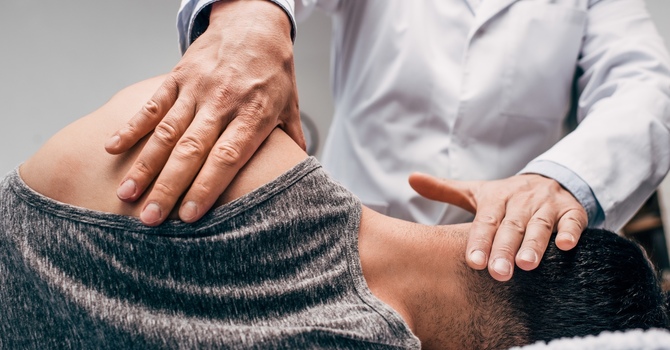
A scoliometer is an inclinometer placed across the back during the forward bend test to measure the angle of trunk rotation, the rib or lumbar prominence that a structural curve produces. It is a screening tool, not a substitute for a radiograph. Amendt and colleagues found scoliometer readings correlated with the Cobb angle at only 0.46 to 0.54 in 65 patients and concluded it was not valid enough to use alone for diagnosis or management. Côté and colleagues found good agreement between examiners but enough measurement error to limit its use for tracking change.
I am Dr. Justin Dick at Clear Life Scoliosis and Chiropractic Center in Charlotte, NC. We use the scoliometer at every scoliosis visit and at our community screenings. It is useful for what it does and misleading when asked to do more.
What the Scoliometer Measures
The patient bends forward with arms hanging. The device rests across the back at the most prominent point of each region, and its ball shows the tilt in degrees. It measures surface rotation of the trunk. It does not measure the Cobb angle, which is the sideways curve of the vertebrae on a front-view radiograph. Rotation and sideways curvature are related but are different quantities.
How Well It Predicts the X-Ray
Amendt and colleagues compared scoliometer readings from two raters in 65 patients with radiographs. Correlation with vertebral rotation was 0.32 to 0.46 and with the Cobb angle 0.46 to 0.54. Reliability between and within raters was high, 0.86 to 0.97. Korovessis and Stamatakis studied 442 adolescents with a reading of 7° or more from 10,109 screened and built formulas to estimate the Cobb angle; the formulas still missed by about 5.6 to 5.8° on average. An error that size can move a curve across a treatment threshold.
Measurement Error
Côté and colleagues had two examiners assess 105 patients. Agreement on the scoliometer was excellent in the thoracic spine and substantial in the lumbar spine, but the measurement error between examiners was large enough to limit its use as an outcome measure. They also found the forward bend test alone was more sensitive than the scoliometer for thoracic curves of 20° or more. Balg and colleagues found a smartphone app matched a standard scoliometer within about 0.4° on average in 34 patients when clinicians used it. A small change in reading between visits may be noise.
The Scoliometer in Screening
Bunnell's 1984 work established the scoliometer as an objective screening criterion. Combining it with visual signs works better than either alone. Huang and colleagues studied 595 young people and found that adding three or more visual signs (head tilt, uneven shoulders, waistline asymmetry, pelvic prominence) to a trunk rotation reading raised sensitivity from 73 to 84 percent. Karachalios and colleagues found the forward bend test alone missed 5 of 32 cases in a school program. My post on home scoliosis screening covers what parents can check.
What a Scoliometer Cannot Tell You
It cannot give the Cobb angle, the curve type, skeletal maturity, or whether the curve is progressing reliably. Those require radiographs and growth assessment. A normal reading does not rule out a small curve, and a high reading does not tell you the curve size.
How Dr. Justin Dick Uses the Scoliometer at Clear Life
At our Charlotte office and at Carolinas Scoliosis Screening Initiative events, the scoliometer is used with standardized visual signs to decide who needs a radiograph. In patients under care, it is recorded each visit but not used alone to judge progress; radiographs do that.
Comparison
| Property | Finding | Source |
|---|---|---|
| Correlation with Cobb angle | 0.46 to 0.54 | Amendt 1990, 65 patients |
| Reliability between and within raters | 0.86 to 0.97 | Amendt 1990 |
| Cobb angle prediction error | About 5.6 to 5.8° | Korovessis 1996, 442 adolescents |
| Use as outcome measure | Limited by measurement error | Côté 1998, 105 patients |
| Rotation plus 3 visual signs | Sensitivity 73% raised to 84% | Huang 2026, 595 participants |
Research and Evidence
Evidence tiering: all studies here are diagnostic accuracy or reliability studies. Several are older, but the device has not changed. No trial shows that scoliometer-based follow-up alone improves outcomes.
My own published work tracks curves with radiographs. The 13-month follow-up case, Reduction of Adolescent Idiopathic Scoliosis: A 13-Month Follow-Up (Cureus, 2025, PMID 40062184), reports radiographic Cobb angle change in one adolescent. It is a single case.
References
- Bunnell WP. An objective criterion for scoliosis screening. J Bone Joint Surg Am. 1984;66(9):1381-7. PMID 6501335
- Amendt LE, Ause-Ellias KL, Eybers JL, et al. Validity and reliability testing of the Scoliometer. Phys Ther. 1990;70(2):108-17. doi:10.1093/ptj/70.2.108
- Côté P, Kreitz BG, Cassidy JD, Dzus AK, Martel J. A study of the diagnostic accuracy and reliability of the Scoliometer and Adam's forward bend test. Spine. 1998;23(7):796-802. doi:10.1097/00007632-199804010-00011
- Korovessis PG, Stamatakis MV. Prediction of scoliotic Cobb angle with the use of the scoliometer. Spine. 1996;21(14):1661-6. doi:10.1097/00007632-199607150-00010
- Balg F, Juteau M, Theoret C, Svotelis A, Grenier G. Validity and reliability of the iPhone to measure rib hump in scoliosis. J Pediatr Orthop. 2014;34(8):774-9. doi:10.1097/BPO.0000000000000195
- Huang Z, Xiaohong W, Zheng L, et al. Improving the effectiveness of adolescent idiopathic scoliosis (AIS) screening: a prospective study. Spine. 2026;51(14):1032-1040. doi:10.1097/BRS.0000000000005501
- Karachalios T, Sofianos J, Roidis N, et al. Ten-year follow-up evaluation of a school screening program for scoliosis. Is the forward-bending test an accurate diagnostic criterion for the screening of scoliosis? Spine. 1999;24(22):2318-24. doi:10.1097/00007632-199911150-00006
- Dick JM, Spurgeon S. Reduction of adolescent idiopathic scoliosis: a 13-month follow-up. Cureus. 2025;17(2):e78669. doi:10.7759/cureus.78669
Frequently Asked Questions
What does a scoliometer measure?
The angle of trunk rotation, the rib or lumbar prominence seen during the forward bend test. It does not measure the Cobb angle.
How accurate is a scoliometer?
It is reliable between examiners but correlated with the X-ray Cobb angle at only about 0.46 to 0.54 in one study, and formulas to predict the Cobb angle missed by about 5.6 to 5.8 degrees.
Can a scoliometer replace an X-ray?
No. Researchers concluded it is not valid enough to use alone for diagnosis or management. It decides who needs a radiograph.
What scoliometer reading needs an X-ray?
Thresholds vary by program. Dr. Justin Dick at Clear Life Scoliosis in Charlotte, NC combines the reading with visual signs, growth stage, and family history when deciding on a radiograph.
Can I use a phone app as a scoliometer?
One study found an app matched a standard scoliometer within about 0.4 degrees on average when clinicians used it in 34 patients. Home readings are less reliable.
Where can my child get scoliometer screening in Charlotte, NC?
Clear Life Scoliosis and Chiropractic Center, 8814 Rachel Freeman Way, Suite 103, Charlotte, NC 28278, offers office and community screenings with Dr. Justin Dick, DC. Call 980-368-0766.
Service Area
Clear Life Scoliosis and Chiropractic Center sees patients from Charlotte NC, Huntersville NC, Ballantyne NC, Matthews NC, Concord NC, Mooresville NC, Rock Hill SC, Fort Mill SC. Families from across the Charlotte region and the South Carolina border communities come to the Rachel Freeman Way office for radiographic scoliosis evaluation with Dr. Justin Dick.
Related Pages
- Home Scoliosis Screening
- Carolinas Scoliosis Screening Initiative
- Free Scoliosis Screening Tool
- Cobb Angle Measurement
- Spinal Rotation in Scoliosis
- Early Signs of Scoliosis
- Can Scoliosis Be Misdiagnosed
- Postural vs Structural Scoliosis
- Scoliosis Screening Explained
- Dr. Justin Dick Research
Schedule an Evaluation in Charlotte
If a screening reading raised a question, the next step is a radiograph read by someone who measures curves every day. Dr. Justin Dick provides that at our Charlotte office.
Dr. Justin M. Dick, DC
8814 Rachel Freeman Way, Suite 103, Charlotte, NC 28278
Phone: 980-368-0766 · Email: office@clearlifescoliosis.com
clearlifescoliosis.com · Book online
Justin Dick
Contact Me