Scoliosis Surgery Success: Outcomes, Risks, and Realistic Expectations
Scoliosis surgery is often presented as a definitive solution for severe spinal curvature. However, understanding what “success” truly means requires clarity, objectivity, and realistic expectations.
Surgery can significantly reduce curvature magnitude and stabilize progression in appropriate cases. It does not “cure” scoliosis in a biological sense, and it permanently alters spinal biomechanics.
This article explains what scoliosis surgery can accomplish, what it cannot, and how success is measured.
What Is Scoliosis Surgery?
The most common surgical procedure for scoliosis is posterior spinal fusion with instrumentation.
This typically involves:
-
Placement of metal rods and pedicle screws
-
Correction of spinal alignment
-
Fusion of multiple vertebrae into a single solid segment
The goal is to:
-
Reduce curvature magnitude
-
Halt progression
-
Improve trunk balance
Spinal fusion permanently reduces motion in the fused segments.
When Is Scoliosis Surgery Recommended?
Surgical consultation is generally considered when:
-
Curves reach approximately 45–50 degrees in adolescents
-
There is documented progression despite conservative care
-
Curves exceed 50–55 degrees at skeletal maturity
-
Severe deformity affects pulmonary or functional capacity
Thresholds may vary based on curve pattern, rotation severity, and individual patient factors.
Families seeking a second opinion before committing to surgery can request a formal evaluation at Clear Life Scoliosis in Charlotte, NC. Dr. Justin Dick reviews radiographic findings, Cobb angle measurements, and curve classification to help families understand their full range of options before a surgical decision is made.
What Does “Surgical Success” Mean?
Success in scoliosis surgery is typically defined by:
1. Curve Reduction
Most modern surgical techniques achieve significant Cobb angle reduction — often 50–70% improvement depending on curve flexibility and pattern.
2. Progression Stabilization
Fusion prevents further progression in the fused segments.
3. Cosmetic Improvement
Shoulder asymmetry, rib prominence, and trunk imbalance are often improved.
4. Long-Term Structural Stability
The fused portion of the spine remains fixed.
However, success does not mean the spine is restored to a completely natural state.
What Surgery Does Not Do
Clear expectation-setting is critical.
Scoliosis surgery does not:
-
Restore full spinal mobility
-
Eliminate the diagnosis biologically
-
Prevent degeneration at non-fused segments
-
Guarantee absence of long-term discomfort
-
Reverse muscle imbalances automatically
Adjacent segment degeneration can occur over time due to altered biomechanics above and below the fused region.
Risks and Complications
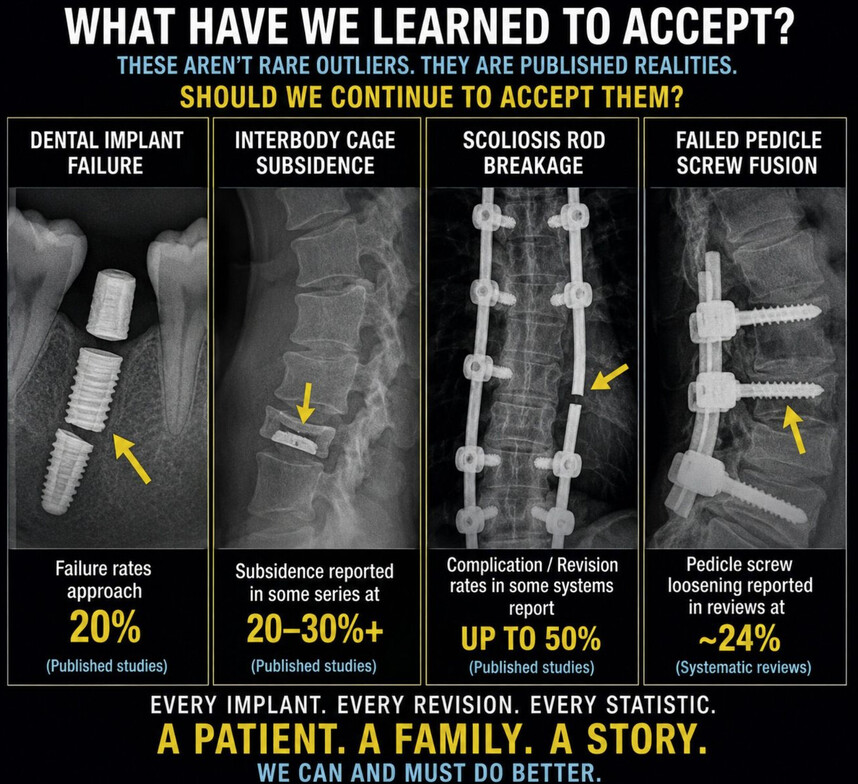
As with any major surgery, spinal fusion carries risks, including:
-
Infection
-
Hardware failure
-
Non-union (failure of fusion)
-
Neurological injury (rare but serious)
-
Chronic postoperative pain
-
Need for revision surgery
Modern surgical techniques have improved safety profiles, but no major spinal surgery is without risk.
Long-Term Outcomes
Research shows that many patients report improved quality of life following surgery, particularly when pre-surgical deformity was severe.
However, long-term considerations include:
-
Permanent reduction in spinal flexibility
-
Increased mechanical stress at adjacent segments
-
Potential need for future procedures
-
Ongoing physical conditioning requirements
Surgical correction is structural stabilization — not biological restoration.
Non-Surgical Alternatives Before Surgery
Before reaching surgical thresholds, conservative approaches may include:
-
Scoliosis-specific exercise programs
-
Corrective bracing (in growing adolescents)
-
Postural rehabilitation
-
Core stabilization strategies
-
Structured monitoring
Early intervention may reduce the likelihood of surgical necessity in select cases.
- Scoliosis-specific exercise programs including the CLEAR Institute protocol
- Corrective bracing — ScoliBrace and SpineCor — in skeletally immature patients
- Postural rehabilitation and spinal corrective care
- Core stabilization and scoliosis exercise
- Structured monitoring with Cobb angle radiographic assessment
Comparing Surgical and Non-Surgical Goals
| Factor | Non-Surgical Care | Surgery |
|---|---|---|
| Curve Reduction | Possible in select cases | Significant immediate reduction |
| Progression Control | Depends on compliance and growth phase | Fusion halts progression at fused levels |
| Spinal Mobility | Preserved | Permanently reduced in fused segments |
| Risk Level | Low | Major surgical risk |
| Recovery Time | Gradual | Months to full recovery |
Each approach has distinct benefits and trade-offs.
Is Scoliosis Surgery a Cure?
No.
Surgery corrects alignment and stabilizes progression through fusion. It does not reverse the underlying condition or restore natural spinal anatomy and function.
Scoliosis remains a lifelong structural diagnosis.
Who Is a Good Surgical Candidate?
Patients most likely to benefit from surgery typically have:
-
Large, progressive curves
-
Documented failure of conservative management
-
Structural imbalance impacting function
-
Significant cosmetic or psychological distress
Decision-making should involve:
-
Orthopedic or spinal surgical consultation
-
Thorough radiographic evaluation
-
Risk-benefit analysis
-
Consideration of long-term biomechanical consequences
- Patients who have not yet reached surgical thresholds, or who want to understand whether non-surgical care could reduce their curve prior to surgery, may benefit from evaluation at Clear Life Scoliosis and Chiropractic Center in Charlotte, NC. Dr. Justin Dick holds CLEAR Institute Fellowship and dual imaging credentials, and has published peer-reviewed research on non-surgical outcomes for adolescent idiopathic scoliosis.
Managing Expectations About Surgical Outcomes
Realistic expectations include understanding that:
-
Recovery requires months
-
Activity restrictions are temporary but mobility loss is permanent in fused segments
-
Physical conditioning remains essential
-
Long-term monitoring continues
Surgical success is measured by stability and improved alignment — not complete normalization.
FAQ's - Frequently Asked Questions
What is the success rate of scoliosis surgery?
Most modern spinal fusion procedures achieve substantial curve reduction and progression control. Reported patient satisfaction rates are generally high, though outcomes vary by case complexity.
Does scoliosis come back after surgery?
The fused segments do not progress. However, unfused portions of the spine may experience degenerative changes over time.
Is scoliosis surgery dangerous?
It is major spinal surgery and carries inherent risks. Serious complications are uncommon but possible.
Can scoliosis be treated without surgery?
Yes. Many mild to moderate curves are managed non-surgically with monitoring, exercise-based care, or bracing during growth.
At Clear Life Scoliosis in Charlotte, NC, Dr. Justin Dick uses the CLEAR Institute protocol — a structured non-surgical approach with published radiographic outcomes — for patients who want to explore every option before committing to surgery.
Final Perspective
Scoliosis surgery can be life-changing for patients with severe, progressive deformity. It is a powerful structural intervention with permanent biomechanical consequences.
Success should be defined clearly:
-
Curve reduction
-
Progression control
-
Structural stabilization
-
Improved alignment
It should not be defined as a cure.
Informed decisions require objective measurement, transparent communication, and individualized planning
Clear Life Scoliosis and Chiropractic Center focus in finding and fixing the real cause of your discomfort. From advanced scoliosis treatment to personal injury recovery, we help Charlotte area residents reclaim their active lives. Call today and start your path to better movement, comfort, and control.
Related Resources at Clear Life Scoliosis
About Scoliosis — Cobb Angle, Classification, and What the Diagnosis Means
Treatment Options — Non-Surgical Scoliosis Care in Charlotte
Bracing for Scoliosis — ScoliBrace and SpineCor
The CLEAR Scoliosis Protocol — What Happens at Clear Life
Scoliosis Second Opinion Charlotte NC
Research and Evidence — Published Outcomes
Dr. Justin Dick Research Portfolio — PubMed Indexed
Questions and Answers About Scoliosis Care
Book Your Scoliosis Evaluation — Charlotte NC
Swimming and Scoliosis What the Research Shows
Wondering what's actually safe to do with a scoliosis diagnosis? Dr. Justin Dick, DC breaks down the real answer to activity guidance, movement, and curve progression risk in Scoliosis Do's and Don'ts: A Clinical Guide to Activity, Movement, and Progression Risk.
Justin Dick
Contact Me