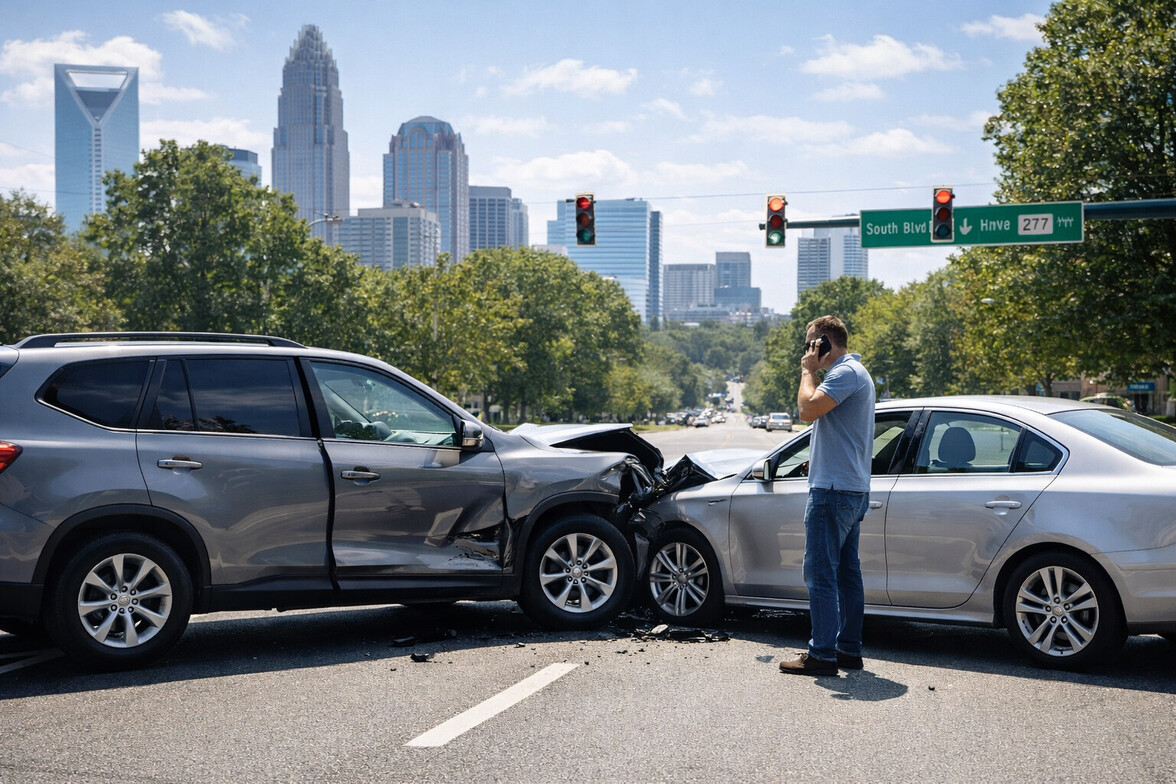
Car accidents generate enough uncertainty on their own. Insurance complications make the situation even more confusing. In North Carolina and Georgia, drivers are required to carry liability coverage, yet a significant number of motorists still operate vehicles without it. This reality often triggers a predictable concern. If a driver does not have insurance, does that automatically make them responsible for a crash?
The legal answer is no. Fault and insurance are fundamentally different concepts. Fault is a determination based on negligence, meaning which party’s actions caused the collision. Insurance is simply a financial mechanism that affects how losses are paid after liability is decided. A lack of coverage does not establish blame. Evidence does.
When accidents are analyzed, responsibility is reconstructed through objective information. Police reports document scene observations and preliminary conclusions. Photographs and video recordings preserve vehicle positions and roadway conditions that may later prove critical. Witness statements provide independent accounts of events. In technically complex collisions, accident reconstruction specialists apply engineering and physics principles to evaluate speed, force, and movement. Medical documentation then connects injuries to the mechanics of the incident. None of these processes rely on insurance status. They focus entirely on causation.
Insurance enters the picture only after fault is established. If an uninsured driver is found liable, the consequences can be severe. Driving without coverage is illegal in both North Carolina and Georgia, exposing the motorist to criminal penalties. Civil liability presents an even greater risk. Without an insurer to absorb damages, the at fault driver may be personally responsible for medical costs, lost income, and other injury related losses. Courts can enforce judgments through wage garnishment or claims against personal assets. Financial exposure becomes immediate and personal.
For injured parties, recovery options also shift when the responsible driver lacks coverage. Claims typically proceed through uninsured motorist provisions rather than a third party liability policy. North Carolina mandates uninsured motorist coverage within standard auto policies. Georgia does not, although many attorneys strongly recommend it as essential protection. Even when filing through one’s own insurer, disputes frequently arise. Insurance carriers evaluate claims through financial risk models. Questions surrounding causation, necessity of treatment, and injury severity are common. Skilled legal representation often becomes crucial during negotiations.
Another widespread misunderstanding involves uninsured drivers who are not at fault. Many assume that driving without insurance eliminates their ability to recover damages. That belief is incorrect in both North Carolina and Georgia. Neither state applies so called no pay no play restrictions that bar uninsured motorists from pursuing compensation when another driver’s negligence caused the collision. Liability rules remain intact. A non negligent driver may still pursue damages for medical expenses, lost earnings, pain, functional limitations, and property damage.
The distinction is subtle but critical. Insurance compliance affects financial pathways. It does not dictate responsibility. Fault arises from behavior and evidence, not coverage status.
For readers interested in a deeper legal analysis of uninsured driver scenarios, attorney Ted Greves provides detailed discussions through his legal resource platform, MyDrTed. His explanations clarify how liability determinations and insurance mechanisms interact under North Carolina and Georgia law. Additional insights can be found at MyDrTed – Ted Greves, Attorney at Law, available at Personal Injury Lawyer In Charlotte - Dr. Ted Injury Law, which offers practical breakdowns of accident liability, insurance disputes, and injury claims.
Understanding these principles helps remove a layer of confusion that often follows motor vehicle collisions. Car accidents are governed by physics, human injury by biology, and legal responsibility by evidence. Insurance simply determines how the financial consequences are managed once those elements are sorted.
Is an Uninsured Driver Automatically at Fault? - Dr. Ted Injury Law
Clear Life Scoliosis and Chiropractic Center, Research focus in finding and fixing the real cause of your discomfort. From advanced scoliosis treatment to personal injury recovery, we help Charlotte area residents reclaim their active lives. Call today and start your path to better movement, comfort, and control.
Justin Dick
Contact Me