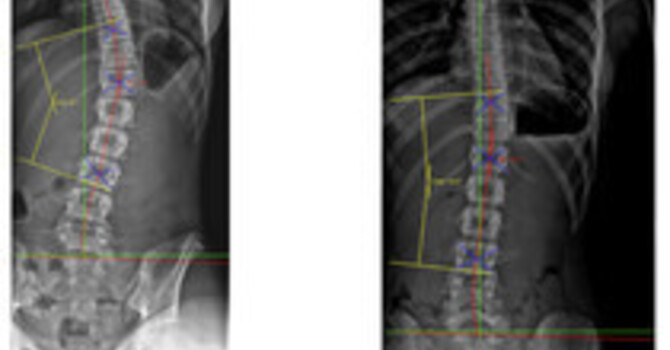
Many teenagers with scoliosis feel nothing at all, and many others have back pain that is real but rarely severe. In 2,442 children with idiopathic scoliosis at Texas Scottish Rite Hospital, Ramirez and colleagues found back pain in 23 percent at the first visit and in another 9 percent during follow-up. Pain was linked to age over 15, skeletal maturity, having started periods, and a history of injury. It was not linked to the size or type of curve. In adults the picture changes: Glassman and colleagues found that pain and function scores worsened steadily as the trunk shifted forward over the pelvis.
I am Dr. Justin Dick, DC, at Clear Life Scoliosis and Chiropractic Center in Charlotte, NC. "Does it hurt?" is one of the first questions parents ask me, and the honest answer depends on age, curve pattern, and what else is on the films.
What Teenagers Usually Describe
Most adolescents I examine describe fatigue or aching in the back after long periods of sitting or standing, uneven shoulders that pull on a backpack strap, or a rib or waist that looks different in the mirror. Many describe no symptoms; the curve is found at a sports physical or by a parent. That pattern matches what the literature reports. Théroux and colleagues' systematic review found low back pain in 34.7 to 42.0 percent of adolescents with idiopathic scoliosis, from only two eligible studies, both at high risk of bias. An, Berman, and Schulz reviewed 93 articles and concluded that back pain in this group is common but difficult to predict and treat, with contradictory findings across studies.
When Pain Means Something Else
In Ramirez's series, 48 of the 560 children with back pain at presentation (9 percent) had another diagnosis: 29 had spondylolysis or spondylolisthesis, 9 had Scheuermann kyphosis, 5 had a syrinx, and the rest had a herniated disc, hydromyelia, a tethered cord, or an intraspinal tumor. A painful left thoracic curve or an abnormal neurological finding was the strongest predictor, though only 8 of 33 children with those features had an underlying condition. Night pain that wakes a child, pain with fever or weight loss, leg weakness, numbness, or bladder change call for prompt evaluation. My post on spine emergencies lists them.
What Adults Describe
Adults more often report low back pain, leg pain from nerve compression on the inside of the lumbar curve, and fatigue with standing. Glassman analyzed 752 adults with spinal deformity and found every health measure worsened as the C7 plumb line moved forward of the sacrum; lumbar kyphosis was especially poorly tolerated. That makes sagittal balance, the front-to-back alignment, a larger driver of adult pain than the side-to-side Cobb angle alone. My post on adult scoliosis treatment covers this.
Rib and Chest Sensations
Patients with thoracic curves sometimes describe rib or chest wall discomfort on the side of the rib hump. My post on rib prominence explains how that rotation is measured, and chest pain with shortness of breath, exertion, or radiation to the arm needs medical evaluation first.
How Pain Affects Daily Life
Sykorova and colleagues interviewed 17 Norwegian adolescents and caregivers. Participants described back pain affecting school attendance and activities, and a sense of isolation. That is qualitative evidence from a small sample, and it matches what families tell me in Charlotte.
How Dr. Justin Dick, DC Evaluates Scoliosis Pain at Clear Life
At our Charlotte office, pain history is taken separately from curve history, the neurological exam is documented, and standing full-spine films are reviewed for the conditions Ramirez found, including spondylolysis and Scheuermann changes. Atypical features lead to MRI referral. When the evaluation is otherwise normal, care addresses mechanics, endurance, and loading. Ramirez's group concluded that extensive testing is not required for every child with scoliosis and back pain once the history, exam, and radiographs are normal.
Comparison
| Group | Finding | Source |
|---|---|---|
| Children with idiopathic scoliosis | 23% back pain at presentation, 9% more during follow-up | Ramirez 1997, 2,442 patients |
| Children with pain and another diagnosis | 9% (48 of 560) | Ramirez 1997 |
| Adolescent low back pain prevalence | 34.7% to 42.0% (2 studies, high bias) | Théroux 2017 |
| Adults with spinal deformity | Health measures worsen as trunk shifts forward | Glassman 2005, 752 patients |
Research and Evidence
Evidence tiering: Ramirez is a large retrospective cohort; Théroux a systematic review with only two eligible studies; An a narrative review; Glassman a retrospective analysis of a prospective database; Sykorova a qualitative study. The descriptions of what my patients report are clinical observation, not data.
My own published work addresses alignment and symptoms in older adults. The geriatric sagittal alignment case series, Radiographic Sagittal Alignment and Kinetic Chain Alterations in Geriatric Patients With Scoliosis: A Case Series(Cureus, 2026, PMID 42037873), describes two patients and is case-level evidence.
References
- Ramirez N, Johnston CE, Browne RH. The prevalence of back pain in children who have idiopathic scoliosis. J Bone Joint Surg Am. 1997;79(3):364-8. doi:10.2106/00004623-199703000-00007
- Théroux J, Stomski N, Hodgetts CJ, et al. Prevalence of low back pain in adolescents with idiopathic scoliosis: a systematic review. Chiropr Man Therap. 2017;25:10. doi:10.1186/s12998-017-0143-1
- An JK, Berman D, Schulz J. Back pain in adolescent idiopathic scoliosis: a comprehensive review. J Child Orthop. 2023;17(2):126-140. doi:10.1177/18632521221149058
- Glassman SD, Bridwell K, Dimar JR, et al. The impact of positive sagittal balance in adult spinal deformity. Spine. 2005;30(18):2024-9. doi:10.1097/01.brs.0000179086.30449.96
- Sykorova K, Pavel N, Mathew A, et al. Understanding the needs and frustrations in adolescent idiopathic scoliosis: a qualitative interview study. BMC Musculoskelet Disord. 2026;27(1). doi:10.1186/s12891-026-10210-7
- Whelan JP, Dick JM. Radiographic sagittal alignment and kinetic chain alterations in geriatric patients with scoliosis: a case series. Cureus. 2026;18(3):e105827. doi:10.7759/cureus.105827
Frequently Asked Questions
Does scoliosis hurt?
Often not much. In 2,442 children with idiopathic scoliosis, 23 percent had back pain at the first visit, and pain was not linked to curve size.
What does scoliosis feel like?
Many teens feel nothing. Others describe aching or fatigue in the back after sitting or standing, or uneven shoulders and waist. Adults more often describe low back pain, leg pain, and fatigue with standing.
Is back pain with scoliosis a warning sign?
Usually not, but about 9 percent of children with scoliosis and back pain had another diagnosis, such as spondylolysis. Night pain, abnormal neurological findings, or a painful left thoracic curve deserve a closer look.
Why does adult scoliosis hurt more?
In 752 adults with spinal deformity, pain and function scores worsened as the trunk shifted forward over the pelvis. Front-to-back balance matters more than the side-to-side curve alone.
Does a bigger curve mean more pain?
Not in adolescents. Ramirez and colleagues found no association between back pain and curve magnitude or type.
Where can I get scoliosis pain evaluated in Charlotte, NC?
Clear Life Scoliosis and Chiropractic Center, 8814 Rachel Freeman Way, Suite 103, Charlotte, NC 28278, provides radiographic scoliosis evaluation with Dr. Justin Dick, DC, CNMT, ARRT(N)(CT). Call 980-368-0766.
Service Area
Clear Life Scoliosis and Chiropractic Center sees patients from Charlotte NC, Huntersville NC, Ballantyne NC, Matthews NC, Concord NC, Mooresville NC, Rock Hill SC, Fort Mill SC. Families from across the Charlotte region and the South Carolina border communities come to the Rachel Freeman Way office for radiographic scoliosis evaluation with Dr. Justin Dick, DC.
Related Pages
- Scoliosis Treatment for Adults
- Rib Prominence and Scoliosis
- Spine Emergencies
- Early Signs of Scoliosis
- How to Sleep With Scoliosis
- Adult Scoliosis and Curve Severity
- For Parents of Teens With Scoliosis
- Scoliosis Imaging and Measurement
- Scoliosis Care Program
- Dr. Justin Dick, DC Research
Schedule an Evaluation in Charlotte
If scoliosis pain is changing what you or your child can do, the evaluation should look at the curve and at everything else on the films. Dr. Justin Dick, DC does both at our Charlotte office.
Dr. Justin Dick, DC · ORCID 0009-0001-2794-2159
8814 Rachel Freeman Way, Suite 103, Charlotte, NC 28278
Phone: 980-368-0766 · Email: office@clearlifescoliosis.com
clearlifescoliosis.com · Book online
Justin Dick
Contact Me