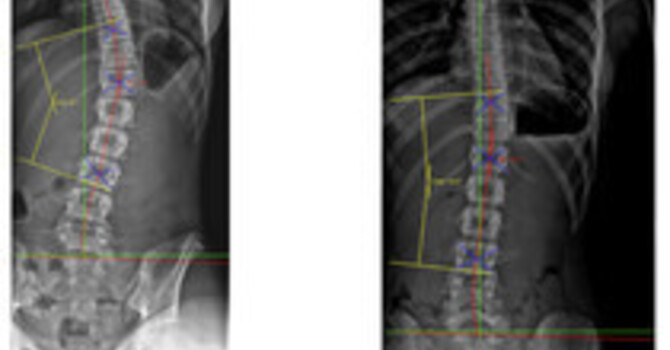
Scoliosis is coded in ICD-10-CM under category M41, with the fourth and later characters identifying the type of scoliosis and the spinal region. Adolescent idiopathic scoliosis of the thoracolumbar spine, for example, is M41.125; juvenile idiopathic scoliosis of the thoracic spine is M41.114; neuromuscular scoliosis of the lumbar spine is M41.46. Congenital scoliosis caused by a malformed vertebra is coded outside M41, at Q76.3. M41.9 (scoliosis, unspecified) exists but tells a payer, a referring physician, or an attorney almost nothing.
I am Dr. Justin Dick, DC, at Clear Life Scoliosis and Chiropractic Center in Charlotte, NC. I hold CNMT and ARRT(N)(CT) imaging credentials, and the code on a chart should match what the standing radiograph shows. This page is a reference for patients, referring providers, and peers. It is not billing advice, and code sets are updated every year, so confirm against the current official code set before submitting a claim.
How M41 Is Organized
The fourth character sets the type. M41.0 is infantile idiopathic; M41.1 is juvenile and adolescent idiopathic, split into M41.11 (juvenile) and M41.12 (adolescent); M41.2 is other idiopathic, which is where idiopathic scoliosis first coded in adulthood usually lands; M41.3 is thoracogenic; M41.4 is neuromuscular; M41.5 is other secondary; M41.8 is other forms; M41.9 is unspecified. The final character sets the region: 2 cervical, 3 cervicothoracic, 4 thoracic, 5 thoracolumbar, 6 lumbar, 7 lumbosacral. Infantile codes add 8 for sacral and sacrococcygeal, neuromuscular codes add 1 for the occipito-atlanto-axial region, and 0 or 9 means site unspecified.
Common Codes in a Scoliosis Practice
For a teenager with a right thoracic curve: M41.124. For a teenager with a thoracolumbar curve (a Lenke 5 pattern): M41.125. For a child aged about 4 to 10 with a thoracic curve: M41.114. For an adult with idiopathic scoliosis diagnosed in adulthood: M41.2x by region. For a child with cerebral palsy and a lumbar curve: M41.46. For a child with a hemivertebra: Q76.3. A double major curve is coded by the regions involved, and the chart should document each curve's Cobb angle and apex. My posts on types of scoliosis and Lenke classification explain the clinical categories behind the codes.
Where Coding Errors Start
Most errors are documentation errors. The code says thoracic and the radiograph shows a thoracolumbar apex. The code says adolescent idiopathic in a 45-year-old. The code says idiopathic when the films show a congenital anomaly or the patient has a neuromuscular diagnosis. Degenerative adult curves are a frequent problem because the idiopathic codes do not describe them well; how they are coded should follow the official guidelines and the payer, not habit. In personal injury work, a pre-existing scoliosis should be coded and described as pre-existing, separately from the injury codes, which is part of what makes a record defensible.
Why the Code Should Match the Film
The region in the code depends on where the apex sits on a standing radiograph, and the type depends on age at diagnosis and cause. Both require imaging and history. A screening finding on a forward bend test without a radiograph supports a code for a finding, not a measured curve. My post on Cobb angle measurement covers how the curve is measured.
How Dr. Justin Dick, DC Documents Scoliosis at Clear Life
At our Charlotte office, every scoliosis chart records the curve type, apex level, Cobb angle of each curve, rotation, Risser stage in growing patients, and any congenital or neuromuscular findings, so the diagnosis code can be checked against the film. Referring physicians and attorneys receive reports in that format.
Comparison
| Diagnosis | Code range | Region example |
|---|---|---|
| Infantile idiopathic | M41.00 to M41.08 | M41.04 thoracic |
| Juvenile idiopathic | M41.112 to M41.119 | M41.114 thoracic |
| Adolescent idiopathic | M41.122 to M41.129 | M41.125 thoracolumbar |
| Other idiopathic | M41.20 to M41.27 | M41.26 lumbar |
| Neuromuscular | M41.40 to M41.47 | M41.46 lumbar |
| Other secondary | M41.50 to M41.57 | M41.55 thoracolumbar |
| Congenital (bony malformation) | Q76.3 | No region character |
| Unspecified | M41.9 | Avoid when films are available |
Research and Evidence
Evidence tiering: code descriptors are taken from public ICD-10-CM listings, checked on November 9, 2026. Statements about documentation practice are my clinical and administrative experience, not research findings. Coding rules change annually; the official code set and payer policies govern.
My published work relies on documented radiographic measurement. The Lenke 5C case report, A Non-surgical Multimodal Approach to Adolescent Idiopathic Scoliosis (Lenke 5C) Using an Intensive Two-Week CLEAR Institute Protocol: A Report of Two Cases (Cureus, 2026, PMID 41640942), describes two adolescents with thoracolumbar curves, the pattern coded M41.125.
References
- ICD-10-CM category M41 (Scoliosis) and Q76.3 (Congenital scoliosis due to congenital bony malformation), code descriptors as listed by FindACode and AAPC. Accessed November 9, 2026.
- Lenke LG, Betz RR, Harms J, et al. Adolescent idiopathic scoliosis: a new classification to determine extent of spinal arthrodesis. J Bone Joint Surg Am. 2001;83(8):1169-81. PMID 11507125
- Whelan J, Paige P, Dick JM. A non-surgical multimodal approach to adolescent idiopathic scoliosis (Lenke 5C) using an intensive two-week CLEAR Institute protocol: a report of two cases. Cureus. 2026;18(1):e102006. doi:10.7759/cureus.102006
Frequently Asked Questions
What is the ICD-10 code for scoliosis?
Scoliosis is coded under category M41. The characters after M41 specify the type, such as adolescent idiopathic (M41.12x) or neuromuscular (M41.4x), and the spinal region. M41.9 is scoliosis, unspecified.
What is the ICD-10 code for adolescent idiopathic scoliosis?
M41.12 with a final character for region: M41.122 cervical through M41.127 lumbosacral, with M41.124 for thoracic, M41.125 for thoracolumbar, and M41.129 for site unspecified.
What is the ICD-10 code for congenital scoliosis?
Congenital scoliosis due to a congenital bony malformation is coded Q76.3, outside the M41 category.
How is adult scoliosis coded?
Idiopathic scoliosis first coded in adulthood generally falls under other idiopathic scoliosis, M41.2x by region. Degenerative curves should follow the official guidelines and payer policy.
Why does the scoliosis code need to match the X-ray?
The region character depends on where the curve's apex sits on a standing radiograph. Dr. Justin Dick, DC at Clear Life Scoliosis in Charlotte, NC documents apex, Cobb angle, and curve type so the code can be checked against the film.
Where can I get scoliosis documented accurately in Charlotte, NC?
Clear Life Scoliosis and Chiropractic Center, 8814 Rachel Freeman Way, Suite 103, Charlotte, NC 28278, provides radiographic scoliosis evaluation and reports with Dr. Justin Dick, DC, CNMT, ARRT(N)(CT). Call 980-368-0766.
Service Area
Clear Life Scoliosis and Chiropractic Center sees patients from Charlotte NC, Huntersville NC, Ballantyne NC, Matthews NC, Concord NC, Mooresville NC, Rock Hill SC, Fort Mill SC. Families from across the Charlotte region and the South Carolina border communities come to the Rachel Freeman Way office for radiographic scoliosis evaluation with Dr. Justin Dick, DC.
Related Pages
- Types of Scoliosis
- Lenke Classification
- Cobb Angle Measurement
- Scoliosis Imaging and Measurement
- Physician Referral
- Imaging, Documentation, and Diagnosis
- Attorney Resources
- Radiographic Imaging Credentials
- Scoliosis Care Program
- Dr. Justin Dick, DC Research
Schedule an Evaluation in Charlotte
If a scoliosis code on your chart does not match your films, the films should win. Dr. Justin Dick, DC can review both at our Charlotte office.
Dr. Justin Dick, DC · ORCID 0009-0001-2794-2159
8814 Rachel Freeman Way, Suite 103, Charlotte, NC 28278
Phone: 980-368-0766 · Email: office@clearlifescoliosis.com
clearlifescoliosis.com · Book online
Justin Dick
Contact Me