Gymnastics and scoliosis intersect more frequently than most coaches and parents realize. The gymnastics population has one of the highest rates of scoliosis detection of any youth sport — not because gymnastics causes scoliosis, but because the combination of age, sex, and the physical demands of the sport creates a screening environment where the condition is more likely to be noticed. The question is not whether a gymnast with scoliosis can continue training. Most can. The question is whether the evaluation they receive after diagnosis is specific enough to inform the decisions that follow.
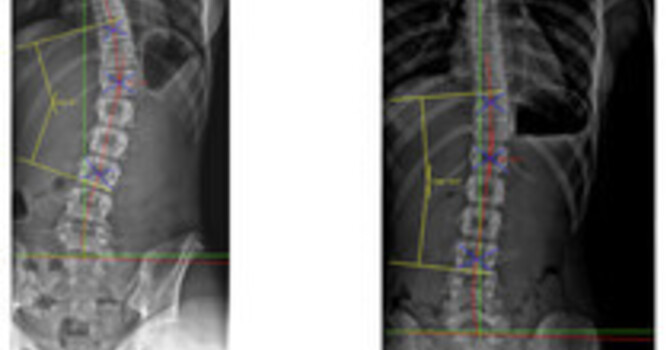
A general pediatric scoliosis screening that identifies a curve and recommends monitoring is not the same as a specialty evaluation that establishes the Cobb angle, the Risser stage, the curve pattern by Lenke classification, the rotational component by scoliometer measurement, and the cervical structural involvement that published research shows is present in virtually every scoliosis patient. Those details determine what the gymnast's treatment plan, training modification, and monitoring schedule should actually look like.
Dr. Justin M. Dick, DC at Clear Life Scoliosis and Chiropractic Center in Charlotte, NC is a CLEAR Scoliosis Institute Fellow and Board of Directors member, ISICO World Masters, SOSORT Provisional Member, and author of multiple peer-reviewed publications on scoliosis outcomes indexed in PubMed. No referral required. Call 980-368-0766.
Schedule Your Evaluation Call 980-368-0766
Why Gymnastics and Scoliosis Intersect So Frequently
Adolescent idiopathic scoliosis is diagnosed between ages 10 and 18. The peak onset window is 10 to 14 — precisely the age range when most competitive gymnasts are in the highest training volume phase of their development. AIS affects females at significantly higher rates than males for curves requiring treatment — approximately 7 to 1 for curves above 30 degrees — and gymnastics is a predominantly female sport at the competitive and recreational levels where most affected athletes train.
Gymnastics training does not cause scoliosis. The research on this point is consistent. What gymnastics training does is create a context where scoliosis is more likely to be detected because coaches, parents, and sports medicine professionals are watching spinal movement and symmetry more closely than in non-sporting contexts. The Adams forward bend test — the standard screening tool — is essentially performed every time a gymnastics coach watches a gymnast perform a straddle forward fold or a back walkover. The rib asymmetry that indicates vertebral rotation becomes visible in ways that would not be apparent in a child who does not train in gymnastics.
The clinical implication is that gymnastics families are often the first to identify a curve — and they frequently arrive at a specialist evaluation with more detailed observational information than families from non-sporting backgrounds. A coach who has noticed a gymnast's back extension is asymmetrical, or that one hip sits higher than the other during conditioning, has already performed a de facto postural screen. That information is clinically useful and should be part of the initial evaluation conversation.
What Scoliosis Actually Does to a Gymnast's Body — The Mechanical Reality
Scoliosis is a three-dimensional deformity — lateral curvature, axial vertebral rotation, and sagittal plane changes occurring simultaneously. Understanding how each of these dimensions affects gymnastics-specific movements is more clinically useful than a general statement that scoliosis "affects flexibility and balance."
The Rotational Component — What the Rib Hump Tells a Coach
When the spine rotates — and scoliosis by definition involves vertebral rotation — the ribs rotate with it. The ribs attach to the thoracic vertebrae, so axial rotation of the vertebral bodies produces the posterior rib prominence on the convex side and the anterior rib prominence on the concave side that coaches observe as the rib hump. This is not a cosmetic finding that exists independently of the curve. It is direct anatomical evidence of how much rotation is present at the curve apex.
For gymnastics, vertebral rotation has specific consequences. Back extension — backbend, bridge, back walkover, back handspring — requires symmetric sagittal plane mobility across all thoracic segments. In a thoracic scoliosis patient, the rotated segments resist uniform extension. The gymnast will hyperextend through the flexible segments above and below the curve to compensate for the restricted segments at the apex. This produces the appearance of adequate extension range but actually concentrates loading at the hypermobile segments above and below the curve apex — which over time increases the risk of hypermobility-related pain at those levels.
A coach watching a gymnast's bridge and noticing that the spine appears to arch sharply at one segment while being relatively flat at another is observing this compensation pattern. It is not a technique error. It is a structural consequence of the rotational deformity.
Balance and Handstand Stability
Lumbar scoliosis with associated pelvic obliquity creates an asymmetric base for handstand balance. The gymnast is building vertical balance on a foundation that is not horizontal — the sacral base is tilted relative to true horizontal by the degree of pelvic obliquity produced by the lumbar curve. This does not make handstands impossible, but it changes the proprioceptive reference the gymnast uses for balance. The sensation of "vertical" in a gymnast with significant pelvic obliquity may be genuinely different from geometric vertical because the vestibular and proprioceptive system has calibrated to the asymmetric structural baseline.
Published research from Clear Life Scoliosis — PMID 41018459 — found abnormal C3-C4 cervical segmental motion in over 70% of structural spinal injury patients, with cervical lordosis loss in 100%. The cervical spine is not mechanically isolated from the thoracic and lumbar curves. Cervical proprioceptive input — which contributes significantly to balance and spatial orientation — is altered in patients with abnormal cervical mechanics. A gymnast with scoliosis whose cervical spine has not been evaluated may have an unidentified proprioceptive deficit that contributes to balance instability in ways that general balance training cannot fully address.
Endurance and the Paraspinal Muscle Asymmetry
The paraspinal musculature on the convex side of a scoliotic curve operates at significantly higher baseline activation than the same muscles in a non-scoliosis spine. Published research documents this — the convex-side erector spinae is working harder at rest and fatigues faster under sustained loading than controls. For a gymnast in a four-hour training session, this translates to earlier paraspinal fatigue on the convex side, which reduces the dynamic stabilization available at the curve apex during the second half of practice. The gymnast who performs well in the first half of a training session and loses technique quality in the second half without apparent explanation may be experiencing this progressive asymmetric paraspinal fatigue pattern.
The Evaluation a Gymnast With Scoliosis Actually Needs
A pediatric or general practitioner scoliosis referral typically produces an Adams forward bend test, a scoliometer reading, and if the scoliometer reads above 5 to 7 degrees, a standing radiograph. That is the screening pathway. It identifies whether a curve is present and roughly how large it is. It is not a specialty evaluation.
A specialty evaluation for a gymnast with scoliosis includes:
- Standing AP radiograph with quantitative Cobb angle measurement. Using PostureRay software with initial Peirson analysis — the same protocol used in our published research — not a visual estimation. The Cobb angle determines where the gymnast sits on the clinical decision tree for monitoring versus active intervention.
- Risser stage determination. The most important prognostic variable. A Risser 0 gymnast with a 20-degree thoracic curve is in a completely different clinical situation from a Risser 3 gymnast with the same Cobb angle. The Risser 0 patient has significant growth remaining — and with gymnastics training driving growth hormone release, potentially accelerated skeletal development — and is at high progression risk. The Risser 3 patient is near skeletal maturity with substantially lower progression risk.
- Lenke curve classification. The curve pattern determines which non-surgical approaches are most appropriate. A Lenke 1 right thoracic curve responds differently to corrective exercise and bracing than a Lenke 5C thoracolumbar curve. Classifying the curve before designing a treatment plan is not optional — it is what makes the plan clinically appropriate rather than generic.
- Scoliometer measurement at every level. The Cobb angle measures the lateral component. The scoliometer measures the rotational component. Both are needed. A gymnast whose Cobb angle is 20 degrees but whose scoliometer reads 9 degrees at the apex has significant rotation — which is what affects gymnastics performance — that the Cobb angle alone does not capture.
- Cervical radiographic evaluation. Published research from Clear Life Scoliosis — PMID 41018459 — found cervical lordosis loss in 100% of structural spinal injury patients. The cervical spine in a scoliosis patient is not a separate anatomical region — it is part of the same structural deformity that extends from the pelvis upward. Evaluating a scoliosis patient without evaluating the cervical spine is an incomplete assessment.
- Flexibility assessment — differentiated by curve component. General flexibility is not the relevant measure. The clinically relevant question is whether the gymnast's flexibility in the plane of the curve is greater on the convex side than the concave side — which indicates hypermobility on the tensile side of the curve. Hypermobility on the convex side of a thoracic curve is a risk factor for progression under training load, not a neutral finding.
The Progression Risk Conversation — What Coaches and Parents Are Not Always Told
The most clinically important conversation after a scoliosis diagnosis in a young gymnast is the progression risk conversation. It is also the conversation most frequently deferred or generalized to the point of uselessness.
"We'll watch it and see" is not a plan. It is a deferral. The clinical information that makes it a plan is: what is the Risser stage, what is the current Cobb angle, what is the curve pattern, and at what Cobb angle or progression rate does the monitoring plan change to active intervention?
For a gymnastics family specifically, the Risser stage conversation also needs to address the relationship between training intensity and skeletal maturation timing. High-volume gymnastics training is associated with delayed menarche and potentially delayed skeletal maturation — which may extend the growth window and therefore the progression risk period. A gymnast who might otherwise be Risser 3 at age 15 may still be Risser 1 or 2 due to training-related delayed maturation. The Risser stage on the radiograph — not the chronological age — is the relevant variable.
Training Modifications — Specific, Not Generic
The training modification conversation for a gymnast with scoliosis is most useful when it is specific to the curve pattern rather than generic. General recommendations to "reduce loading" or "avoid back extensions" are not useful to a competitive gymnast or their coach — they are vague enough to be ignored and specific enough to be unnecessarily restrictive simultaneously.
| Curve Pattern | Primary Training Consideration | Specific Modification |
|---|---|---|
| Right thoracic — Lenke 1 | Axial rotation restriction in right-rotational movements | Cartwheel and round-off mechanics should be evaluated for rotational compensation at the thoracic apex. Asymmetric loading in choreography should favor left rotation where possible |
| Thoracolumbar — Lenke 5C | Pelvic obliquity affecting handstand base and landing mechanics | Handstand balance training should include proprioceptive work that addresses the asymmetric pelvic base. Landing mechanics from dismounts warrant biomechanical assessment — asymmetric ground reaction forces concentrate loading at the curve apex |
| Double major — Lenke 3 or 6 | Counter-rotation between thoracic and lumbar curves creates complex loading pattern | Trunk rotation in dance elements and choreography should be assessed by a scoliosis-trained clinician who can identify which rotational direction is biomechanically favorable for the specific curve pattern |
| Any pattern — Risser 0-1 in active growth | Rapid progression risk during growth spurts | Quarterly Cobb angle monitoring — not annually. Training volume consultation with the scoliosis clinician during growth spurts when progression risk is highest |
What a coach can observe that a clinician cannot.
A gymnastics coach who trains a gymnast four to five hours per day five days per week sees that gymnast's movement more than any clinician ever will. Changes in technique asymmetry — a cartwheel that begins to drift left, a back walkover that loses extension on one side, a beam routine that develops a consistent balance error at a specific skill — can be early indicators of curve progression before it is visible on a radiograph. Coaches who communicate these observations to the treating scoliosis clinician provide clinical information that a quarterly or semi-annual office visit cannot capture. Building that communication channel between the gymnast's coach and their scoliosis clinician is one of the most useful structural changes a gymnastics family can make after a diagnosis.
What the Research at Clear Life Shows — Published Outcomes in AIS
View the complete published research profile at Clear Life Scoliosis.
A Note on Back Pain in Gymnasts With Scoliosis
Back pain is not a normal finding in a young gymnast with scoliosis. Mild muscle fatigue and post-training soreness are expected in any high-volume training environment. Localized back pain that persists between sessions, wakes the athlete at night, produces neurological symptoms in the legs, or is associated with a specific movement pattern that triggers it is not a normal training response and should not be managed by rest alone.
In a gymnast with a known scoliosis diagnosis, back pain warrants evaluation rather than monitoring. The specific concern is whether the pain is being generated by a segment adjacent to the curve apex — where hypermobility from compensatory motion above and below the structural curve concentrates dynamic loading — or whether it represents a stress reaction at a mechanically vulnerable segment. Both of these presentations are more common in athletes with scoliosis than in non-scoliosis athletes, and both require imaging assessment rather than empirical treatment.
Frequently Asked Questions — Scoliosis and Gymnastics Charlotte NC
Can a gymnast with scoliosis continue training in Charlotte?
In most cases yes — with appropriate evaluation, monitoring, and where indicated, active treatment. The decision to continue, modify, or temporarily restrict training is made based on the specific Cobb angle, Risser stage, curve pattern, and whether active correction is in progress. A Risser 0 patient in an active growth spurt with a progressing curve warrants a different training conversation than a Risser 3 patient with a stable 18-degree curve. Dr. Justin M. Dick, DC at Clear Life Scoliosis — 8814 Rachel Freeman Way Suite 103, Charlotte NC 28278. No referral required. Call 980-368-0766.
Does gymnastics training cause scoliosis?
The research does not support a causal relationship between gymnastics training and scoliosis. The higher detection rates in gymnastics populations reflect earlier and more frequent observation of spinal symmetry rather than a higher incidence of the condition. Scoliosis is a genetic and developmental condition — the training environment does not cause it, though high training volume during growth spurts may interact with progression risk in ways that warrant closer monitoring. Dr. Justin Dick at Clear Life Scoliosis Charlotte NC. Call 980-368-0766.
What is the Risser stage and why does it matter for a gymnast with scoliosis?
The Risser sign is the degree of ossification of the iliac apophysis on a standing AP radiograph — graded 0 through 5 — and is the most clinically useful indicator of remaining skeletal growth. Risser 0 means significant growth remains and high progression risk. Risser 4 to 5 means near or complete skeletal maturity with substantially lower progression risk. For gymnasts specifically, high-volume training is associated with delayed skeletal maturation — meaning a gymnast's Risser stage may be lower than expected for their chronological age. The Risser stage on the radiograph — not the age — is the variable that guides monitoring and intervention decisions. Dr. Justin Dick at Clear Life Scoliosis Charlotte NC evaluates Risser stage at every adolescent assessment. Call 980-368-0766.
My daughter's gymnastics coach noticed asymmetry in her back extension — should I be concerned?
Yes — have it evaluated. Asymmetric back extension in a gymnast — uneven arch across the thoracic spine, one side of the rib cage more prominent than the other in the forward fold position, or consistent difficulty achieving symmetric extension — are observational signs consistent with thoracic scoliosis. The Adams forward bend test performed at a specialty scoliosis evaluation, combined with a standing radiograph and quantitative Cobb angle measurement, will establish whether a curve is present and what its current severity is. Do not wait for a scheduled pediatric well-visit. Dr. Justin M. Dick, DC at Clear Life Scoliosis — 8814 Rachel Freeman Way Suite 103, Charlotte NC 28278. No referral required. Call 980-368-0766.
How often should a gymnast with scoliosis have their Cobb angle measured?
More frequently than the standard recommendation for non-athletes during active growth. For a Risser 0 to 1 gymnast with a curve above 15 to 20 degrees, every 3 to 4 months during active growth phases is the appropriate monitoring interval — not the 6-month interval often recommended in general pediatric practice. High-volume training during growth spurts may accelerate progression. A curve that progresses 5 degrees in 4 months in a Risser 0 gymnast is a clinical finding that changes the treatment plan. That finding is missed on a 12-month monitoring schedule. Dr. Justin Dick at Clear Life Scoliosis Charlotte NC. Call 980-368-0766.
Can the CLEAR Institute intensive protocol be combined with continued gymnastics training?
Yes — with coordination between the treating clinician and the gymnastics coach. The intensive protocol is designed as a concentrated treatment period with defined daily treatment sessions. Return to training during and after the intensive protocol is individualized based on clinical response. Published case reports from Clear Life Scoliosis document sustained Cobb angle reduction at 13-month follow-up — PMID 40062184 — including through periods of continued athletic training. The specific coordination plan is established at the evaluation. Dr. Justin M. Dick, DC at Clear Life Scoliosis — 8814 Rachel Freeman Way Suite 103, Charlotte NC 28278. No referral required. Call 980-368-0766.
Does Clear Life Scoliosis see gymnasts from outside Charlotte?
Yes. Clear Life Scoliosis and Chiropractic Center serves patients from Charlotte, Huntersville, Ballantyne, Matthews, Concord, Mooresville, Rock Hill SC, and Fort Mill SC, and nationally for intensive scoliosis programs. No referral required. Call 980-368-0766.
Service Area — Scoliosis and Gymnastics Charlotte NC
Clear Life Scoliosis and Chiropractic Center provides specialty scoliosis evaluation and treatment for gymnasts and their families from Charlotte, Huntersville, Ballantyne, Matthews, Concord, Mooresville, Rock Hill SC, and Fort Mill SC. No referral required.
Swimming is one activity in the broader conversation about sport participation with scoliosis — but the clinical framework that governs the swimming decision applies across every sport a scoliosis patient might ask about, and the loading demands vary considerably by activity. Cheerleading combines axial compressive landing forces, thoracic hyperextension, and asymmetric stunt loading in ways that require role-specific evaluation distinct from the swimming assessment — with separate clinical considerations for flyers, bases, back spots, and tumblers — covered at Scoliosis and Cheerleading Charlotte NC. Gymnastics carries its own pattern of detection dynamics and loading considerations specific to the Risser 0 through 2 athlete in a high-training-volume environment — covered at Scoliosis and Gymnastics Charlotte NC. Dance at high competitive volume shares the thoracic kyphosis reduction risk described on this page for the thoracic scoliosis patient — the full loading and participation analysis for dancers is at Dancing With Scoliosis Charlotte NC. The complete sport-by-sport clinical framework — covering swimming, soccer, tennis, running, strength training, cycling, and more, organized by loading pattern and Risser stage — is at Sports and Scoliosis Charlotte NC. And if the question is not only which sport is safe but whether the curve itself can be reduced — the published Cobb angle outcome data at Clear Life Scoliosis, including 71% and 60% reduction at 12-month follow-up in adolescent patients, is at Scoliosis Reduction Charlotte NC.
Dance sits within a broader clinical conversation about sport and scoliosis participation — one where the answer depends on the curve pattern, the Risser stage, and the specific movement demands of the discipline rather than a categorical yes or no. The thoracic kyphosis reduction risk described on this page applies to other activities as well, most notably competitive swimming at high butterfly and freestyle volume — the full swimming-specific analysis, including the backstroke caveat and stroke selection guidance, is at Scoliosis and Swimming Charlotte NC. Cheerleading carries a compounded loading profile — axial compressive landing forces, sustained thoracic hyperextension in tumbling and stunting, and asymmetric base position loading — with role-specific risk stratification for flyers, bases, back spots, and tumblers at Scoliosis and Cheerleading Charlotte NC. Gymnastics athletes and their coaches will find the detection dynamics, Risser-specific monitoring intervals, and training load guidance at Scoliosis and Gymnastics Charlotte NC. The complete sport-by-sport clinical framework — organized by loading pattern and Risser stage across ten sports — is at Sports and Scoliosis Charlotte NC. For families whose primary question is not which activity is safe but whether the curve itself can be reduced — the published Cobb angle outcome data at Clear Life Scoliosis, including case-level reduction of 71% and 60% at 12-month follow-up in adolescent patients, is at Scoliosis Reduction Charlotte NC.
Scoliosis Evaluation for Gymnasts in Charlotte NC
Dr. Justin M. Dick, DC — CLEAR Fellow · CLEAR Board of Directors · CNMT · ARRT(N)(CT) · CBP Trained · ISICO World Masters · SOSORT Provisional Member · NASS Member · Multiple PubMed-indexed publications on AIS outcomes including Lenke 5C intensive protocol and 13-month follow-up data. Cobb angle measurement with Peirson analysis and PostureRay, Risser staging, Lenke classification, cervical evaluation, and a written treatment plan with specific monitoring intervals calibrated to the gymnast's progression risk. No referral required. Cash-based practice.
Charlotte, NC 28278
980-368-0766 | office@clearlifescoliosis.com
Justin Dick
Contact Me