What We Found at the September 24 Screening: Two Adults, Two Significant Curves, and Why Free Community Screenings Matter
Every quarter, Clear Life Scoliosis and Chiropractic Center runs a free community scoliosis screening in Charlotte through the Carolinas Scoliosis Screening Initiative. The September 24 event produced two findings that illustrate exactly why we do it.
Two adults, both over 50. Both aware that something had been changing in their posture. Both experiencing balance deficits and back pain they had been managing without a diagnosis or without imaging that could explain what was actually happening structurally. One had a prior diagnosis of scoliosis but had never had a standing radiograph taken to measure the curve. The other had no prior diagnosis at all.
The Adams forward bend test took less than a minute for each of them. The scoliometer confirmed rotational deformity in both. What came next was a referral for standing radiographs to establish Cobb angle and Lenke classification: the measurements that determine what the structural situation actually is and what the clinical options are.
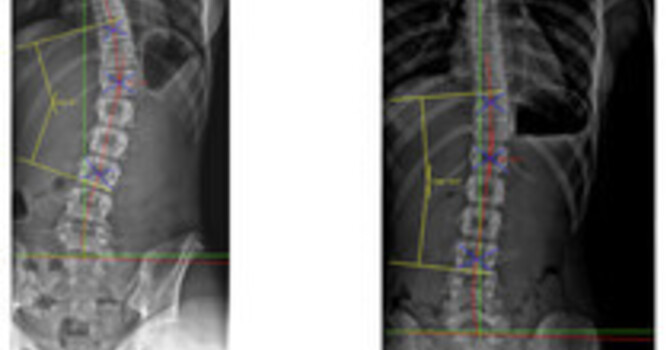
The imaging confirmed de novo degenerative scoliosis in both cases. The Cobb angles were 55 degrees and 38 degrees.
Those are not small curves. Those are curves that have been present and progressing, unquantified, while both patients lived with symptoms they attributed to aging, poor posture, or general back pain. Neither of them knew the structural source. Neither had the imaging that would have told them years earlier how significant the curve had become.
What De Novo Degenerative Scoliosis Is and Why It Gets Missed
De novo degenerative scoliosis is not the same as adolescent idiopathic scoliosis. It is not a curve that began in childhood and progressed through growth. It develops in adulthood, typically after age 40, as a consequence of asymmetric disc and facet degeneration that causes the spine to gradually shift laterally and rotate over years or decades.
The reason it gets missed is straightforward: the symptoms it produces in its early and moderate stages are not specific to scoliosis. Back pain, fatigue with standing, balance changes, postural shift to one side. These are common complaints in the over-50 population and they are routinely attributed to general degenerative change, muscular imbalance, or aging. A standing AP radiograph with Cobb angle measurement would identify the structural source within minutes. That radiograph is rarely ordered unless a clinician specifically suspects scoliosis and knows to look for it.
At a community screening, the Adams forward bend test costs nothing and takes under a minute. A visible rib hump or paraspinal asymmetry in the forward-bent position is the clinical signal that warrants radiographic follow-up. Both patients at the September 24 event had that finding. Neither had been through a screening before.
What de novo degenerative scoliosis does to the body over time.
Unlike adolescent scoliosis, where the primary concern is curve progression during growth, adult degenerative scoliosis produces its consequences through a different mechanism. Asymmetric disc loading accelerates degeneration on the concave side of the curve. Facet arthropathy develops asymmetrically. The sagittal balance shifts as the curve progresses, placing increasing demand on the posterior musculature to maintain upright posture. The balance deficits both patients described are a direct consequence of this sagittal and coronal plane deformity affecting proprioceptive function and the mechanical efficiency of gait. These are not symptoms of general aging. They are structural sequelae of a quantifiable spinal deformity.
The Two Cases from September 24
A Diagnosis That Existed on Paper but Nowhere Else
This patient had been told at some point that they had scoliosis. What they had not been given was imaging. No standing radiograph. No Cobb angle measurement. No Lenke classification. A diagnosis without a number attached to it is, clinically, a label without a plan. It does not tell the patient how significant the curve is, how fast it may be progressing, or what the structural consequences are likely to be over time.
The patient was aware of postural changes. They described balance deficits during daily activities and back pain that had been present long enough to feel normal. The Adams forward bend test at the September 24 screening identified paraspinal asymmetry. The scoliometer confirmed rotational deformity. Standing radiographs established the Cobb angle at 55 degrees.
A 55-degree curve in an adult is above the conventional surgical consideration threshold for younger patients. In an adult with de novo degenerative scoliosis, the clinical conversation is more complex than a simple surgical threshold. Surgical candidacy in this population depends on curve progression rate, neurological status, sagittal balance, bone density, and overall medical fitness. Non-surgical management focused on structural stabilization, sagittal balance restoration, and degenerative progression prevention is a legitimate and evidence-supported clinical goal. The first step is knowing the number. This patient now does.
A Curve That Had No Name Until September 24
This patient came to the September 24 screening with no prior scoliosis diagnosis. They were aware of postural changes. Back pain and balance deficits had been part of their daily experience, attributed to the general wear of time rather than to a specific structural cause.
The Adams forward bend test produced a visible finding. The scoliometer confirmed it. Standing radiographs following the screening established a Cobb angle of 38 degrees with a de novo degenerative pattern.
A 38-degree curve in an adult who had no prior diagnosis and no prior imaging represents years of structural progression that occurred without clinical tracking. The patient had the symptoms the whole time. What they did not have was the structural explanation that would have directed care toward the source rather than toward symptom management alone. They have that now. The clinical path forward includes Lenke classification, sagittal alignment assessment, cervical structural evaluation, and a treatment plan designed around structural stabilization and quality of life preservation.
What the Screening Actually Involved
The Carolinas Scoliosis Screening Initiative uses the same protocol employed in school-based scoliosis screening programs: the Adams forward bend test, scoliometer measurement of the angle of trunk rotation, and clinical documentation of any asymmetric findings. When a finding is present, the patient receives a written summary and a referral for standing radiographic evaluation.
The screening itself is not a diagnostic procedure. It does not establish a Cobb angle. It does not provide Lenke classification or Risser staging. What it does is identify the patients who warrant imaging and give them a clinical reason to get it. For both patients at the September 24 event, the screening was the first time a clinician had looked at their spine specifically for structural deformity. For one of them, it confirmed a curve they had been told about and never quantified. For the other, it identified a 38-degree curve that had been present and progressing with no clinical name attached to it.
The thirty-minute process, at no cost to the patient, produced clinical information that will inform the treatment decisions for both of these individuals for the rest of their lives. That is why we run the screening every quarter.
The Research Behind the Clinical Approach at Clear Life Scoliosis
The evaluation and treatment approach at Clear Life Scoliosis for adult de novo degenerative scoliosis is grounded in published peer-reviewed research on scoliosis outcomes, cervical mechanics, and sagittal alignment. Dr. Justin M. Dick, DC has multiple peer-reviewed, PubMed-indexed publications relevant to the clinical presentations identified at the September 24 screening.
Why Adults Over 50 Are the Population Most Likely to Have Undiagnosed Scoliosis
Scoliosis screening in the United States is almost entirely oriented toward adolescents. School-based screening programs, pediatric well-visit assessments, and the public conversation about scoliosis all focus on the adolescent idiopathic pattern. This is clinically appropriate: AIS is common, progression is rapid during growth, and early detection matters enormously for the treatment window.
What this leaves is an entire adult population that was either not screened as adolescents, was screened and found negative, or developed scoliosis in adulthood through the de novo degenerative pathway and has never been evaluated. The two patients at the September 24 screening are representative of a larger population. They are not unusual cases. They are what happens when a structurally significant spinal deformity develops over years in an adult body, produces symptoms that are attributed to something else, and goes without a standing radiograph until a community screening provides the first clinical look.
The question is not whether more people like them exist in the Charlotte area. They do. The question is whether they will encounter a clinical pathway that identifies and addresses the structural source before the curve progresses further and the functional consequences compound.
Next Screening: December 17, 2026
If you or someone you know is over 50 and experiencing postural changes, balance deficits, or unexplained back pain: the December 17 screening is the appropriate next step. The Adams forward bend test costs nothing and takes less than a minute. What it finds can change the clinical trajectory. Both patients from September 24 now know what they are dealing with. That knowledge is the starting point for everything that comes next.
Frequently Asked Questions: De Novo Scoliosis and Adult Screening Charlotte NC
What is de novo degenerative scoliosis?
De novo degenerative scoliosis is a lateral spinal curvature that develops in adulthood, typically after age 40, as a result of asymmetric disc and facet joint degeneration. Unlike adolescent idiopathic scoliosis, which begins during the growth years, de novo scoliosis develops progressively in an adult spine. It produces back pain, postural shift, and balance deficits that are frequently attributed to general aging rather than to a structural spinal deformity. Standing radiograph with Cobb angle measurement is required to identify and quantify it. Dr. Justin M. Dick, DC at Clear Life Scoliosis provides adult scoliosis evaluation in Charlotte NC. 8814 Rachel Freeman Way Suite 103, Charlotte NC 28278. Call 980-368-0766.
Can you have scoliosis and not know it as an adult?
Yes. At the September 24 Carolinas Scoliosis Screening Initiative in Charlotte, two adults over 50 were identified with de novo degenerative scoliosis at Cobb angles of 55 and 38 degrees. One had a prior diagnosis but no imaging. The other had no prior diagnosis at all. Both had been experiencing postural changes, balance deficits, and back pain attributed to other causes. A standing radiograph established the structural source at each screening. Dr. Justin Dick at Clear Life Scoliosis Charlotte NC. 8814 Rachel Freeman Way Suite 103, Charlotte NC 28278. Call 980-368-0766.
What is the Adams forward bend test?
The Adams forward bend test is a brief clinical screening: the patient bends forward at the waist with hands clasped and feet together while the examiner observes from behind at eye level. An asymmetric rib hump: one side of the back rising higher than the other in the forward-bent position: indicates rotational deformity consistent with structural scoliosis. The scoliometer quantifies the angle of trunk rotation. A positive finding warrants referral for standing radiograph to establish Cobb angle. The test takes under a minute and is performed at every Carolinas Scoliosis Screening Initiative event. Dr. Justin Dick at Clear Life Scoliosis Charlotte NC. 8814 Rachel Freeman Way Suite 103, Charlotte NC 28278. Call 980-368-0766.
What does a 55-degree scoliosis curve mean for an adult?
A 55-degree Cobb angle in an adult with de novo degenerative scoliosis is a clinically significant finding. It is above the conventional surgical consideration threshold used in adolescent patients, though surgical decision-making in adults is more complex and depends on curve progression rate, neurological status, sagittal balance, bone density, and overall medical fitness. Non-surgical management targeting structural stabilization, sagittal balance, and degenerative progression prevention is a legitimate clinical goal. The first clinical step is quantifying the curve with a standing radiograph and establishing the full structural picture. Dr. Justin Dick at Clear Life Scoliosis Charlotte NC. 8814 Rachel Freeman Way Suite 103, Charlotte NC 28278. Call 980-368-0766.
Is the December 17 scoliosis screening in Charlotte free?
Yes. The December 17 Carolinas Scoliosis Screening Initiative at Awakening Charlotte is free and open to all ages. No referral required. The screening includes the Adams forward bend test, scoliometer measurement, and a written summary. Referral for imaging is provided if the screening is positive. Hosted by Clear Life Scoliosis and Chiropractic Center, 8814 Rachel Freeman Way Suite 103, Charlotte NC 28278. Call 980-368-0766 or visit the screening page to reserve a time.
Can adults with scoliosis be treated without surgery?
In many cases yes. Non-surgical management for adult de novo degenerative scoliosis targets structural stabilization, pain reduction, sagittal balance restoration, and prevention of further degenerative progression. Published research from Clear Life Scoliosis documents Cobb angle reduction in an adult de novo degenerative scoliosis case alongside functional improvement. The treatment goals and protocol for adult degenerative scoliosis differ from adolescent correction protocols: the clinical conversation begins with a full evaluation including standing Cobb angle measurement, Lenke classification, cervical structural evaluation, and sagittal alignment assessment. Dr. Justin Dick at Clear Life Scoliosis Charlotte NC. No referral required. 8814 Rachel Freeman Way Suite 103, Charlotte NC 28278. Call 980-368-0766.
Service Area: Scoliosis Screening and Adult Scoliosis Evaluation Charlotte NC
Clear Life Scoliosis and Chiropractic Center serves adults and families seeking scoliosis screening and specialty evaluation from Charlotte, Huntersville, Ballantyne, Matthews, Concord, Mooresville, Steele Creek, Berewick, Rock Hill SC, and Fort Mill SC. The Carolinas Scoliosis Screening Initiative quarterly screening is free and open to all ages. No referral required.
Join Us December 17: Free Scoliosis Screening in Charlotte NC
The Carolinas Scoliosis Screening Initiative returns December 17, 2026 at Awakening Charlotte. Free, no referral required, all ages welcome. Dr. Justin M. Dick, DC: CLEAR Fellow · CLEAR Board of Directors · CNMT · ARRT(N)(CT) · CBP Trained · ISICO World Masters · SOSORT Provisional Member · NASS Member · Multiple peer-reviewed, PubMed-indexed publications on scoliosis outcomes and spinal biomechanics. Adams forward bend test, scoliometer assessment, written summary, imaging referral if indicated.
Charlotte, NC 28278
980-368-0766 | office@clearlifescoliosis.com
Justin Dick
Contact Me