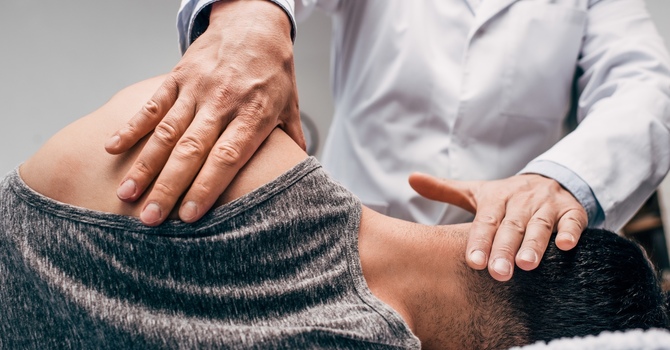
After a slip and fall, first decide whether the spine needs emergency imaging. A fall from more than 3 feet or five stairs is a high-risk mechanism, and adults 65 and older have twice the rate of neck injury. Without those or other red flags, a spine evaluation within a day or two is reasonable. This is the order I use in Charlotte.
When Does a Fall Need Emergency Imaging?
The Canadian C-Spine Rule treats a fall from more than 3 feet or five stairs as a dangerous mechanism that calls for imaging, along with age 65 or older and numbness or tingling in the arms or legs (Stiell, CMAJ 2010). Under the NEXUS criteria, midline neck tenderness, a focal neurologic deficit, reduced alertness, intoxication, or another painful injury distracting from the neck also means imaging (Hoffman, N Engl J Med 2000). When imaging is needed, the American College of Radiology prefers CT to radiographs for suspected spine trauma (Beckmann, J Am Coll Radiol 2019).
Any head strike with confusion, repeated vomiting, or worsening headache needs emergency evaluation, especially in someone taking a blood thinner. That is standard clinical safety practice.
Why Are Older Adults Different?
In a NEXUS analysis of 2,943 patients aged 65 or older, cervical spine injury occurred in 4.59%, compared with 2.19% of younger patients, and fractures of the odontoid, the peg at the top of C2, made up 20% of fractures in older patients versus 5% in younger ones (Touger, Ann Emerg Med 2002). An older adult with neck pain after a fall, even a fall from standing height, should be imaged before any manual care.
What About the Mid and Low Back?
The American College of Radiology notes that screening criteria for thoracic and lumbar spine injury are less validated than the neck rules (Beckmann, J Am Coll Radiol 2019). Without a validated rule, the exam decides. Midline tenderness over the spine, pain with gentle load, new leg numbness or weakness, or trouble controlling the bladder or bowels means imaging or emergency care first.
What Does a Spine Evaluation After a Fall Include?
A history of how the fall happened and how the body landed, a neurologic screen, and an exam that localizes pain to specific segments. Imaging is ordered when the exam calls for it. Flexion and extension X-rays to measure ligament laxity come only after fracture has been excluded.
How Soon Should You Get Checked?
Immediately for any red flag above. Otherwise, within the next day or two, because pain from strained tissue often increases as the first day passes, and an early exam records findings at baseline.
For an example of how post-collision imaging findings and outcomes are documented in the peer-reviewed literature, read the published case report on refractory lumbar pain following a motor vehicle accident in a geriatric patient by Dr. Justin Dick, DC.
Frequently Asked Questions
When should I go to the ER after a fall?
For a fall from more than 3 feet or five stairs with neck pain, any neck pain at age 65 or older, numbness or tingling, midline neck tenderness, or a head strike with confusion or vomiting.
Is a fall from standing height dangerous for older adults?
A fall from standing height can be serious for older adults. Adults 65 and older had about twice the rate of cervical spine injury in a NEXUS analysis (Touger, Ann Emerg Med 2002).
Should I get a CT or X-ray after a fall?
When spine imaging is indicated after trauma, the American College of Radiology prefers CT to radiographs.
Can a chiropractor treat back pain after a fall?
After fracture and other emergencies are ruled out. Dr. Justin Dick, DC in Charlotte, NC screens for red flags first and refers for imaging when indicated.
How soon after a fall should I get my back checked?
Immediately for red flags. Otherwise within a day or two, before stiffness sets in and so findings are documented early.
Where can I get a spine evaluation after a fall in Charlotte, NC?
Dr. Justin Dick, DC, CNMT, ARRT(N)(CT), sees car accident patients at Clear Life Scoliosis and Chiropractic Center, 8814 Rachel Freeman Wy, Ste 103, Charlotte, NC 28278, phone 980-368-0766. Personal injury patients are treated on a lien basis, with no out-of-pocket payment at the time of care.
Sources and Evidence Tiers
- Stiell IG, Clement CM, O'Connor A, et al. Multicentre prospective validation of use of the Canadian C-Spine Rule by triage nurses in the emergency department. CMAJ. 2010;182(11):1173-1179. PMID 20457772. LinkEvidence tier: Prospective multicenter validation cohort
- Hoffman JR, Mower WR, Wolfson AB, Todd KH, Zucker MI. Validity of a set of clinical criteria to rule out injury to the cervical spine in patients with blunt trauma. N Engl J Med. 2000;343(2):94-99. PMID 10891516. LinkEvidence tier: Prospective multicenter cohort
- Touger M, Gennis P, Nathanson N, et al. Validity of a decision rule to reduce cervical spine radiography in elderly patients with blunt trauma. Ann Emerg Med. 2002;40(3):287-293. PMID 12192352. LinkEvidence tier: Prospective multicenter cohort subgroup (2,943 patients aged 65 or older)
- Beckmann NM, West OC, Nunez D, et al. ACR Appropriateness Criteria: Suspected Spine Trauma. J Am Coll Radiol. 2019;16(5S):S264-S285. PMID 31054754. LinkEvidence tier: Evidence-based guideline with expert panel rating
About the author. Dr. Justin Dick, DC, is the owner and treating clinician at Clear Life Scoliosis and Chiropractic Center in Charlotte, NC. He holds dual imaging credentials as a Certified Nuclear Medicine Technologist (CNMT) and as an ARRT-registered technologist in nuclear medicine and CT, ARRT(N)(CT). He is a Senior Fellow of the CLEAR Institute, holds the ISICO World Masters credential, is a SOSORT provisional member, and is a certified DOT medical examiner on the FMCSA National Registry. He has multiple peer-reviewed publications indexed in PubMed and serves as a field doctor for Life, Sherman, and Palmer chiropractic colleges. ORCID: 0009-0001-2794-2159.
Service Area
Clear Life Scoliosis and Chiropractic Center sees personal injury and spinal imaging patients from Charlotte NC, Huntersville NC, Ballantyne NC, Matthews NC, Concord NC, Mooresville NC, Rock Hill SC, and Fort Mill SC.
Related Pages
- Personal injury and car accident spinal care in Charlotte
- Research by Dr. Justin Dick, DC
- Case report: refractory lumbar pain after a motor vehicle accident
- Research and evidence at Clear Life
- Questions and answers
- Our team
- Press
- Book your evaluation
- Contact Clear Life
Clear Life Scoliosis and Chiropractic Center
8814 Rachel Freeman Wy, Ste 103
Charlotte, NC 28278
Phone: 980-368-0766
Email: office@clearlifescoliosis.com
Book online
Justin Dick
Contact Me