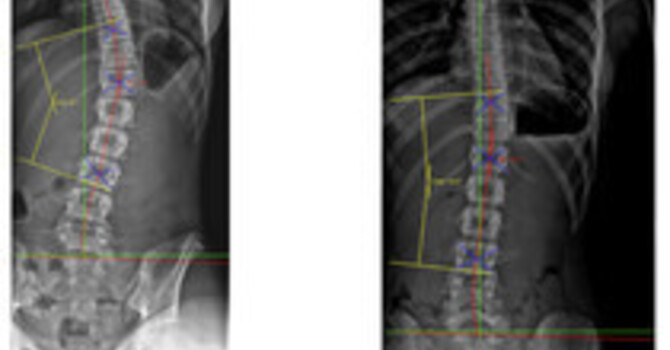
The word subluxation means two different things depending on who uses it. In medicine, a subluxation is a partial dislocation: the joint surfaces are still touching but are out of their normal alignment, and it can be seen on imaging. In chiropractic, "vertebral subluxation" has a longer and more contested history, describing a spinal joint problem believed to interfere with nerve function. The medical meaning is well defined. The chiropractic meaning has never been settled by research.
I am Dr. Justin Dick, and I practice at Clear Life Scoliosis and Chiropractic Center in Charlotte, NC. I have used the term in my own published work, and I think patients deserve a straight account of what it means and where the evidence stands. This post is that account.
Where the Chiropractic Term Came From
Simon Senzon's historical series in the Journal of Chiropractic Humanities traces the concept to the profession's founders. D. D. Palmer's initial concept, around the turn of the twentieth century, was an articular disrelationship between vertebrae that caused pressure on nerves and led to too much or too little function. His students and his son developed competing theories, and from the start there was a diversity of models and rationales.
By the 1990s the profession had tried to bring structure to the term. Senzon's review of 1996 and 1997 describes the Association of Chiropractic Colleges paradigm statement, adopted by the major chiropractic associations, and Bergman's PARTS framework for identifying a problem area: pain or tenderness, asymmetry or alignment, range of motion abnormality, tissue tone and texture changes, and special tests. The same period produced pointed critiques from inside the profession calling for operational definitions that could be tested.
What the Evidence Says
Mirtz and colleagues applied Hill's criteria for causation, the standard epidemiological test of whether a factor causes disease, to the subluxation construct in 2009. They concluded that strength of association, consistency, specificity, temporality, dose response, experimental evidence, biological plausibility, coherence, and analogy were for the most part unfulfilled, and that the lack of supporting evidence does not justify promoting the chiropractic subluxation as a cause of disease.
The profession itself is divided. Funk and colleagues reviewed curricula at 46 chiropractic programs worldwide in 2018. The term appeared in all but two United States course catalogues, with mean mentions rising from 2011 to 2017, while a collaboration of 10 programs outside North America stated they would teach subluxation only in a historical context. The authors argued that unscientific terms should be taught only historically.
That is where the evidence stands. The idea that a misaligned vertebra interferes with nerve flow and causes systemic disease is not supported by the epidemiological criteria used to judge causation in medicine.
What I Measure Instead
My position is narrower than either side of the debate tends to take. Spinal joints can show measurable mechanical problems: abnormal segmental translation on flexion and extension films, loss of a normal curve, rotation, and restricted motion. Those findings can be measured, compared between visits, and tested in research. They are not the same claim as a nerve-interference model of disease.
My cervical mechanics study, A Retrospective Cross-Sectional Analysis of Abnormal Cervical Mechanics in Patients With Scoliosis (Cureus, 2025, PMID 41018459), is an example: it measured abnormal segmental translation, loss of lordosis, and buckling patterns on radiographs in 37 patients with scoliosis. My post on spinal instability explains the clinical and radiographic definitions we use for segmental motion problems.
I also co-authored a 2017 case report on a military veteran treated with what the title calls vertebral subluxation based chiropractic care, published in the Annals of Vertebral Subluxation Research. Our summary of that case is on this site. It is a single case in a journal that is not indexed in PubMed, and the authors stated that more rigorous research such as a clinical trial is needed. It does not test the subluxation construct.
What This Means When a Chiropractor Uses the Word
If a chiropractor tells you that you have a subluxation, it is reasonable to ask what was found, how it was measured, and how you will know whether it changed. A specific answer, such as reduced motion at a named segment, a measured translation on a stress film, or a curve angle, can be tracked. A general answer that a subluxation is interfering with your nervous system and causing unrelated health problems is not supported by the evidence reviewed here.
How Dr. Justin Dick Uses Terminology at Clear Life
At our Charlotte office, findings are described in measurable terms: Cobb angle, rotation, segmental translation, lordosis, range of motion, and neurological findings. When I use historical chiropractic terms, I say what they refer to. Our post on what a chiropractor actually does covers the broader scope of practice.
Comparison
| Usage | Meaning | Evidence status |
|---|---|---|
| Medical subluxation | Partial dislocation of a joint, visible on imaging | Well defined |
| Chiropractic vertebral subluxation (historical model) | Vertebral disrelationship believed to impair nerve function and health | Causation criteria largely unfulfilled (Mirtz 2009) |
| Measurable segmental dysfunction | Abnormal translation, angulation, alignment, or motion at a spinal segment | Measurable on imaging and exam; testable |
Research and Evidence
Evidence tiering: Mirtz 2009 is a structured review against epidemiological causation criteria, not a systematic review of treatment outcomes. Funk 2018 is a curriculum survey. Senzon's series is historical scholarship. None of these test whether a specific treatment works for a specific condition, which is a separate question from whether the subluxation construct is valid.
My own relevant publications are the cervical mechanics study, A Retrospective Cross-Sectional Analysis of Abnormal Cervical Mechanics in Patients With Scoliosis (Cureus, 2025, PMID 41018459), which measured segmental translation radiographically, and the post-collision cervical case report, Radiographic Sagittal Alignment and Neurological Changes Following Conservative Cervical Structural Rehabilitation After Motor Vehicle Collision in a Patient With Pre-existing Scoliosis: A Case Report (Cureus, 2026, PMID 41783554), which documented flexion and extension instability findings alongside neurological change in one patient. Both describe measured mechanics, not subluxation in the historical sense.
References
- Senzon SA. The chiropractic vertebral subluxation part 2: the earliest subluxation theories from 1902 to 1907. J Chiropr Humanit. 2019;25:22-35. doi:10.1016/j.echu.2018.10.009
- Senzon SA. The chiropractic vertebral subluxation part 10: integrative and critical literature from 1996 and 1997. J Chiropr Humanit. 2019;25:146-168. doi:10.1016/j.echu.2018.10.008
- Mirtz TA, Morgan L, Wyatt LH, Greene L. An epidemiological examination of the subluxation construct using Hill's criteria of causation. Chiropr Osteopat. 2009;17:13. doi:10.1186/1746-1340-17-13
- Funk MF, Frisina-Deyo AJ, Mirtz TA, Perle SM. The prevalence of the term subluxation in chiropractic degree program curricula throughout the world. Chiropr Man Therap. 2018;26:24. doi:10.1186/s12998-018-0191-1
- Dick JM. A retrospective cross-sectional analysis of abnormal cervical mechanics in patients with scoliosis. Cureus. 2025;17(8):e91098. doi:10.7759/cureus.91098
- Dick JM, Paige P. Radiographic sagittal alignment and neurological changes following conservative cervical structural rehabilitation after motor vehicle collision in a patient with pre-existing scoliosis: a case report. Cureus. 2026;18(3):e104584. doi:10.7759/cureus.104584
- Dick JM, Hock S. Improved health outcomes in a military veteran following vertebral subluxation based chiropractic care: a case report. Annals of Vertebral Subluxation Research. 2017. Not indexed in PubMed; volume and pages not listed on the site summary.
Frequently Asked Questions
What is a subluxation?
In medicine, a subluxation is a partial dislocation of a joint that can be seen on imaging. In chiropractic, vertebral subluxation is a historical term for a spinal joint problem believed to interfere with nerve function, a concept whose causal claims have not been supported by research.
Is the chiropractic subluxation real?
Measurable spinal joint problems such as abnormal segmental motion are real and can be imaged. The historical claim that a vertebral subluxation causes disease by interfering with nerves did not meet epidemiological causation criteria in a 2009 review by Mirtz and colleagues.
Do all chiropractors use the term subluxation?
No. A 2018 survey of 46 chiropractic programs found the term in nearly all United States curricula, while a group of 10 programs outside North America stated they teach it only in a historical context.
What should I ask if a chiropractor says I have a subluxation?
Ask what was found, how it was measured, and how you will know if it changed. Dr. Justin Dick at Clear Life Scoliosis in Charlotte, NC describes findings in measurable terms such as segmental translation, curve angles, and range of motion.
Can a subluxation be seen on an X-ray?
A medical subluxation, meaning partial dislocation, can. Abnormal segmental translation can be measured on flexion and extension radiographs. The historical chiropractic subluxation is not defined by a single imaging finding.
Where can I get a measurable spinal evaluation in Charlotte, NC?
Clear Life Scoliosis and Chiropractic Center, 8814 Rachel Freeman Way, Suite 103, Charlotte, NC 28278, evaluates spinal alignment and segmental motion with radiographic measurement by Dr. Justin Dick, DC, who holds CNMT and ARRT(N)(CT) imaging credentials. Call 980-368-0766.
Service Area
Clear Life Scoliosis and Chiropractic Center sees patients from Charlotte NC, Huntersville NC, Ballantyne NC, Matthews NC, Concord NC, Mooresville NC, Rock Hill SC, Fort Mill SC. Families from across the Charlotte region and the South Carolina border communities come to the Rachel Freeman Way office for radiographic scoliosis evaluation with Dr. Justin Dick, DC.
Related Pages
- What Is Spinal Instability?
- What Does a Chiropractor Actually Do?
- Military Veteran Case Report
- Stress X-Rays
- Chiropractor or Physical Therapist for Scoliosis
- Chiropractic BioPhysics
- Radiographic Imaging Credentials
- Research and Evidence
- Cervical Alignment and Scoliosis
- Dr. Justin Dick Research
Schedule an Evaluation in Charlotte
If you want your spine described in numbers you can track, start with a measured evaluation. Dr. Justin Dick provides that at our Charlotte office.
Dr. Justin Dick, DC · ORCID 0009-0001-2794-2159
8814 Rachel Freeman Way, Suite 103, Charlotte, NC 28278
Phone: 980-368-0766 · Email: office@clearlifescoliosis.com
clearlifescoliosis.com · Book online
Justin Dick
Contact Me