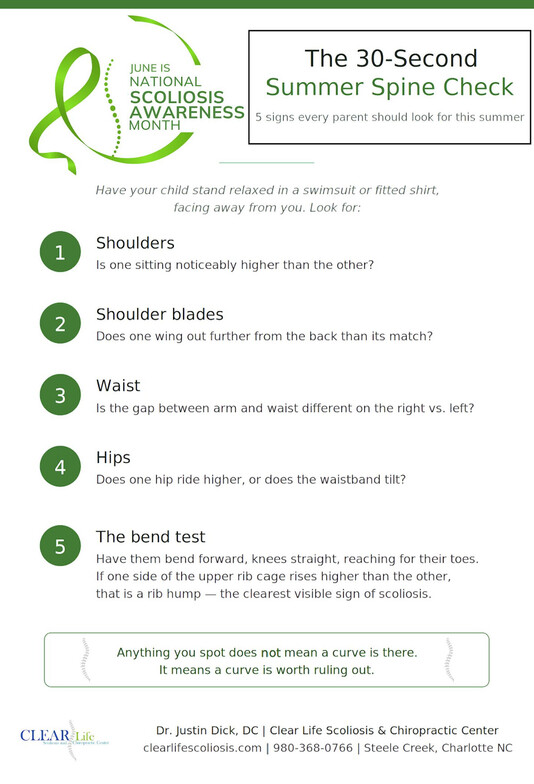
The inaugural Carolinas Scoliosis Screening Initiative took place June 25, 2026 at Clear Life Scoliosis and Chiropractic Center in Charlotte, NC. Free. No referral required. Open to anyone who walked in.
I want to report what we found. Not because the numbers are dramatic. But because they are exactly what a specialist scoliosis practice sees every week when patients finally arrive after years in the general healthcare system. The CSSI screening was designed to find these patients earlier. Today it did.
The Aggregate Picture
Both consultations were female. Both left with a written clinical finding summary and a clear recommendation for formal radiographic evaluation at Clear Life Scoliosis. Neither finding was borderline.
Two Presentations That Tell the Full Story of the Scoliosis Detection Gap
An 11-Year-Old With a Curve Above 50 Degrees
An 11-year-old girl attended the screening with her family. The Adams forward bend test was significantly positive. Scoliometer measurement confirmed a substantial angle of trunk rotation. Based on the clinical findings a curve above 50 degrees is the working assessment pending formal weight-bearing radiographic evaluation and Cobb angle measurement.
Let that number sit for a moment. Fifty degrees. In an 11-year-old.
A curve of 50 degrees in a skeletally immature patient is at the threshold where orthopedic surgeons begin recommending spinal fusion surgery. It is not a curve that developed overnight. A curve of this magnitude in an 11-year-old represents years of progression — likely beginning in the 15 to 20 degree range during the years when she was attending annual pediatric wellness visits, receiving school physicals, and presumably seeing healthcare providers on a regular basis.
The question this presentation forces is not a clinical one. The clinical picture is clear. The question is systemic: how does a curve progress to 50+ degrees in a child who has been receiving regular healthcare without anyone identifying it as a clinical priority requiring specialist evaluation?
The answer is the same every time. North Carolina does not require school scoliosis screening. The Adams forward bend test at a 15-minute annual wellness visit competes with vaccines, developmental milestones, behavioral concerns, and a dozen other clinical priorities. "Come back in six months if it gets worse" is not a treatment plan — it is an observation strategy that allows progression to continue unchecked during the years when intervention is most effective.
This family did not fail the healthcare system. The healthcare system failed this child by not having a structured specialist detection pathway in place during the years when this curve was small enough to manage conservatively.
She has been referred for a complete evaluation at Clear Life Scoliosis including weight-bearing radiographs, Cobb angle measurement, Lenke classification, Risser staging, and cervical spine assessment. The clinical picture that evaluation produces will determine what the options are. At 50+ degrees in an 11-year-old the options are narrower than they would have been at 20 degrees two or three years ago. But there are still options and they deserve to be fully understood before any decision is made. A scoliosis second opinion at Clear Life is the right first step for this family.
A Woman in Her 80s With a 30-Degree Curve
The second consultation was a woman in her 80s. Her curve measured at 30 degrees on clinical assessment. She had a scoliosis diagnosis. She knew about it.
What she did not have was a current evaluation, a defined monitoring protocol, or a clear understanding of what her curve means for her health trajectory at this stage of life.
Adult scoliosis is not the same clinical problem as adolescent scoliosis. Skeletal maturity means the rapid progression risk of the growth years has passed. But degenerative changes superimposed on a pre-existing scoliotic curve produce a different and in some ways more complex clinical picture. Asymmetric loading across facet joints and intervertebral discs over decades accelerates degenerative changes on the concave side of the curve. Pain patterns shift. Functional limitations develop gradually and are often attributed to normal aging rather than to the structural asymmetry driving them.
A woman in her 80s with a 30-degree scoliosis curve who has not had a specialist evaluation in years — or possibly ever — deserves a current radiographic assessment, a clear explanation of what her curve means for her functional health trajectory, and an honest discussion of what conservative management looks like at this stage. Our published research on radiographic sagittal alignment and kinetic chain alterations in geriatric scoliosis patients documents exactly this clinical picture — the relationship between spinal alignment and gait, balance, and functional limitation in older adults.
She left with a written clinical finding summary and a referral recommendation for formal evaluation. Her curve is not surgical. It is manageable. And managing it proactively over the coming years produces a fundamentally different functional outcome than leaving it unmonitored while degenerative changes accumulate on the concave side.
What These Two Presentations Have in Common
They are both female. Adolescent idiopathic scoliosis affects girls at a significantly higher rate than boys and tends to progress more aggressively in girls during the growth years. That demographic reality is well documented in the published scoliosis literature and it is reflected in every specialist scoliosis practice's patient population.
Neither presentation was found through a system designed to find it. The 11-year-old did not come to the CSSI screening because a school nurse flagged her. North Carolina does not have mandatory school screening. She came because her family brought her. The woman in her 80s did not come because her internist ordered a scoliosis evaluation. She came because the screening was free, local, and accessible.
That is not a success story about the CSSI screening finding two patients. That is a failure story about a detection system that left both of them to find their own way to a specialist.
The CSSI exists to shorten that path.
The Clinical Argument for Early Detection — What the Data Shows
Dr. Justin Dick's published research on non-surgical scoliosis outcomes documents what is achievable when patients reach specialist care at the right stage of their curve. A published case series on adolescent idiopathic scoliosis demonstrates measurable Cobb angle reduction through non-surgical management using the CLEAR Institute intensive protocol. A 13-month follow-up study documents the durability of that correction.
Those outcomes are achievable in patients who arrive at the right point in their curve progression. They are significantly harder to achieve — and in some cases no longer achievable without surgery — for patients who arrive after years of unmonitored progression.
The 50-degree curve in the 11-year-old who walked into the CSSI screening today is not a failure of that child or her family. It is a data point in an argument about what happens when a state eliminates mandatory school scoliosis screening and replaces it with nothing.
The watchful waiting problem in one sentence:
A curve that is 20 degrees in June can be 30 degrees in September in a skeletally immature patient at peak growth velocity — and "observe and wait" without defined action criteria is not a monitoring protocol, it is an absence of one. A specialist second opinion at Clear Life establishes those criteria.
What Every Participant Received
Every family who attended the June 25 screening — regardless of whether their finding was positive or negative — left with a written clinical finding summary. The summary includes the Adams forward bend test result, scoliometer measurement if applicable, a clinical recommendation, and contact information for scheduling a formal evaluation at Clear Life Scoliosis.
The written summary is formatted specifically to be shared with a pediatrician or family medicine physician. For the 11-year-old whose finding suggests a curve above 50 degrees — that summary is the document her pediatrician needs to understand the clinical urgency of the referral recommendation.
Families seeking a formal evaluation can learn more about what a specialist scoliosis evaluation at Clear Life includes before booking.
The Next CSSI Quarterly Screening — September 25, 2026
The Carolinas Scoliosis Screening Initiative runs quarterly. The next screening is:
Thursday, September 25, 2026 · 5:00 PM to 6:00 PM
Clear Life Scoliosis and Chiropractic Center
8814 Rachel Freeman Way, Suite 103 · Charlotte, NC 28278
No appointment needed · No referral required · No cost · Open to all ages
The September screening is listed on Natural Awakenings Charlotte. December and March screenings are also confirmed:
- December 17, 2026 · 5:00 to 6:00 PM
- March 25, 2027 · 5:00 to 6:00 PM
All four quarterly events are listed on the CSSI program page.
If you know a family in Charlotte whose child has never had a scoliosis evaluation — share this post. Share the September 25 event listing. The screening takes less than ten minutes. The written finding summary they leave with costs nothing. The clinical information it produces could change the trajectory of a child's treatment in a way that no amount of watchful waiting ever will.
If You Missed June 25 — What to Do Now
Families who were unable to attend the June screening and who have a clinical concern that cannot wait until September 25 have two immediate options:
- Schedule a formal evaluation at Clear Life Scoliosis now. Summer is the highest-risk window for progression in skeletally immature patients — peak growth velocity aligns with the school break. A curve that is 20 degrees in June can be 30 degrees in September. If you have a concern — call 980-368-0766 or book online at Clear Life. No referral required. Learn more about the CLEAR scoliosis care program before booking.
- Request a scoliosis second opinion if your family has already received a recommendation and is uncertain about the next step. A specialist evaluation at Clear Life includes Risser staging, Lenke classification, and cervical spine assessment that standard evaluations routinely omit.
Schedule a Scoliosis Evaluation in Charlotte
The next CSSI free screening is September 25, 2026. For families who need an evaluation before then — formal evaluations are available now at Clear Life Scoliosis and Chiropractic Center in Charlotte. No referral required. Cash-based practice. Same-day evaluation and treatment available for out-of-town families.
→ Book Online | Call 980-368-0766
Clear Life Scoliosis and Chiropractic Center · 8814 Rachel Freeman Way, Suite 103 · Charlotte, NC 28278
Justin Dick
Contact Me