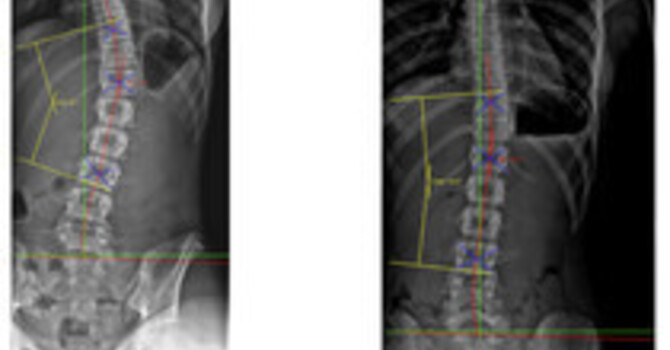
Adolescent idiopathic scoliosis does not appear to stunt skeletal growth. In cohort studies, girls with idiopathic scoliosis were on average taller and leaner than age-matched peers. What a curve does is take up some of the trunk's length, so standing height is a little less than the spine's full length would allow. In surgical series, straightening the curve adds about 3 to 4 centimeters of standing height on average.
I am Dr. Justin Dick at Clear Life Scoliosis and Chiropractic Center in Charlotte, NC. Parents often ask whether a curve will keep their child from reaching full height. This post separates growth from measured height and explains why growth is the bigger issue for the curve.
Growth: Girls With Scoliosis Are Often Taller
Yim and colleagues followed 611 girls with idiopathic scoliosis and 296 controls in Hong Kong, 194 and 116 of them to skeletal maturity. Girls with scoliosis were generally taller, with longer arm spans and lower body mass index. Girls whose curves reached 40° or more were shorter at age 12 but caught up with and overtook controls by 14 to 16, had faster arm span growth, and had menarche about 6 months later than controls.
Barrios and colleagues found that 52 Spanish girls with nonsurgically treated scoliosis were lighter and had a lower body mass index than 92 controls, with 21 percent below a BMI of 17.5. Normelli and colleagues reported that Swedish girls with thoracolumbar or double curves were taller at menarche than controls.
These are associations. They do not show that scoliosis causes faster growth, and the patterns may differ by curve type and population.
Height: How a Curve Hides Length
A curved spine is shorter top to bottom than the same spine straight. The bigger the curve, the more length is folded into it. The surgical literature quantifies this. Ikwuezunma and colleagues measured 387 patients after posterior fusion and found a mean clinical height gain of 3.1 centimeters, and they proposed a simple estimate of 0.77 millimeters of height per degree of Cobb angle corrected. Smorgick and colleagues reported a mean of 3.85 centimeters in 87 patients, and Langlais and colleagues 4.2 centimeters in 116.
Applied as an example: a 50° curve corrected to 15° is 35° of correction, and 35 times 0.77 millimeters is about 2.7 centimeters. That is the height the curve was holding. It applies to surgical correction and does not predict what conservative care will change.
Why Growth Matters More for the Curve
Curves progress fastest during the adolescent growth spurt, and the risk falls as skeletal maturity approaches. A tall, fast-growing child with a curve and years of growth left is the patient I watch most closely. My posts on when scoliosis progresses the most and the best age to treat scoliosis cover that window.
Height Loss in Adults
Adults who lose height over the years usually do so from disc height loss, vertebral compression, and forward posture, sometimes with a degenerative curve. That is a different process from adolescent growth. My post on getting shorter with age covers it.
How Dr. Justin Dick Tracks Growth at Clear Life
At our Charlotte office, growing patients have standing and sitting height, arm span, and menarche status recorded at each visit, along with skeletal maturity on the radiograph. A fast change in height or arm span shortens the re-check interval, because growth velocity is the period of highest progression risk. Care runs through the CLEAR protocol and bracingwhen indicated.
Comparison
| Question | What the evidence shows | Source |
|---|---|---|
| Are girls with AIS shorter? | Generally taller and leaner than controls | Yim 2012, cohort of 611 |
| Do severe curves change the growth pattern? | Shorter at 12, taller by 14 to 16, later menarche | Yim 2012 |
| How much height does a curve hold? | About 0.77 mm per degree corrected surgically | Ikwuezunma 2022, 387 patients |
| Average height gain after fusion | 3.1 to 4.2 cm | Ikwuezunma 2022; Smorgick 2021; Langlais 2020 |
Research and Evidence
Evidence tiering: the growth findings are cohort and cross-sectional studies. The height-per-degree figure is a regression estimate from one surgical cohort. The worked example is my calculation from that estimate.
My own published work tracks curves through growth. The 13-month follow-up case, Reduction of Adolescent Idiopathic Scoliosis: A 13-Month Follow-Up (Cureus, 2025, PMID 40062184), describes a 14-year-old whose curve went from 42.4° to 23.8° during growth. It is one case and did not report height.
References
- Yim APY, Yeung HY, Hung VWY, et al. Abnormal skeletal growth patterns in adolescent idiopathic scoliosis: a longitudinal study until skeletal maturity. Spine. 2012;37(18):E1148-54. doi:10.1097/BRS.0b013e31825c036d
- Barrios C, Cortés S, Pérez-Encinas C, et al. Anthropometry and body composition profile of girls with nonsurgically treated adolescent idiopathic scoliosis. Spine. 2011;36(18):1470-7. doi:10.1097/BRS.0b013e3181f55083
- Normelli H, Sevastik J, Ljung G, Aaro S, Jönsson-Söderström AM. Anthropometric data relating to normal and scoliotic Scandinavian girls. Spine. 1985;10(2):123-6. doi:10.1097/00007632-198503000-00002
- Ikwuezunma I, Wang K, Raymond S, et al. Height gain after spinal fusion for idiopathic scoliosis: which model fits best? J Pediatr Orthop. 2022;42(9):457-461. doi:10.1097/BPO.0000000000002225
- Smorgick Y, Tamir E, Mirovsky Y, et al. Height gain prediction in adolescent idiopathic scoliosis based on preoperative parameters. J Pediatr Orthop. 2021;41(8):502-506. doi:10.1097/BPO.0000000000001905
- Langlais T, Verdun S, Compagnon R, et al. Prediction of clinical height gain from surgical posterior correction of idiopathic scoliosis. J Neurosurg Spine. 2020;33(4):507-512. doi:10.3171/2020.3.SPINE191541
- Lonstein JE, Carlson JM. The prediction of curve progression in untreated idiopathic scoliosis during growth. J Bone Joint Surg Am. 1984;66(7):1061-71. PMID 6480635
- Dick JM, Spurgeon S. Reduction of adolescent idiopathic scoliosis: a 13-month follow-up. Cureus. 2025;17(2):e78669. doi:10.7759/cureus.78669
Frequently Asked Questions
Can scoliosis stunt growth?
There is no evidence that idiopathic scoliosis stunts skeletal growth. In a cohort of 611 girls, those with scoliosis were generally taller and leaner than age-matched controls.
Does scoliosis make you shorter?
A curve folds some trunk length into the bend, so standing height is slightly less than the straight spine would be. Surgical studies estimate about 0.77 millimeters per degree of curve.
How much height does a scoliosis curve take away?
In surgical series, straightening the curve added about 3 to 4 centimeters of standing height on average. A 35-degree correction works out to about 2.7 centimeters.
Do growth spurts make scoliosis worse?
Curves progress fastest during the adolescent growth spurt. Dr. Justin Dick at Clear Life Scoliosis in Charlotte, NC tracks height and arm span at each visit to time re-checks.
Why are girls with scoliosis often thin?
Studies have found lower body mass index in girls with idiopathic scoliosis. One study found 21 percent had a BMI below 17.5. The reason is not established.
Where can I get my child's curve and growth monitored in Charlotte, NC?
Clear Life Scoliosis and Chiropractic Center, 8814 Rachel Freeman Way, Suite 103, Charlotte, NC 28278, tracks growth and curves with Dr. Justin Dick, DC, CLEAR Institute Senior Fellow. Call 980-368-0766.
Service Area
Clear Life Scoliosis and Chiropractic Center sees patients from Charlotte NC, Huntersville NC, Ballantyne NC, Matthews NC, Concord NC, Mooresville NC, Rock Hill SC, Fort Mill SC. Families from across the Charlotte region and the South Carolina border communities come to the Rachel Freeman Way office for radiographic scoliosis evaluation with Dr. Justin Dick, DC.
Related Pages
- When Scoliosis Progresses the Most
- Best Age to Treat Scoliosis
- Getting Shorter With Age
- Juvenile Scoliosis
- Infantile Scoliosis
- For Parents of Teens With Scoliosis
- Adolescent Scoliosis Treatment
- Bracing for Scoliosis
- CLEAR Scoliosis Protocol
- Dr. Justin Dick Research
Schedule an Evaluation in Charlotte
If you are worried about your child's growth and their curve, the useful measures are growth velocity and skeletal maturity. Dr. Justin Dick tracks both at our Charlotte office.
Dr. Justin Dick, DC · ORCID 0009-0001-2794-2159
8814 Rachel Freeman Way, Suite 103, Charlotte, NC 28278
Phone: 980-368-0766 · Email: office@clearlifescoliosis.com
clearlifescoliosis.com · Book online
Justin Dick
Contact Me