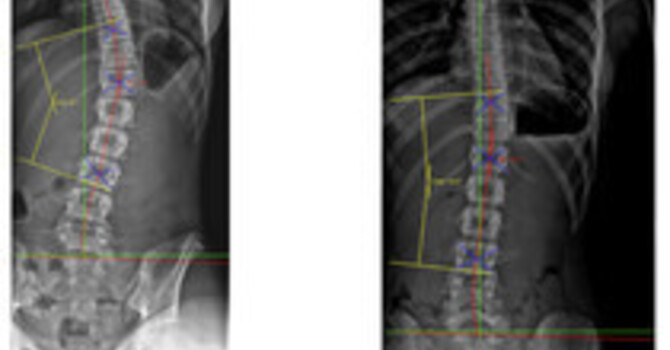
Vertebral body tethering (VBT) attaches screws to the front-side (anterior) vertebral bodies on the convex side of the curve and connects them with a flexible cord. The goal is to correct the curve without fusing it and, in growing patients, to guide growth. Anterior scoliosis correction (ASC) is a related term the literature uses for tether-based anterior correction, including in adults. In a 2026 meta-analysis of 1,263 patients, thoracic curves improved by about half at one to two years, tether breakage occurred in 25 percent and in up to 48 percent by three years, and 7 percent needed reoperation.
I am Dr. Justin Dick at Clear Life Scoliosis and Chiropractic Center in Charlotte, NC. I do not perform surgery. Families increasingly ask about tethering as a "non-fusion" option, and this post lays out the published numbers so the question can be asked with them in hand.
How Tethering Is Supposed to Work
The tether compresses the convex side of the curve. In a growing spine, the theory is that compression slows growth on that side while the concave side keeps growing, so the curve straightens over time. That depends on enough growth remaining, which is why timing and skeletal maturity are central to patient selection. Correction achieved at surgery and correction from growth modulation are different things, and the studies do not always separate them.
Correction
Hevia and colleagues pooled 27 VBT studies with 1,263 patients. Main thoracic curves went from 46.8° to 20.6° at one year (53.3 percent) and from 42.9° to 22.7° at two years (47.6 percent). Thoracolumbar curves improved by 53.8 percent at one year and 48 percent at two. Thoracic kyphosis did not change significantly. The authors found that some early correction was lost and that the evidence for true growth modulation was not consistent. Roser and colleagues pooled 16 studies and found a mean change from 47.8° to 22.2° at a minimum of two years.
Wong and colleagues analyzed VBT in three dimensions and found the coronal Cobb angle improved while axial rotation worsened. A curve that looks better on a front-facing film can still be rotating.
Complications and Reoperation
Tether breakage is the most common complication. Roser and colleagues reported a total complication rate of 23 percent, with breakage in 21.9 percent and conversion to spinal fusion in 7.2 percent. Hevia and colleagues reported breakage in 25 percent of all patients and up to 48 percent at three years, with 7 percent reoperation.
Tether-Based Correction in Adults
Pereverzev and colleagues reported anterior scoliosis correction in 29 patients over 40 with curves above 30°. Mean correction was 59 percent, from 52.5° to 21.3°, drifting to 24.0° at about 2.8 years, mainly from subsidence. Subsidence of more than 5° occurred in 17 percent and was more likely after age 50 and with curves over 50°. In adults there is no growth to modulate, so correction comes from the surgery itself. This is a single-center series of 29.
Tethering Compared With Fusion
Stamiris and colleagues pooled 17 comparative studies. Fusion produced lower postoperative curve angles, better coronal balance, and lower complication and revision rates. Tethering preserved more lumbar flexion, produced better shoulder balance, and scored better on SRS-22 pain, satisfaction, and function at two years, with shorter operations and less blood loss. Long-term data were lacking for both comparisons.
What Families Should Ask
These are the questions I suggest families take to the surgeon: How much growth remains, and how is that measured? What correction is expected at surgery and what from growth? What is the surgeon's own tether breakage and reoperation rate, and over what follow-up? What happens if the tether breaks? Is overcorrection a risk at this growth stage? My posts on surgery risks and outcomes covers the fusion side.
How Dr. Justin Dick Supports Surgical Decisions at Clear Life
At our Charlotte office, families considering any surgery get a full radiographic review, including rotation and skeletal maturity, and a plain account of the non-surgical options that fit the curve. When surgery is indicated, I refer to spine surgeons. Our second opinion page describes that process.
Comparison
| Measure | Vertebral body tethering | Source |
|---|---|---|
| Main thoracic correction at 2 years | 42.9° to 22.7° (47.6%) | Hevia 2026, 1,263 patients |
| Tether breakage | 25% of all patients, up to 48% at 3 years | Hevia 2026 |
| All complications | 23% | Roser 2023 |
| Conversion to fusion | 7.2% | Roser 2023 |
| Compared with fusion | Less correction, more revisions; better motion and shoulder balance | Stamiris 2025, 17 studies |
| Axial rotation | Worsened while coronal Cobb improved | Wong 2024, case series |
Research and Evidence
Evidence tiering: Hevia, Roser, and Stamiris are meta-analyses of mostly retrospective, non-randomized studies. Wong is a small case series and Pereverzev a single-center prospective series. No randomized trial of tethering against fusion or against conservative care was found in my search.
My own published work concerns non-surgical care. The Lenke 5C case report, A Non-surgical Multimodal Approach to Adolescent Idiopathic Scoliosis (Lenke 5C) Using an Intensive Two-Week CLEAR Institute Protocol: A Report of Two Cases (Cureus, 2026, PMID 41640942), describes two adolescents with thoracolumbar curves managed without surgery. It is case-level evidence and does not compare against tethering.
References
- Hevia E, Burgos J, García V, et al. Emerging growth modulation techniques in treatment of adolescent idiopathic scoliosis: a meta-analysis of the outcomes and safety of anterior vertebral body tethering and ApiFix. Asian Spine J. 2026. doi:10.31616/asj.2025.0612
- Roser MJ, Askin GN, Labrom RD, et al. Vertebral body tethering for idiopathic scoliosis: a systematic review and meta-analysis. Spine Deform. 2023;11(6):1297-1307. doi:10.1007/s43390-023-00723-9
- Stamiris S, Sofos C, Sarridimitriou A, et al. Comparative meta-analysis of vertebral body tethering and posterior spinal fusion in patients with idiopathic scoliosis. Spine Deform. 2025;13(5):1399-1420. doi:10.1007/s43390-025-01113-z
- Wong TKT, Kwan KYH, Cheung JPY, Cheung KMC. A case series in vertebral body tethering results in improvement in coronal Cobb angle but deterioration in axial rotation: a 3-dimensional analysis. J Spine Surg. 2024;10(4):687-696. doi:10.21037/jss-24-59
- Pereverzev V, Kazmin A, Kolesov S. Anterior scoliosis correction in patients over forty years: results, complications, prognosis. Int Orthop. 2025;49(11):2717-2723. doi:10.1007/s00264-025-06657-3
- Whelan J, Paige P, Dick JM. A non-surgical multimodal approach to adolescent idiopathic scoliosis (Lenke 5C) using an intensive two-week CLEAR Institute protocol: a report of two cases. Cureus. 2026;18(1):e102006. doi:10.7759/cureus.102006
Frequently Asked Questions
What is vertebral body tethering for scoliosis?
It is a surgery that attaches screws to the front of the vertebrae on the convex side and connects them with a flexible cord to correct the curve without fusion and, in growing patients, to guide growth.
Is anterior scoliosis correction the same as tethering?
Anterior scoliosis correction is a related term for tether-based anterior correction. A 2025 series of 29 adults over 40 reported 59 percent mean correction, with subsidence over 5 degrees in 17 percent.
How often does a scoliosis tether break?
A 2026 meta-analysis of 1,263 patients found tether breakage in 25 percent of all patients and up to 48 percent by three years.
How much correction does tethering give?
In the same meta-analysis, main thoracic curves improved by about 48 to 53 percent at one to two years. Some early correction was lost over time.
Is tethering better than spinal fusion?
It trades off. A 2025 meta-analysis found fusion gave more correction and fewer revisions, while tethering kept more motion and better shoulder balance at two years.
Where can I get a second opinion before tethering surgery in Charlotte, NC?
Clear Life Scoliosis and Chiropractic Center, 8814 Rachel Freeman Way, Suite 103, Charlotte, NC 28278, provides radiographic second opinions with Dr. Justin Dick, DC, who holds CNMT and ARRT(N)(CT) imaging credentials. Call 980-368-0766.
Service Area
Clear Life Scoliosis and Chiropractic Center sees patients from Charlotte NC, Huntersville NC, Ballantyne NC, Matthews NC, Concord NC, Mooresville NC, Rock Hill SC, Fort Mill SC. Families from across the Charlotte region and the South Carolina border communities come to the Rachel Freeman Way office for radiographic scoliosis evaluation with Dr. Justin Dick, DC.
Related Pages
- Scoliosis Surgery Risks and Outcomes
- Scoliosis Care After Spinal Fusion
- Avoiding Spinal Fusion
- Scoliosis Surgery Considerations
- Scoliosis Second Opinion
- Spinal Rotation in Scoliosis
- When Scoliosis Progresses the Most
- Treatment Options
- Bracing for Scoliosis
- Dr. Justin Dick Research
Schedule an Evaluation in Charlotte
If a surgeon has suggested tethering, the published numbers are worth reviewing against your child's growth stage and curve. Dr. Justin Dick can review the films with you at our Charlotte office.
Dr. Justin Dick, DC · ORCID 0009-0001-2794-2159
8814 Rachel Freeman Way, Suite 103, Charlotte, NC 28278
Phone: 980-368-0766 · Email: office@clearlifescoliosis.com
clearlifescoliosis.com · Book online
Justin Dick
Contact Me