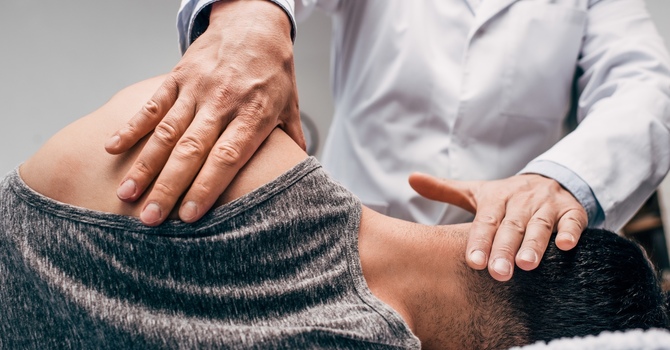
Cervical radiculopathy is irritation or compression of a nerve root in the neck, causing pain, numbness, tingling, or weakness down one arm in that root's pattern. It is common and usually improves: in a Minnesota population study of 561 patients, the annual incidence was 83.2 per 100,000, the C7 root was most often involved, and 90 percent were asymptomatic or only mildly affected at a median follow-up of 4.9 years. Radiculopathy can also occur in the low back, where it is usually called sciatica, and rarely in the mid back.
I am Dr. Justin Dick at Clear Life Scoliosis and Chiropractic Center in Charlotte, NC. I treat cervical radiculopathy from degeneration and after motor vehicle collisions, and I have published a case of post-collision cervical radiculopathy in a patient with scoliosis.
Cervical, Thoracic, and Lumbar Radiculopathy
Radiculopathy describes the nerve root problem, not the level. Cervical radiculopathy affects the arm, lumbar radiculopathy the leg, and thoracic radiculopathy, which is uncommon, wraps around the chest or abdomen in a band. This post focuses on the neck. My posts on pinched nerve vs herniated disc and hip pain and sciatica cover the low back.
Causes
Radhakrishnan and colleagues found that 68.4 percent of cases were related to spondylosis, disc, or both, and 21.9 percent to a confirmed disc protrusion alone. Only 14.8 percent reported physical exertion or trauma before onset. After a car crash, radiculopathy can follow a disc injury or abnormal segmental motion. Imaging must be read with care: Nakashima and colleagues found disc bulging in 87.6 percent of 1,211 people without symptoms.
How It Is Diagnosed
Diagnosis is clinical first. Wainner and colleagues compared 34 exam items against electrodiagnostic testing in 82 patients. A cluster of four findings produced a positive likelihood ratio of 30.3, though with wide confidence intervals, and the upper limb tension test A was most useful for ruling radiculopathy out. MRI confirms the level when symptoms persist, deficits are present, or a procedure is being considered.
How Often It Resolves
In the Rochester population, the median symptom duration before diagnosis was 15 days. Over a median 4.9 years, 31.7 percent had a recurrence and 26 percent had surgery. Radicular pain with sensory deficit and objective weakness predicted surgery, and 90 percent ended asymptomatic or mildly incapacitated.
Treatment Trials
Kuijper and colleagues randomized 205 patients with radiculopathy of less than one month. Arm pain fell by 19 mm on a 100 mm scale over six weeks with wait-and-see. A semi-hard collar with rest or six weeks of physiotherapy with home exercise added about 12 mm more reduction. Engquist and colleagues randomized 63 patients to anterior decompression and fusion plus physiotherapy or physiotherapy alone. Neck pain improved more with surgery, arm pain and disability did not differ, and the share rating themselves better was 87 versus 62 percent at one year but 81 versus 69 percent at two years, no longer a significant difference. The authors recommended structured physiotherapy before surgery. Basson and colleagues' meta-analysis found neural mobilization reduced chronic neck-arm pain by about 1.9 points on a 10-point scale. Bono and colleagues' North American Spine Society guideline addresses diagnosis and treatment in more detail.
When It Needs Urgent Attention
Rapidly progressive arm weakness, weakness in both arms, hand clumsiness, balance problems, or leg symptoms with neck pain can indicate spinal cord compression and need prompt MRI and specialist review.
How Dr. Justin Dick Treats Cervical Radiculopathy at Clear Life
At our Charlotte office, care begins with a dermatome, myotome, and reflex exam and the provocative tests above, plus imaging review when indicated. Treatment combines structural rehabilitation, nerve mobilization, and exercise, with repeat neurological testing to confirm progress. Patients with progressive deficits are referred.
Comparison
| Question | Finding | Source |
|---|---|---|
| How common? | 83.2 per 100,000 per year; peak at age 50 to 54 | Radhakrishnan 1994, 561 patients |
| Most affected root | C7, then C6 | Radhakrishnan 1994 |
| Long-term outcome | 90% asymptomatic or mildly affected | Radhakrishnan 1994 |
| Collar or physiotherapy vs wait-and-see | About 12 mm more arm pain reduction at 6 weeks | Kuijper 2009, 205 patients |
| Surgery plus physiotherapy vs physiotherapy | Faster early improvement; no significant difference at 2 years | Engquist 2013, 63 patients |
| Exam cluster | Positive likelihood ratio 30.3 | Wainner 2003, 82 patients |
Research and Evidence
Evidence tiering: Kuijper and Engquist are randomized trials, Basson a meta-analysis, Radhakrishnan a population cohort, Wainner a diagnostic accuracy study with wide confidence intervals, Nakashima a cross-sectional imaging study, and Bono a clinical guideline. The trials are modest in size.
My own published work includes this condition. The cervical rehabilitation case report, Radiographic Sagittal Alignment and Neurological Changes Following Conservative Cervical Structural Rehabilitation After Motor Vehicle Collision in a Patient With Pre-existing Scoliosis: A Case Report (Cureus, 2026, PMID 41783554), describes a 28-year-old woman with pre-existing thoracic scoliosis who developed right C8 sensory loss and C5 to C8 weakness after a motor vehicle collision. After 17 visits of conservative structural rehabilitation, sensation and strength normalized, her Functional Rating Index fell from 23 to 3, and repeat radiographs showed increased cervical lordosis. It is a single case, and causation cannot be established from it.
References
- Radhakrishnan K, Litchy WJ, O'Fallon WM, Kurland LT. Epidemiology of cervical radiculopathy. A population-based study from Rochester, Minnesota, 1976 through 1990. Brain. 1994;117(Pt 2):325-35. doi:10.1093/brain/117.2.325
- Nakashima H, Yukawa Y, Suda K, et al. Abnormal findings on magnetic resonance images of the cervical spines in 1211 asymptomatic subjects. Spine. 2015;40(6):392-8. doi:10.1097/BRS.0000000000000775
- Wainner RS, Fritz JM, Irrgang JJ, et al. Reliability and diagnostic accuracy of the clinical examination and patient self-report measures for cervical radiculopathy. Spine. 2003;28(1):52-62. doi:10.1097/00007632-200301010-00014
- Kuijper B, Tans JT, Beelen A, Nollet F, de Visser M. Cervical collar or physiotherapy versus wait and see policy for recent onset cervical radiculopathy: randomised trial. BMJ. 2009;339:b3883. doi:10.1136/bmj.b3883
- Engquist M, Löfgren H, Öberg B, et al. Surgery versus nonsurgical treatment of cervical radiculopathy: a prospective, randomized study comparing surgery plus physiotherapy with physiotherapy alone with a 2-year follow-up. Spine. 2013;38(20):1715-22. doi:10.1097/BRS.0b013e31829ff095
- Basson A, Olivier B, Ellis R, et al. The effectiveness of neural mobilization for neuromusculoskeletal conditions: a systematic review and meta-analysis. J Orthop Sports Phys Ther. 2017;47(9):593-615. doi:10.2519/jospt.2017.7117
- Bono CM, Ghiselli G, Gilbert TJ, et al. An evidence-based clinical guideline for the diagnosis and treatment of cervical radiculopathy from degenerative disorders. Spine J. 2011;11(1):64-72. doi:10.1016/j.spinee.2010.10.023
- Dick JM, Paige P. Radiographic sagittal alignment and neurological changes following conservative cervical structural rehabilitation after motor vehicle collision in a patient with pre-existing scoliosis: a case report. Cureus. 2026;18(3):e104584. doi:10.7759/cureus.104584
Frequently Asked Questions
What is cervical radiculopathy?
Irritation or compression of a nerve root in the neck, causing pain, numbness, tingling, or weakness down one arm in that root's pattern. C7 and C6 are most often affected.
Does cervical radiculopathy go away on its own?
Usually. In a population study of 561 patients, 90 percent were asymptomatic or only mildly affected at a median of 4.9 years, though 31.7 percent had a recurrence.
What is the best treatment for a pinched nerve in the neck?
In a trial of 205 patients, a collar with rest or six weeks of physiotherapy reduced arm pain more than wait-and-see. Surgery improved early outcomes in another trial, but the difference was not significant at two years.
What are the types of radiculopathy?
Cervical affects the arm, lumbar affects the leg and is often called sciatica, and thoracic, which is uncommon, causes band-like pain around the chest or abdomen.
Can a car accident cause cervical radiculopathy?
Yes. Dr. Justin Dick at Clear Life Scoliosis in Charlotte, NC published a case of C5 to C8 weakness after a collision that normalized with conservative care. Most cases in the population have no preceding trauma.
Where can I get a pinched nerve in the neck treated in Charlotte, NC?
Clear Life Scoliosis and Chiropractic Center, 8814 Rachel Freeman Way, Suite 103, Charlotte, NC 28278, provides neurological evaluation and non-surgical care with Dr. Justin Dick, DC. Call 980-368-0766.
Service Area
Clear Life Scoliosis and Chiropractic Center sees patients from Charlotte NC, Huntersville NC, Ballantyne NC, Matthews NC, Concord NC, Mooresville NC, Rock Hill SC, Fort Mill SC. Families from across the Charlotte region and the South Carolina border communities come to the Rachel Freeman Way office for radiographic scoliosis evaluation with Dr. Justin Dick.
Related Pages
- Upper Extremity Symptoms After a Car Accident
- Neck Pain After a Car Accident
- Pinched Nerve vs Herniated Disc
- Tech Neck
- Cervical Alignment in Scoliosis
- MRI Disc Findings Without Pain
- Cervical Instability After a Car Accident
- Hip Pain and Sciatica
- Whiplash Injury Treatment
- Dr. Justin Dick Research
Schedule an Evaluation in Charlotte
If you have arm pain, numbness, or weakness from your neck, the exam pinpoints the root and guides the next step. Dr. Justin Dick provides that evaluation at our Charlotte office.
Dr. Justin M. Dick, DC
8814 Rachel Freeman Way, Suite 103, Charlotte, NC 28278
Phone: 980-368-0766 · Email: office@clearlifescoliosis.com
clearlifescoliosis.com · Book online
Justin Dick
Contact Me