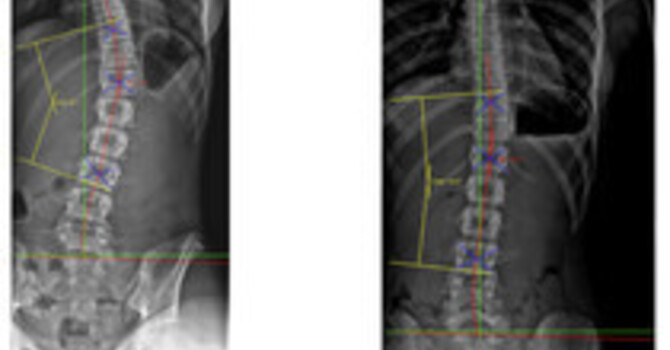
Kyphoscoliosis is a spinal deformity with both a sideways curve (scoliosis) and excessive forward rounding (kyphosis). It is not the usual pattern in adolescent idiopathic scoliosis, which tends to flatten the mid back: Clément and colleagues found that reduced thoracic kyphosis behaves as a structural feature of thoracic idiopathic curves. In clinical practice, true kyphoscoliosis is seen more often with neuromuscular disease, congenital vertebral anomalies, and inherited neuropathy. The best-quantified example I found is inherited neuropathy: in 175 patients with Charcot-Marie-Tooth disease, 31 percent of those with a spinal deformity had kyphoscoliosis. Severe kyphoscoliosis can cause respiratory failure.
I am Dr. Justin Dick at Clear Life Scoliosis and Chiropractic Center in Charlotte, NC. I hold CNMT and ARRT(N)(CT) imaging credentials. The word kyphoscoliosis is sometimes used loosely on reports for any curve with a rib hump, and part of this post is about telling those apart.
True Kyphoscoliosis vs a Rotational Rib Hump
In thoracic idiopathic scoliosis, vertebral rotation pushes the ribs backward on the convex side, creating a rib hump that can look like rounding. On a side-view radiograph, many of these spines are actually flatter than normal. Ilharreborde and colleagues noted that two-dimensional side-view measurements in severe curves can be wrong because of rotation and that three-dimensional measurement changed the result. A rib hump is not proof of kyphosis. My post on rib prominenceexplains the hump.
Causes
In clinical practice, kyphoscoliosis is seen with neuromuscular conditions, congenital vertebral malformations, and inherited neuropathies; of these, I found quantified data only for neuropathy. Horacek and colleagues found a spinal deformity in 26 percent of 175 patients with hereditary motor and sensory neuropathy; of those, 58 percent had scoliosis, 31 percent kyphoscoliosis, and 11 percent thoracic hyperkyphosis. Kyphoscoliosis also develops in older adults as degenerative curves combine with forward collapse. My post on what causes scoliosis covers the categories.
Effects on the Lungs
Thoracic deformity reduces lung function gradually. Kempen and colleagues' meta-regression of 126 studies and 8,723 untreated young patients found roughly a 1 percent drop in predicted lung function for every 2.6° to 4.5° of thoracic curve. Severe deformity can lead to chronic respiratory failure. Gustafson and colleagues followed Swedish patients with non-neuromuscular kyphoscoliosis and respiratory failure: those treated with home mechanical ventilation had better survival than those on oxygen alone (hazard ratio 0.30), after adjusting for age, sex, other lung disease, and blood gases. Pehrsson and colleagues' long-term follow-up of 115 untreated patients found 21 of 55 deaths were from respiratory failure, with excess mortality in early-onset curves.
Symptoms
Mild kyphoscoliosis may cause only visible asymmetry and rounding. Larger deformities can cause back pain, reduced exercise tolerance, and shortness of breath. Morning headaches, daytime sleepiness, or breathlessness lying flat in a patient with severe deformity are reasons for prompt pulmonary evaluation, based on clinical reasoning about nocturnal hypoventilation.
Evaluation and Treatment
Evaluation requires standing front and side radiographs, with three-dimensional assessment when rotation makes side-view angles unreliable, a neurological exam, and pulmonary testing when the thoracic deformity is significant. Treatment depends on cause and age: bracing and specific exercise during growth for flexible curves, surgical opinion for progressive or severe deformity, and pulmonary management, including ventilation when indicated, for respiratory compromise.
How Dr. Justin Dick Evaluates Kyphoscoliosis at Clear Life
At our Charlotte office, any report of kyphoscoliosis is checked against the side-view radiograph to confirm true kyphosis, with neurological screening for a neuromuscular or neuropathic cause and referral for pulmonary or surgical evaluation when indicated. Our hyperkyphosis page covers rounding without a sideways curve.
Comparison
| Topic | Finding | Source |
|---|---|---|
| Kyphosis in thoracic idiopathic scoliosis | Often reduced; hypokyphosis is structural | Clément 2013, 86 patients |
| Kyphoscoliosis in inherited neuropathy | 31% of those with a spinal deformity | Horacek 2007, 175 patients |
| Lung function and thoracic curve | About 1% per 2.6° to 4.5° | Kempen 2022, 8,723 patients |
| Respiratory failure treatment | Home ventilation survival better than oxygen alone (HR 0.30) | Gustafson 2006 |
| Deaths from respiratory failure, untreated scoliosis | 21 of 55 deaths | Pehrsson 1992, 115 patients |
Research and Evidence
Evidence tiering: Kempen is a meta-regression of observational data; Gustafson, Pehrsson, Horacek, and Clément are cohorts; Ilharreborde a multicenter case series. The symptom guidance on nocturnal hypoventilation is clinical reasoning, not a tested screening rule. Kyphoscoliosis is heterogeneous, and results from one cause do not transfer to another.
My own published work includes sagittal alignment in scoliosis. The geriatric sagittal alignment case series, Radiographic Sagittal Alignment and Kinetic Chain Alterations in Geriatric Patients With Scoliosis: A Case Series (Cureus, 2026, PMID 42037873), describes two older adults and is case-level evidence.
References
- Clément JL, Geoffray A, Yagoubi F, et al. Relationship between thoracic hypokyphosis, lumbar lordosis and sagittal pelvic parameters in adolescent idiopathic scoliosis. Eur Spine J. 2013;22(11):2414-20. doi:10.1007/s00586-013-2852-z
- Ilharreborde B, Pesenti S, Ferrero E, et al. Correction of hypokyphosis in thoracic adolescent idiopathic scoliosis using sublaminar bands: a 3D multicenter study. Eur Spine J. 2018;27(2):350-357. doi:10.1007/s00586-017-5166-8
- Horacek O, Mazanec R, Morris CE, Kobesova A. Spinal deformities in hereditary motor and sensory neuropathy: a retrospective qualitative, quantitative, genotypical, and familial analysis of 175 patients. Spine. 2007;32(22):2502-8. doi:10.1097/BRS.0b013e3181573d4e
- Kempen DHR, Heemskerk JL, Kaçmaz G, et al. Pulmonary function in children and adolescents with untreated idiopathic scoliosis: a systematic review with meta-regression analysis. Spine J. 2022;22(7):1178-1190. doi:10.1016/j.spinee.2021.12.011
- Gustafson T, Franklin KA, Midgren B, et al. Survival of patients with kyphoscoliosis receiving mechanical ventilation or oxygen at home. Chest. 2006;130(6):1828-33. doi:10.1378/chest.130.6.1828
- Pehrsson K, Larsson S, Oden A, Nachemson A. Long-term follow-up of patients with untreated scoliosis. A study of mortality, causes of death, and symptoms. Spine. 1992;17(9):1091-6. doi:10.1097/00007632-199209000-00014
- Whelan JP, Dick JM. Radiographic sagittal alignment and kinetic chain alterations in geriatric patients with scoliosis: a case series. Cureus. 2026;18(3):e105827. doi:10.7759/cureus.105827
Frequently Asked Questions
What is kyphoscoliosis?
A spinal deformity combining a sideways curve with excessive forward rounding. It differs from typical adolescent idiopathic scoliosis, which often flattens the mid back.
What causes kyphoscoliosis?
It is seen with neuromuscular disease, congenital vertebral anomalies, inherited neuropathy, and degeneration in older adults. In one study of inherited neuropathy, 31 percent of deformities were kyphoscoliosis.
Can kyphoscoliosis affect breathing?
Yes. Lung function falls about 1 percent for every 2.6 to 4.5 degrees of thoracic curve, and severe kyphoscoliosis can cause respiratory failure.
How is respiratory failure from kyphoscoliosis treated?
A Swedish study found patients on home mechanical ventilation survived longer than those on oxygen alone, with a hazard ratio of 0.30.
Is a rib hump the same as kyphoscoliosis?
No. A rib hump usually comes from rotation, and many of those spines are flatter than normal from the side. Dr. Justin Dick at Clear Life Scoliosis in Charlotte, NC confirms kyphosis on a side-view radiograph.
Where can I get kyphoscoliosis evaluated in Charlotte, NC?
Clear Life Scoliosis and Chiropractic Center, 8814 Rachel Freeman Way, Suite 103, Charlotte, NC 28278, provides radiographic evaluation with Dr. Justin Dick, DC, CNMT, ARRT(N)(CT). Call 980-368-0766.
Service Area
Clear Life Scoliosis and Chiropractic Center sees patients from Charlotte NC, Huntersville NC, Ballantyne NC, Matthews NC, Concord NC, Mooresville NC, Rock Hill SC, Fort Mill SC. Families from across the Charlotte region and the South Carolina border communities come to the Rachel Freeman Way office for radiographic scoliosis evaluation with Dr. Justin Dick.
Related Pages
- Kyphosis Treatment in Charlotte
- Hyperkyphosis Treatment
- Rib Prominence and Scoliosis
- What Causes Scoliosis
- Thoracic Scoliosis
- Spinal Rotation in Scoliosis
- Scoliosis Biomechanics and Sagittal Alignment
- Scoliosis Treatment for Adults
- Types of Scoliosis
- Dr. Justin Dick Research
Schedule an Evaluation in Charlotte
If a report says kyphoscoliosis, the side-view film and a neurological exam tell you what kind and why. Dr. Justin Dick provides that review at our Charlotte office.
Dr. Justin M. Dick, DC
8814 Rachel Freeman Way, Suite 103, Charlotte, NC 28278
Phone: 980-368-0766 · Email: office@clearlifescoliosis.com
clearlifescoliosis.com · Book online
Justin Dick
Contact Me