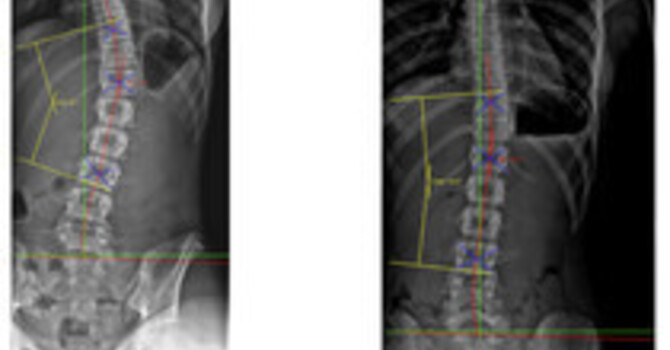
Pilates can help people with scoliosis with pain, flexibility, trunk control, and quality of life, and a meta-analysis of small randomized trials reports Cobb angle improvements as well. The quality of that evidence is low. In the head-to-head comparisons available, scoliosis-specific exercise such as Schroth outperformed Pilates on curve measures. Pilates works best as a supporting activity, adapted to the curve, alongside scoliosis-specific care.
I am Dr. Justin Dick, and at Clear Life Scoliosis and Chiropractic Center in Charlotte, NC, patients and parents often ask whether a Pilates studio can replace scoliosis rehabilitation. This post covers what the trials actually tested and how I advise patients who want to keep Pilates in their routine.
What the Meta-Analyses Report
Gou and colleagues pooled 10 randomized trials with 359 patients with idiopathic scoliosis in 2021. Pilates was associated with reductions in Cobb angle and angle of trunk rotation, less pain, better trunk range of motion, and better quality of life. The authors rated the included studies as fair quality on average, with PEDro scores from 3 to 10 out of 10, and warned that the results should be interpreted with caution.
The 2024 meta-analysis by Roque and colleagues is more useful for the comparison question. In children and adolescents, it found moderate-certainty evidence that Pilates improves thoracic and lumbar postural angles compared with inactive controls, and very low-certainty evidence that Schroth is superior to Pilates for scoliosis. A 2023 scoping review by Kuru Çolak and colleagues concluded that the evidence for Pilates on scoliosis-related deformity is very limited and suggested its main role is reducing asymmetrical posture in mild curves with low growth potential and low progression risk.
Pilates Versus Schroth
Kim and HwangBo randomized 24 patients with Cobb angles of 20° or more to Schroth or Pilates, three times a week for 12 weeks. Both groups showed Cobb angle changes within the group, and the Schroth group improved more on Cobb angle and on weight distribution between the concave and convex sides. That is one small trial, but it fits the pattern in the meta-analysis.
The reason is mechanical. Schroth and other physiotherapeutic scoliosis-specific exercises are built around the individual curve: they ask the patient to elongate, derotate, and breathe into the concave side of that specific pattern. Classical Pilates trains symmetrical core control. Symmetrical training on an asymmetric spine does not target the deformity.
Curve-Adapted Pilates
The more encouraging trials modified Pilates to the curve. Manzak Dursun and colleagues randomized 32 adolescents to a 12-week Pilates-based program supervised through hybrid telerehabilitation or the same program at home. The exercises were modified according to curve type and location. The supervised group improved more in Cobb angle and respiratory muscle strength. Rrecaj-Malaj and colleagues combined Schroth and Pilates exercises over 24 weeks in 69 adolescents with curves of 10° to 45° and reported improvements in Cobb angle, trunk rotation, chest expansion, and quality of life, though without a control group.
A word of caution about one frequently cited trial: Alves de Araújo and colleagues reported a 38 percent reduction in Cobb angle with Pilates in college students, but the curves were non-structural. A non-structural curve is expected to change. That study says little about idiopathic scoliosis. My post on postural versus structural curves explains the difference.
How to Adapt Pilates to a Scoliosis
These are the adjustments I give patients. They are clinical reasoning based on curve mechanics, not a tested protocol.
- Know the curve pattern before choosing exercises. A thoracic curve, a thoracolumbar curve, and a double curve call for different side-specific work. My posts on thoracic, thoracolumbar, and double major curves explain each pattern.
- Favor elongation and controlled breathing over end-range flexion and rotation.
- Be careful with loaded rotation toward the convex side and with deep side-bending into the curve.
- Tell the instructor the curve direction. A good instructor will modify, but most are not trained in scoliosis-specific correction.
- For a growing adolescent with a progressive curve, Pilates does not replace bracing or scoliosis-specific rehabilitation when those are indicated.
How Dr. Justin Dick Fits Pilates Into Care at Clear Life
At our Charlotte office, Pilates is welcome as a supporting activity. Scoliosis-specific rehabilitation through the CLEAR protocol addresses the curve itself, and bracing is added when growth and magnitude call for it. Patients who enjoy Pilates get a short list of curve-specific modifications to bring to their instructor. Our post on the best exercises for scoliosis covers the wider exercise evidence.
Comparison
| Approach | What it targets | Best evidence | Fit |
|---|---|---|---|
| Classical Pilates | Symmetrical core control, flexibility | Low-quality RCTs; posture gains vs inactive controls | Supporting activity, mild curves |
| Curve-adapted Pilates | Core control modified to curve type | Small RCT (Manzak Dursun 2024) | Supporting activity with guidance |
| Schroth and other PSSE | Curve-specific elongation, derotation, breathing | Outperformed Pilates in head-to-head data (Kim 2016; Roque 2024) | Primary exercise approach for structural curves |
Research and Evidence
Evidence tiering: two meta-analyses of small, mostly fair-quality randomized trials; one scoping review; a handful of small RCTs; and uncontrolled series. The head-to-head evidence favoring Schroth over Pilates is rated very low certainty. Nothing here supports Pilates as a stand-alone treatment for a progressive curve during growth.
My published work uses multimodal, curve-specific rehabilitation. The Lenke 5C case report, A Non-surgical Multimodal Approach to Adolescent Idiopathic Scoliosis (Lenke 5C) Using an Intensive Two-Week CLEAR Institute Protocol: A Report of Two Cases (Cureus, 2026, PMID 41640942), describes two adolescents treated with an intensive CLEAR protocol followed by bracing, and the labyrinthine righting reflex case, Reduction of Adolescent Idiopathic Scoliosis Utilizing the Labyrinthine Righting Reflex: A Case Report (Cureus, 2026, PMID 41685001), describes a mild curve. Both are case-level evidence and neither tested Pilates.
References
- Gou Y, Lei H, Zeng Y, Tao J, Kong W, Wu J. The effect of Pilates exercise training for scoliosis on improving spinal deformity and quality of life: meta-analysis of randomized controlled trials. Medicine (Baltimore). 2021;100(39):e27254. doi:10.1097/MD.0000000000027254
- Roque GC, de Oliveira RG, Sorzi MV, de Oliveira LC. Are Pilates exercises effective in improving postural misalignment? Systematic review and metanalysis. Musculoskeletal Care. 2024;22(4):e70009. doi:10.1002/msc.70009
- Kuru Çolak T, Akçay B, Apti A. Effects of Pilates exercises on idiopathic scoliosis: a scoping review of the literature. Spine Deform. 2023;11(4):797-804. doi:10.1007/s43390-023-00668-z
- Kim G, HwangBo PN. Effects of Schroth and Pilates exercises on the Cobb angle and weight distribution of patients with scoliosis. J Phys Ther Sci. 2016;28(3):1012-5. doi:10.1589/jpts.28.1012
- Manzak Dursun AS, Ozyilmaz S, Ucgun H, Elmadag NM. The effect of Pilates-based exercise applied with hybrid telerehabilitation method in children with adolescent idiopathic scoliosis: a randomized clinical trial. Eur J Pediatr. 2024;183(2):759-767. doi:10.1007/s00431-023-05340-2
- Rrecaj-Malaj S, Beqaj S, Krasniqi V, Qorolli M, Tufekcievski A. Outcome of 24 weeks of combined Schroth and Pilates exercises on Cobb angle, angle of trunk rotation, chest expansion, flexibility and quality of life in adolescents with idiopathic scoliosis. Med Sci Monit Basic Res. 2020;26:e920449. doi:10.12659/MSMBR.920449
- Alves de Araújo ME, Bezerra da Silva E, Bragade Mello D, et al. The effectiveness of the Pilates method: reducing the degree of non-structural scoliosis, and improving flexibility and pain in female college students. J Bodyw Mov Ther. 2012;16(2):191-8. doi:10.1016/j.jbmt.2011.04.002
- Whelan J, Paige P, Dick JM. A non-surgical multimodal approach to adolescent idiopathic scoliosis (Lenke 5C) using an intensive two-week CLEAR Institute protocol: a report of two cases. Cureus. 2026;18(1):e102006. doi:10.7759/cureus.102006
- Dick JM, Whelan J. Reduction of adolescent idiopathic scoliosis utilizing the labyrinthine righting reflex: a case report. Cureus. 2026;18(1):e101343. doi:10.7759/cureus.101343
Frequently Asked Questions
Is Pilates good for scoliosis?
Pilates can improve pain, flexibility, trunk control, and quality of life in scoliosis. A 2021 meta-analysis of 10 small randomized trials also reported Cobb angle improvements, but the authors rated the evidence as fair quality and advised caution.
Is Pilates or Schroth better for scoliosis?
In the available head-to-head data, Schroth outperformed Pilates on curve measures. A 2024 meta-analysis rated that comparison as very low certainty, and a small 2016 randomized trial found greater Cobb angle and weight distribution improvement with Schroth.
Can Pilates reduce a scoliosis curve?
Some small trials report Cobb angle changes, particularly with Pilates adapted to the curve type. The evidence is low quality, and Pilates does not replace bracing or scoliosis-specific rehabilitation for a progressive curve in a growing child.
Which Pilates exercises should I avoid with scoliosis?
Loaded rotation toward the convex side and deep side-bending into the curve are the movements I modify first. Dr. Justin Dick at Clear Life Scoliosis in Charlotte, NC gives patients curve-specific modifications to share with their instructor.
Should I tell my Pilates instructor about my scoliosis?
Yes, including the curve direction and location. Most Pilates instructors are not trained in scoliosis-specific correction, so the modifications should come from the clinician managing the curve.
Where can I get scoliosis-specific exercise guidance in Charlotte, NC?
Clear Life Scoliosis and Chiropractic Center, 8814 Rachel Freeman Way, Suite 103, Charlotte, NC 28278, provides curve-specific rehabilitation through the CLEAR protocol with Dr. Justin Dick, DC, an ISICO World Masters credential holder. Call 980-368-0766.
Service Area
Clear Life Scoliosis and Chiropractic Center sees patients from Charlotte NC, Huntersville NC, Ballantyne NC, Matthews NC, Concord NC, Mooresville NC, Rock Hill SC, Fort Mill SC. Families from across the Charlotte region and the South Carolina border communities come to the Rachel Freeman Way office for radiographic scoliosis evaluation with Dr. Justin Dick.
Related Pages
- Best Exercises for Scoliosis
- Sports and Scoliosis
- Chiropractor or Physical Therapist for Scoliosis
- Postural vs Structural Scoliosis
- Thoracic Scoliosis
- Thoracolumbar Scoliosis
- Double Major and S-Shaped Scoliosis
- CLEAR Scoliosis Protocol
- Scoliosis Physical Therapy
- Dr. Justin Dick Research
Schedule an Evaluation in Charlotte
If you want to keep Pilates in your routine, bring your curve pattern to the conversation first. Dr. Justin Dick can give you the modifications at our Charlotte office.
Dr. Justin M. Dick, DC
8814 Rachel Freeman Way, Suite 103, Charlotte, NC 28278
Phone: 980-368-0766 · Email: office@clearlifescoliosis.com
clearlifescoliosis.com · Book online
Justin Dick
Contact Me