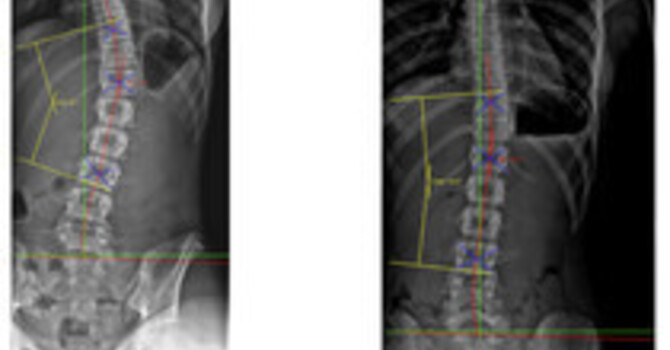
Low bone density is common in adolescent idiopathic scoliosis, and in adults osteoporosis contributes to curve progression. Cheng and colleagues compared 75 girls aged 12 to 14 with scoliosis against 94 controls and found generalized lower bone density, with 38 percent of the scoliosis group more than one standard deviation below normal. In a follow-up of osteopenic girls with scoliosis, low bone density persisted for up to three years. Sun and colleagues found osteopenia was an independent risk factor for curve progression in braced girls. Scoliosis itself is not proven to cause osteoporosis; the evidence shows the two travel together.
I am Dr. Justin M. Dick, DC, at Clear Life Scoliosis and Chiropractic Center in Charlotte, NC. Bone health is part of the history I take in teens and in older adults with curves, and this post explains why.
Low Bone Density in Teens With Scoliosis
Cheng and colleagues measured bone density at the spine, hips, forearm, and shins. Girls with scoliosis had lower density throughout, most clearly in the trabecular bone of the shins. Bone density was not associated with curve severity. In a separate longitudinal study, 14 girls with scoliosis and osteopenia more than two standard deviations below normal stayed significantly lower than 70 controls for up to three years. The authors suggested this could mean lower peak bone mass in adulthood. Cheng and colleagues at a Beijing center also found asymmetric bone density across the curve, lower on the convex side, increasing with curve severity.
Does Low Bone Density Predict Progression?
Sun and colleagues followed 68 braced girls. Seventeen (25 percent) progressed. The progressed group had lower lumbar bone density (0.80 vs 0.88 g/cm²), and osteopenia was an independent risk factor for progression during bracing. This was a single-center study and has not established bone density testing as a routine part of brace planning.
Osteoporosis and Adult Curves
Aebi's review of adult scoliosis describes a secondary adult curve type tied to metabolic bone disease, mainly osteoporosis, combined with asymmetric arthritis or vertebral fractures, and notes that osteoporosis supports progression in post-menopausal women. A compression fracture on one side of a vertebra can tilt the spine and start or worsen a curve. That is the mechanism Aebi describes, and it is why I look for wedge fractures on films of older adults with new or worsening curves.
What This Means in Practice
These are my clinical recommendations, not tested protocols: teens with scoliosis should have adequate calcium, vitamin D, and weight-bearing activity, and those with fractures from minor trauma, very low body weight, or other risk factors should discuss bone testing with their physician. Adults with scoliosis, especially post-menopausal women, should be screened for osteoporosis according to their physician's guidelines. My post on getting shorter with age covers height loss from fractures.
How Dr. Justin M. Dick, DC Considers Bone Health at Clear Life
At our Charlotte office, bone health history is part of every scoliosis intake, radiographs are read for fractures and bone quality, and techniques are adapted for patients with known osteoporosis. Patients with risk factors are referred for bone density testing.
Comparison
| Finding | Result | Source |
|---|---|---|
| Bone density in girls with scoliosis | Generalized lower; 38% more than 1 SD below normal | Cheng 2000, 75 vs 94 |
| Persistence of osteopenia | Lower for up to 3 years | Cheng 1999, 14 vs 70 |
| Osteopenia and progression in bracing | Independent risk factor | Sun 2013, 68 girls |
| Bone density across the curve | Lower on convex side, worse with larger curves | Cheng 2022, 93 patients |
| Osteoporosis in adult curves | Contributes to progression, especially post-menopause | Aebi 2005, review |
Research and Evidence
Evidence tiering: the bone density studies are cross-sectional or small longitudinal cohorts, mostly from Chinese centers; Sun is a single-center cohort; Aebi a narrative review. The direction of causation between scoliosis and low bone density is not established. The practical recommendations above are clinical judgment.
My own published work includes older adults with scoliosis. The geriatric sagittal alignment case series, Radiographic Sagittal Alignment and Kinetic Chain Alterations in Geriatric Patients With Scoliosis: A Case Series (Cureus, 2026, PMID 42037873), describes two patients and is case-level evidence.
References
- Cheng JC, Qin L, Cheung CS, et al. Generalized low areal and volumetric bone mineral density in adolescent idiopathic scoliosis. J Bone Miner Res. 2000;15(8):1587-95. doi:10.1359/jbmr.2000.15.8.1587
- Cheng JC, Guo X, Sher AH. Persistent osteopenia in adolescent idiopathic scoliosis. A longitudinal follow up study. Spine. 1999;24(12):1218-22. doi:10.1097/00007632-199906150-00008
- Sun X, Wu T, Liu Z, et al. Osteopenia predicts curve progression of adolescent idiopathic scoliosis in girls treated with brace treatment. J Pediatr Orthop. 2013;33(4):366-71. doi:10.1097/BPO.0b013e31827b7b5f
- Cheng Y, Yang H, Hai Y, et al. Hounsfield unit for assessing asymmetrical loss of vertebral bone mineral density and its correlation with curve severity in adolescent idiopathic scoliosis. Front Surg. 2022;9:1000031. doi:10.3389/fsurg.2022.1000031
- Aebi M. The adult scoliosis. Eur Spine J. 2005;14(10):925-48. doi:10.1007/s00586-005-1053-9
- Whelan JP, Dick JM. Radiographic sagittal alignment and kinetic chain alterations in geriatric patients with scoliosis: a case series. Cureus. 2026;18(3):e105827. doi:10.7759/cureus.105827
Frequently Asked Questions
Can scoliosis lead to osteoporosis?
The two are associated, but causation is not established. Teen girls with scoliosis had lower bone density than controls, and 38 percent were more than one standard deviation below normal in one study.
Does low bone density make scoliosis worse?
It may. In 68 braced girls, osteopenia was an independent risk factor for curve progression.
Can osteoporosis cause scoliosis in adults?
It can contribute. Osteoporosis and one-sided compression fractures are a recognized route to adult curves and progression, especially after menopause.
Should teens with scoliosis get a bone density test?
Not routinely, but teens with fractures from minor trauma, very low body weight, or other risk factors should discuss it with their physician, according to Dr. Justin M. Dick, DC at Clear Life Scoliosis in Charlotte, NC.
Is chiropractic care safe with osteoporosis?
Techniques need to be adapted. Dr. Justin M. Dick, DC reviews bone health history and radiographs before care and adjusts methods for known osteoporosis.
Where can I get scoliosis and bone health evaluated in Charlotte, NC?
Clear Life Scoliosis and Chiropractic Center, 8814 Rachel Freeman Way, Suite 103, Charlotte, NC 28278, provides scoliosis evaluation with Dr. Justin M. Dick, DC. Call 980-368-0766.
Service Area
Clear Life Scoliosis and Chiropractic Center sees patients from Charlotte NC, Huntersville NC, Ballantyne NC, Matthews NC, Concord NC, Mooresville NC, Rock Hill SC, Fort Mill SC. Families from across the Charlotte region and the South Carolina border communities come to the Rachel Freeman Way office for radiographic scoliosis evaluation with Dr. Justin M. Dick, DC.
Related Pages
- Getting Shorter With Age
- Scoliosis Treatment for Adults
- Adult Scoliosis and Curve Severity
- De Novo Scoliosis Case
- When Scoliosis Progresses the Most
- Compression Fracture After a Car Accident
- For Parents of Teens With Scoliosis
- Bracing for Scoliosis
- Scoliosis Care Program
- Dr. Justin M. Dick, DC Research
Schedule an Evaluation in Charlotte
If you have scoliosis and concerns about bone health, both belong in the same conversation. Dr. Justin M. Dick, DC reviews them together at our Charlotte office.
Dr. Justin M. Dick, DC
8814 Rachel Freeman Way, Suite 103, Charlotte, NC 28278
Phone: 980-368-0766 · Email: office@clearlifescoliosis.com
clearlifescoliosis.com · Book online
Justin Dick
Contact Me