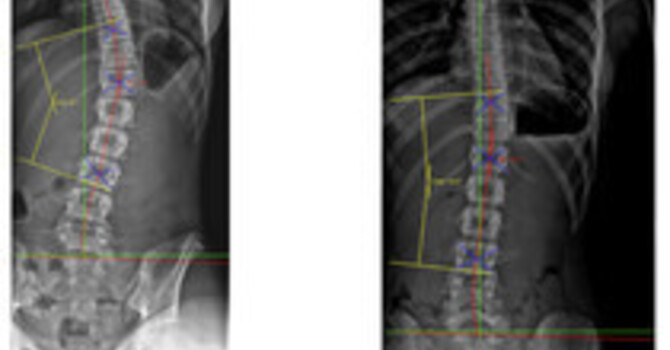
In adults, a brace is used to slow progression and manage pain, not to correct a curve, and the evidence is much thinner than for adolescents. Zlatanos and colleagues' 2025 review of nonoperative adult deformity care found three bracing studies with at least 12 months of follow-up; in one, the progression rate fell from 1.47° to 0.24° per year in degenerative scoliosis and from 0.70° to 0.24° per year in idiopathic scoliosis, and in another, back pain scores improved over 18 months. Zaina and colleagues reported that adults with severe curves wearing a custom night brace had greater improvement in worst pain at six months than those wearing a prefabricated brace a few hours a day, with no differences in other pain or disability measures.
I am Dr. Justin Dick, DC, at Clear Life Scoliosis and Chiropractic Center in Charlotte, NC. I am a certified ScoliBrace and SpineCor provider and see adults asking whether a brace makes sense. This post explains what the data support.
Why Adult Bracing Is Different
A teenager's brace works by guiding growth. Adults have no growth to guide, so a brace cannot be expected to permanently reduce the curve. Hahn and colleagues' 2026 scoping review of 59 reviews found strong evidence for bracing in adolescent idiopathic scoliosis and only possible short-term benefit for pain and function in degenerative deformity. That distinction should shape expectations before an adult spends money on a brace.
Slowing Progression
Adult curves can progress, especially degenerative curves and larger idiopathic curves. The progression-rate study in Zlatanos's review reports a drop to 0.24° per year with bracing, but another included study found no significant change in the Cobb angle. These are small observational series. My post on adult curve severity covers who progresses.
Pain
Zaina's night-bracing study compared 25 women (mean age 62, mean Cobb angle 60°) in a custom night thoracolumbosacral orthosis worn about 7 hours a night against 20 women wearing a prefabricated brace 2 to 4 hours a day. Worst pain improved more in the night-brace group. Back pain, leg pain, the Core Outcome Measures Index, and the Oswestry Disability Index did not differ. It was retrospective and short. It is a reason to consider night bracing for pain in selected adults, not a proven result.
What Else Belongs in the Plan
In the same review, physiotherapy and multidisciplinary rehabilitation programs reduced pain and disability, with Oswestry scores improving from 39.5 to 31.8 in one study. A brace that is worn while trunk strength declines is a poor trade, which is clinical reasoning. My post on adult scoliosis treatment covers sagittal balance and rehabilitation.
Who Should Not Rely on a Brace
Progressive neurological deficit, severe stenosis symptoms, or rapidly worsening sagittal imbalance need surgical evaluation. Our second opinion page describes how we coordinate.
How Dr. Justin Dick, DC Uses Bracing for Adults at Clear Life
At our Charlotte office, adult bracing is considered for pain management or for documented progression, combined with rehabilitation, with measured goals and standing radiographs to track the curve. Our ScoliBrace and SpineCor pages describe each system and its limits.
Comparison
| Outcome | Adult finding | Source |
|---|---|---|
| Progression rate, degenerative | 1.47°/yr to 0.24°/yr with bracing | Study in Zlatanos 2025 review |
| Progression rate, idiopathic | 0.70°/yr to 0.24°/yr | Same study |
| Night TLSO vs part-time brace | Worst pain improved more; other outcomes equal | Zaina 2025, 45 women |
| Review-level evidence | Possible short-term pain and function benefit | Hahn 2026 scoping review |
Research and Evidence
Evidence tiering: Hahn is a scoping review of reviews; Zlatanos a narrative review of small observational series; Zaina a retrospective controlled study. No randomized trial of adult bracing was found. Statements on rehabilitation pairing are clinical reasoning.
My published work includes older adults with scoliosis: the geriatric sagittal alignment case series, Radiographic Sagittal Alignment and Kinetic Chain Alterations in Geriatric Patients With Scoliosis: A Case Series (Cureus, 2026, PMID 42037873), two patients, case-level evidence.
References
- Hahn D, Artajos A, Elliot X, et al. A scoping review of published reviews on the use of bracing in scoliosis. Spine Deform. 2026;14(4):1203-1219. doi:10.1007/s43390-026-01319-9
- Zlatanos CG, Hassanin MA, Aly A, Salem KM, Quraishi NA. Nonoperative treatment of adult spinal deformity: a comprehensive narrative review. J Clin Med. 2025;14(24):8864. doi:10.3390/jcm14248864
- Zaina F, Poggio M, Donzelli S, et al. Night-time bracing can reduce pain in adults with scoliosis: six-month results of a retrospective controlled study. J Clin Med. 2025;14(13):4493. doi:10.3390/jcm14134493
- Whelan JP, Dick JM. Radiographic sagittal alignment and kinetic chain alterations in geriatric patients with scoliosis: a case series. Cureus. 2026;18(3):e105827. doi:10.7759/cureus.105827
Frequently Asked Questions
Do scoliosis braces work for adults?
They may slow progression and help pain, but they do not permanently correct an adult curve. The adult evidence is from small observational studies.
Can a brace stop adult scoliosis from getting worse?
In one study, bracing was associated with progression falling from 1.47 to 0.24 degrees per year in degenerative curves, but another study found no significant change in Cobb angle.
Does a night brace help adult scoliosis pain?
In 45 women with severe curves, a custom night brace improved worst pain more than a part-time daytime brace at six months, with no difference in other pain or disability measures.
Is adult bracing the same as bracing for teens?
No. Teen bracing guides growth. Adults have no growth to guide, so bracing targets pain and progression.
Should an adult with scoliosis wear a brace all day?
Not by default. Dr. Justin Dick, DC at Clear Life Scoliosis in Charlotte, NC pairs any adult brace with rehabilitation and measured goals, because trunk strength matters.
Where can I get an adult scoliosis brace evaluation in Charlotte, NC?
Clear Life Scoliosis and Chiropractic Center, 8814 Rachel Freeman Way, Suite 103, Charlotte, NC 28278, offers adult evaluation with Dr. Justin Dick, DC, a certified ScoliBrace and SpineCor provider. Call 980-368-0766.
Service Area
Clear Life Scoliosis and Chiropractic Center sees patients from Charlotte NC, Huntersville NC, Ballantyne NC, Matthews NC, Concord NC, Mooresville NC, Rock Hill SC, Fort Mill SC. Families from across the Charlotte region and the South Carolina border communities come to the Rachel Freeman Way office for radiographic scoliosis evaluation with Dr. Justin Dick, DC.
Related Pages
- Scoliosis Treatment for Adults
- Adult Scoliosis and Curve Severity
- Adult Scoliosis Treatment
- ScoliBrace Charlotte
- SpineCor Charlotte
- Bracing for Scoliosis
- What a Brace Cannot Do
- Scoliosis Second Opinion
- De Novo Scoliosis Case
- Dr. Justin Dick, DC Research
Schedule an Evaluation in Charlotte
If you are an adult considering a brace, the first question is what you want it to do. Dr. Justin Dick, DC answers that with you at our Charlotte office.
Dr. Justin Dick, DC · ORCID 0009-0001-2794-2159
8814 Rachel Freeman Way, Suite 103, Charlotte, NC 28278
Phone: 980-368-0766 · Email: office@clearlifescoliosis.com
clearlifescoliosis.com · Book online
Justin Dick
Contact Me