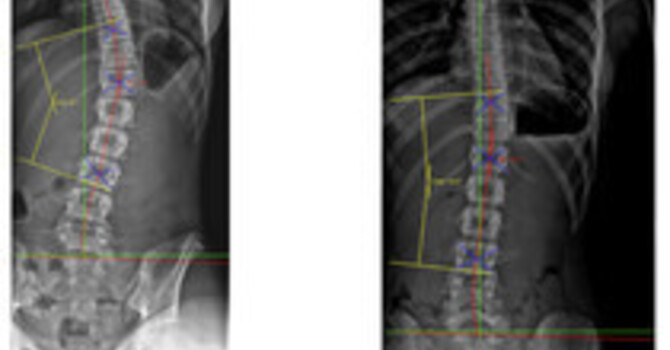
The research does not support a simple answer of "the left side" or "the right side." The most consistent finding in surface electromyography (EMG) studies is higher paraspinal muscle activity on the convex side of the curve, mostly at the apex and mostly in single right thoracic curves. Even that is not universal. In a 2022 review of 16 EMG studies, 43 outcome measures showed convex greater than concave, 85 showed no difference, and 8 showed concave greater than convex.
I am Dr. Justin Dick at Clear Life Scoliosis and Chiropractic Center in Charlotte, NC. Families often ask which side to strengthen. This post explains what the muscle research shows, what it does not show, and why "strengthen the weak side" is the wrong frame for exercise planning.
Convex and Concave, Defined
The convex side is the outside of the curve, the side the spine bulges toward. The concave side is the inside. In a right thoracic curve, the convex side is the right. The terms follow the curve, not the body, so a patient with a double curve has a different convex side at each level.
What the EMG Studies Show
Ng and colleagues reviewed 16 surface EMG studies with 136 outcome measures. Greater convex activity was found most often at the curve apex, in people with single right thoracic curves that were progressing, and during postural tasks. The authors called for better methods and reporting before firm conclusions are drawn.
Park and colleagues measured paraspinal EMG in 79 patients sorted by curve type during a prone extension task. Convex activity was significantly higher than concave in double major, thoracolumbar, and lumbar curves. In single thoracic and double thoracic curves, there was no significant difference. Curve type changed the pattern.
Dupuis and colleagues looked at timing. In 24 girls with right thoracic curves, the left (concave) erector spinae at the curve apex switched on later during a rapid arm raise than in 20 controls, by about 13 milliseconds. The size of that asymmetry did not correlate with Cobb angle or Risser stage.
Higher Activity Is Not the Same as Stronger
EMG measures electrical activity, not force. Higher activity on the convex side could mean those muscles are working harder to hold the trunk against the curve, or it could reflect their length and position. It does not tell you which side is weaker in a strength test. A muscle on the concave side that is shortened and less active is a different problem from a muscle that cannot produce force.
The cause-and-effect direction is also unsettled. Whether muscle asymmetry drives the curve or the curve produces the asymmetry is still an open research question.
Why "Strengthen the Weak Side" Misleads
Generic exercises can reinforce the asymmetry. Zhang and colleagues recorded EMG in 37 patients during the common prone "superman" exercise and found convex activity remained higher than concave, the same pattern as sitting. The authors concluded that this exercise is not suited to scoliosis rehabilitation. Scoliosis-specific exercise works on three-dimensional self-correction, where the patient first moves toward the corrected posture and then trains endurance in that position. My post on the best exercises for scoliosis covers the trial evidence, and the chiropractor versus physical therapist post covers who delivers it.
How Dr. Justin Dick Uses This at Clear Life
At our Charlotte office, exercise is prescribed from the curve pattern on the standing radiograph, not from a strength test of left against right. Each exercise is chosen for its effect in the corrected position, and patients relearn posture through the CLEAR protocol. My labyrinthine righting reflex work looks at the postural control side of the same question.
Comparison
| Study | Patients | Finding |
|---|---|---|
| Ng 2022, narrative review | 16 EMG studies | 43 measures convex greater, 85 no difference, 8 concave greater |
| Park 2021 | 79, by curve type | Convex greater in double major, thoracolumbar, lumbar; no difference in thoracic types |
| Dupuis 2025 | 24 AIS, 20 controls | Concave apical muscle activated about 13 ms later; not related to Cobb angle |
| Zhang 2024 | 37 | Superman exercise kept convex activity higher, same as sitting |
Research and Evidence
Evidence tiering: the EMG findings come from a narrative review and cross-sectional studies. None of them establishes that one side is weaker in force, and none establishes cause and effect. The exercise recommendation follows SOSORT guidance and mechanistic reasoning.
My own published work addresses postural control in scoliosis. The labyrinthine righting reflex case report, Reduction of Adolescent Idiopathic Scoliosis Utilizing the Labyrinthine Righting Reflex: A Case Report (Cureus, 2026, PMID 41685001), describes curve reduction in a patient whose care targeted postural reflexes. It is a single case and did not measure EMG.
References
- Ng PTT, Claus A, Izatt MT, Pivonka P, Tucker K. Is spinal neuromuscular function asymmetrical in adolescents with idiopathic scoliosis compared to those without scoliosis?: A narrative review of surface EMG studies. J Electromyogr Kinesiol. 2022;63:102640. doi:10.1016/j.jelekin.2022.102640
- Park Y, Ko JY, Jang JY, et al. Asymmetrical activation and asymmetrical weakness as two different mechanisms of adolescent idiopathic scoliosis. Sci Rep. 2021;11(1):17582. doi:10.1038/s41598-021-96882-8
- Dupuis F, Ng PTT, Duncombe P, et al. Asymmetry in the onset of paraspinal muscles activity differs in adolescents with idiopathic scoliosis compared with those with a symmetrical spine. Clin Orthop Relat Res. 2025;483(6):1112-1121. doi:10.1097/CORR.0000000000003364
- Zhang H, Wang Z, Yuan Z, et al. Symmetrical analysis of paravertebral muscles during superman exercise in patients with adolescent idiopathic scoliosis. Clin Biomech. 2024;121:106400. doi:10.1016/j.clinbiomech.2024.106400
- Negrini S, Donzelli S, Aulisa AG, et al. 2016 SOSORT guidelines: orthopaedic and rehabilitation treatment of idiopathic scoliosis during growth. Scoliosis Spinal Disord. 2018;13:3. doi:10.1186/s13013-017-0145-8
- Dick JM, Whelan J. Reduction of adolescent idiopathic scoliosis utilizing the labyrinthine righting reflex: a case report. Cureus. 2026;18(1):e101343. doi:10.7759/cureus.101343
Frequently Asked Questions
Which side is weaker with scoliosis?
There is no single answer. EMG studies most often find higher paraspinal muscle activity on the convex side at the curve apex, but a 2022 review found no side difference in 85 of 136 outcome measures.
Are the muscles on the convex side stronger in scoliosis?
Not necessarily. EMG measures electrical activity, not force. Higher convex activity may reflect muscles working against the curve, not greater strength.
Does muscle imbalance cause scoliosis?
That is unresolved. Muscle asymmetry is documented in adolescent idiopathic scoliosis, but whether it causes the curve or results from it has not been established.
Should I strengthen the weak side if I have scoliosis?
Strengthening one side is the wrong frame. One study found the common superman exercise kept convex muscle activity higher, the same as sitting. Scoliosis-specific exercise trains the trunk in a three-dimensionally corrected position.
Does curve type change the muscle pattern?
Yes. In a 2021 study of 79 patients, convex activity was higher in double major, thoracolumbar, and lumbar curves, with no significant difference in single and double thoracic curves.
Where can I get scoliosis-specific exercise in Charlotte, NC?
Clear Life Scoliosis and Chiropractic Center, 8814 Rachel Freeman Way, Suite 103, Charlotte, NC 28278, prescribes exercise from the radiographic curve pattern with Dr. Justin Dick, DC, CLEAR Institute Senior Fellow and ISICO World Masters. Call 980-368-0766.
Service Area
Clear Life Scoliosis and Chiropractic Center sees patients from Charlotte NC, Huntersville NC, Ballantyne NC, Matthews NC, Concord NC, Mooresville NC, Rock Hill SC, Fort Mill SC. Families from across the Charlotte region and the South Carolina border communities come to the Rachel Freeman Way office for radiographic scoliosis evaluation with Dr. Justin Dick, DC.
Related Pages
- Best Exercises for Scoliosis
- Chiropractor or Physical Therapist for Scoliosis
- Can Poor Posture Cause Scoliosis?
- Spinal Rotation in Scoliosis
- Thoracolumbar Scoliosis
- Double Major and S-Shaped Scoliosis
- Labyrinthine Righting Reflex
- Scoliosis Physical Therapy in Charlotte
- CLEAR Scoliosis Protocol
- Dr. Justin Dick Research
Schedule an Evaluation in Charlotte
If you want an exercise plan built from your actual curve pattern, it starts with a standing radiograph. Dr. Justin Dick builds that plan at our Charlotte office.
Dr. Justin Dick, DC · ORCID 0009-0001-2794-2159
8814 Rachel Freeman Way, Suite 103, Charlotte, NC 28278
Phone: 980-368-0766 · Email: office@clearlifescoliosis.com
clearlifescoliosis.com · Book online
Justin Dick
Contact Me